
Have you ever written the word glue and then stopped when you needed its -ing form? You may wonder whether the correct spelling is gluing or glueing.
Both forms look reasonable, so this small spelling question can cause a surprising amount of confusion.
The confusion usually comes from a familiar English spelling rule. Many verbs that end in a final e drop that e before adding -ing.
For example, make becomes making, and write becomes writing. This makes gluing look like the obvious answer.
However, glueing is not simply a random spelling mistake. Major dictionaries record glueing as an alternative form. Cambridge lists glueing and gluing as forms of glue, while Collins gives both forms in its British English entry. Collins’ American English entry uses gluing.
That means the real issue is not just “correct or incorrect.” The two spellings have the same meaning and grammar, but gluing is the spelling most learners should normally choose in modern general writing.
By the end, you will know exactly what gluing and glueing mean, how they work in sentences, why both forms exist, which spelling to choose, and how to avoid this common spelling problem.
Explore More Posts
Crews vs Cruise (2026): What’s the Difference? Easy Grammar Guide with Examples
Everything vs Every Thing: Easy Difference, Rules, Examples & Practice (2026)
All Is vs All Are: Which One Is Correct? Complete Grammar Guide for 2026
At the Weekend or On the Weekend? 2026 Guide to British and American English
What Does “Gluing” Mean?
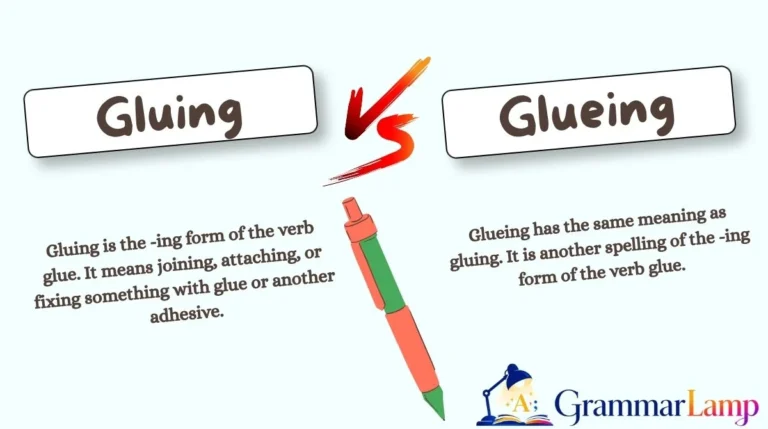
Gluing is the -ing form of the verb glue. It means joining, attaching, or fixing something with glue or another adhesive.
For example:
She is gluing the pictures onto the paper.
Here, gluing tells us what she is doing right now. She is using glue to attach the pictures to the paper.
The word can be used in several common grammar structures. Most often, you will see it after forms of be in continuous tenses:
I am gluing the pieces together.
He was gluing a model car.
It can also act as a noun-like gerund:
Gluing takes patience.
In that sentence, gluing names the activity itself.
The spelling is:
glue → gluing
The final e is removed before -ing is added. This follows a very common spelling pattern in English.
Examples of “Gluing”
- She is gluing the broken pieces together.
- I am gluing the card to the envelope.
- They were gluing pictures onto the wall.
- He spent an hour gluing the model together.
- We are gluing the labels onto the boxes.
- Gluing the small parts requires care.
- Are you gluing those two pieces together?
- The children are gluing colored paper onto their project.
In every example, gluing has the same basic idea: using glue to attach something.
When Should You Use “Gluing”?
Use gluing when you are talking about the action of using glue.
It is especially common in everyday English, school instructions, crafts, repair work, manufacturing, and technical writing. Dictionaries give gluing as the present participle of glue. Cambridge has a dedicated entry for gluing, and Collins lists it among the verb forms of glue.
You can use it with:
Present continuous:
She is gluing the paper.
Past continuous:
He was gluing the pieces.
Future continuous:
They will be gluing the decorations tomorrow.
Gerund:
Gluing the wood takes time.
Common Learner Confusion
Some learners think gluing might be wrong because the original word is spelled glue. They may think that the full word must stay unchanged:
glue + ing = glueing
That way of building words feels logical, but English spelling does not always work by simply adding letters. In many cases, spelling changes when a suffix is added.
So, for ordinary modern writing, remember:
glue → gluing
This is the form you will most often want.
What Does “Glueing” Mean?
Glueing has the same meaning as gluing. It is another spelling of the -ing form of the verb glue.
In other words, there is no important difference in meaning.
She is glueing the pieces together.
means the same thing as:
She is gluing the pieces together.
The difference is spelling, not grammar or meaning.
This is important because some learners see glueing and assume it must be wrong. That is too simple. Cambridge lists glueing as the present participle of glue, and Collins records glueing alongside gluing in its British English entry.
Examples of “Glueing”
- She is glueing the photos into her scrapbook.
- He was glueing the paper to the cardboard.
- They spent the afternoon glueing small decorations together.
- I am glueing the broken box back together.
- We were glueing labels onto the bottles.
- Glueing the pieces in the correct position is important.
- Are you glueing the pages together?
- The students were glueing colored shapes onto their posters.
These sentences are grammatically fine. The same sentences could use gluing without changing the meaning.
When Should You Use “Glueing”?
You may see glueing in British English or in writing influenced by British spelling traditions. It is a recognized variant, not a completely different word.
However, there is a useful practical point for learners. Collins’ British English entry gives gluing or glueing, while its American English entry gives gluing.
So if you are unsure which one to use, gluing is the simpler general choice.
Common Learner Confusion
A common mistake is to think:
gluing = American English
and
glueing = British English
That explanation is too strict.
There is evidence that both spellings are recognized, including in British English. The difference is better understood as a variant spelling, with gluing serving as the more straightforward and widely familiar form for general use. Collins explicitly gives both forms for British English but only gluing in its American English verb entry.
So do not treat glueing as automatically wrong.
Difference Between Glueing and Gluing
The most important thing to understand is this:
Glueing and gluing have the same meaning and perform the same grammatical job.
The main difference is their spelling and usage preference.
| Feature | Gluing | Glueing |
|---|---|---|
| Base verb | glue | glue |
| Meaning | Joining with glue | Joining with glue |
| Grammar | Present participle / gerund | Present participle / gerund |
| Spelling | Drops final e | Keeps final e |
| Meaning difference | None | None |
| British English | Used | Also used |
| American English | Standard form in dictionary entry | Less typical |
| Best general choice | Yes | Recognized variant |
Cambridge has separate entries for gluing and glueing, both identifying them as the present participle of glue. Collins likewise records both spellings for British English, while its American English entry uses gluing.
Usage Difference
There is no difference such as:
gluing = joining two things
and
glueing = joining three things
That is not how these words work.
Both can be used for the same action:
She is gluing the paper to the box.
She is glueing the paper to the box.
The meaning remains the same.
Grammar Logic
Both forms can be used as:
Present participles
He is gluing the parts.
He is glueing the parts.
Gerunds
Gluing the parts takes time.
Glueing the parts takes time.
After another verb
I started gluing the pieces.
I started glueing the pieces.
The grammar does not change.
Sentence Structure
The sentence structure also stays the same.
Compare:
We are gluing the labels onto the bottles.
We are glueing the labels onto the bottles.
The subject, helping verb, object, and rest of the sentence are identical. Only the spelling of the -ing form changes.
Meaning Comparison
There is no separate dictionary meaning attached to the two spellings.
Both come from glue, which means to join or stick something using glue. Collins defines glue as a verb meaning to join or stick things together with glue, and lists the relevant forms as gluing or glueing in British English.
The practical difference is therefore:
gluing = the usual spelling to choose
glueing = a recognized alternative spelling
That distinction is much more useful than calling one spelling “right” and the other “wrong.”
Grammar Rules You Must Remember
Rule 1: Many verbs ending in final “e” drop the “e” before “-ing”
This is one of the most useful spelling patterns for English learners.
For example:
make → making
write → writing
bake → baking
drive → driving
Following the same pattern:
glue → gluing
That is why gluing looks natural in modern English writing.
Do not simply add -ing to every verb without checking the spelling pattern.
Rule 2: “Gluing” and “glueing” are both forms of “glue”
The important point is that glueing is documented as a variant rather than being a separate word.
Cambridge lists glueing as the present participle of glue, while Collins lists gluing or glueing in British English.
So this sentence is understandable and recognized:
She is glueing the pieces together.
But the more straightforward form for most learners is:
She is gluing the pieces together.
Rule 3: The two spellings do not change the tense
Both forms can appear in continuous tenses.
For example:
I am gluing the paper.
I was gluing the paper.
They are gluing the decorations.
The same is possible with glueing:
I am glueing the paper.
I was glueing the paper.
They are glueing the decorations.
The tense comes from the helping verb am, is, are, was, were, and so on. The choice between gluing and glueing does not change the tense.
Rule 4: Choose one spelling consistently in formal writing
Because the two forms are variants, switching between them in the same piece of writing can make your spelling look inconsistent.
For example, avoid writing:
She is gluing the paper. Later, she was glueing the box.
A cleaner approach is to choose one form and keep using it.
For most general, academic, professional, and online writing, gluing is the easiest choice because it is concise and familiar.
More Useful posts
To Discuss or Discuss About: Which Is Correct? | Easy Grammar Guide 2026
Seam vs Seem: Difference, Meaning, Examples & Grammar Rules (2026)
Upmost vs Utmost: Meaning, Difference, and Correct Usage in 2026
All the Time vs Every Time: Meaning, Difference, Rules & Examples (2026)
Common Mistakes Students Make
Mistake 1: Thinking “glueing” is always wrong
Because learners are taught the rule “drop the final e before -ing,” they may immediately mark glueing as incorrect.
That conclusion is too strong.
Reliable dictionaries recognize glueing as a form of glue. Cambridge lists it directly, and Collins gives both forms in British English.
Better approach:
Use gluing as your normal choice, but understand that glueing can also be found in real English.
Mistake 2: Assuming the two words have different meanings
Some learners think there must be a meaning difference because the spelling is different.
There is not.
Wrong idea:
Gluing means putting glue on something.
Glueing means sticking something together.
In practice, both forms can describe the same activity.
Mistake 3: Keeping the final “e” because the base word has it
A learner may reason:
glue + ing = glueing
This is understandable, but English spelling often requires changes when suffixes are added.
The common pattern is:
use → using
hope → hoping
move → moving
glue → gluing
Mistake 4: Believing British and American English always use completely different forms
Language varieties sometimes differ, but spelling choices are not always divided into neat boxes.
With this word, Collins gives gluing or glueing for British English and gluing in its American English entry.
So it is better to remember that glueing is a recognized variant, while gluing is the safer everyday choice for most learners.
Wrong vs. Correct
Less suitable for a learner’s default:
I am glueing my project together.
Recommended everyday form:
I am gluing my project together.
The first sentence is not necessarily grammatically wrong. The second simply gives you the more familiar spelling.
Easy Trick to Remember the Difference
Here is an easy memory trick:
“Glue loses e before -ing.”
Think of the word in two steps:
GLUE → GLU + ING → GLUING
You can compare it with words you already know:
bake → baking
make → making
ride → riding
write → writing
glue → gluing
Now imagine you are doing a school craft project. You tell your friend:
“I’m gluing these pieces together.”
The shorter spelling is easy to see and easy to remember.
There is one extra thing to keep in mind: glueing exists too. Think of it as the version that keeps the original e.
So your memory rule can be:
Gluing = first choice
Glueing = accepted variant
This helps you avoid two opposite mistakes. You will not accidentally assume that glueing is the only correct form, and you will not spend time worrying that you have found a completely different word.
Daily Life Examples
The following conversations show how natural gluing can be in everyday English.
1. During a school project
Ali: What are you doing?
Sara: I’m gluing these pictures onto the poster.
2. Fixing a box
Brother: Is the box ready?
Sister: Not yet. I’m still gluing the broken side.
3. Doing crafts
Teacher: What are you making?
Student: I’m making a paper flower and gluing the petals together.
4. Repairing a toy
Dad: Why are you holding the toy like that?
Son: I’m gluing the wheel back onto it.
5. Asking for help
Sam: Can you help me?
Tom: Sure. What do you need?
Sam: I need help gluing these two parts together.
6. Talking about yesterday
Mina: What did you do after lunch?
Hina: I spent an hour gluing photos into my scrapbook.
7. A classroom activity
Teacher: Are you gluing the shapes onto the paper?
Student: Yes, I am.
8. Home decoration
Mother: What are you doing with those letters?
Daughter: I’m gluing them onto the wall.
9. A model-building hobby
Friend: How is your model going?
You: Pretty well. I’m gluing the small pieces together now.
10. Giving instructions
Teacher: First, cut the paper. Then, start gluing the pieces onto the card.
Notice that gluing works naturally in all of these situations. It can describe crafts, repairs, schoolwork, hobbies, and simple household tasks.
You could replace gluing with glueing in many of these sentences without changing the meaning.
Practice Section
Choose the better spelling for each sentence.
1. She is ______ the pieces together.
a) glueing
b) gluing
2. We spent the afternoon ______ pictures onto the poster.
a) gluing
b) glueing
3. Are you ______ the label to the box?
a) glueing
b) gluing
4. He was ______ the broken parts of the model together.
a) gluing
b) glueing
5. ______ the small pieces carefully can take a long time.
a) Glueing
b) Gluing
Answers
1. b) gluing
2. a) gluing
3. b) gluing
4. a) gluing
5. b) Gluing
In these exercises, gluing is used as the normal general-writing choice. Remember, however, that glueing is a recognized alternative form, especially in British English references.
Explore More Posts
Afterward or Afterwards? Meaning, Difference, and Correct Usage in 2026
A MA or an MA Degree? The Correct Grammar Rule in 2026
A or an: Easy Rules, Examples, and Common Mistakes in 2026
From My End or From My Side? Which Is Correct in English? (2026 Guide)
FAQs
What is the difference between glueing and gluing?
There is no difference in meaning. Both are forms of the verb glue and describe joining or attaching something with glue.
The main difference is spelling. Gluing is the simpler and more commonly preferred form for general modern writing, while glueing is a recognized variant.
Is “gluing” the correct spelling?
Yes. Gluing is a correct and widely used spelling of the present participle of glue.
Cambridge lists gluing as the present participle, and Collins gives gluing as a standard verb form. Collins’ American English entry also uses gluing.
Is “glueing” also correct?
Yes. Glueing is also documented as an English form of the verb glue.
Cambridge lists it as the present participle, and Collins gives glueing or gluing in its British English entry. It is less convenient as a default spelling for many learners, but it is not simply meaningless or nonexistent.
Can we use “gluing” in questions?
Absolutely.
For example:
Are you gluing the paper to the card?
Why are you gluing those pieces together?
The word works normally in questions just as it does in statements.
Is “glueing” formal or informal?
Glueing is better described as a spelling variant than as a formal or informal word.
You may see it in British English and other writing where that variant is accepted. For a general audience, especially when you want the most familiar spelling, gluing is usually the safer choice.
Why does “gluing” lose the “e”?
The spelling follows the common pattern in which a final e is dropped before -ing.
That gives:
glue → gluing
Similar examples include:
make → making
write → writing
drive → driving
However, English has exceptions and variant spellings, which is why glueing is also recorded by major dictionaries.
Conclusion
The glueing vs gluing question is confusing because both spellings look natural. The good news is that the difference is much smaller than it first appears.
Gluing and glueing have the same meaning. Both are forms of the verb glue, and both can be used as present participles or gerunds.
Major dictionaries recognize both forms, although their entries show a stronger preference for gluing, especially in American English.
For everyday writing, schoolwork, websites, emails, and most professional situations, gluing is the easiest spelling to remember and use.
Just keep this simple rule in your mind:
glue → gluing
At the same time, do not panic when you see glueing. It is a recognized spelling variant, not a completely different word.
The best way to remember the difference is to use gluing regularly. The more you read and write it, the more natural the spelling will become.

Liam Derren is a language writer at GrammarLamp, creating simple, helpful content about grammar, words, and everyday English. He makes language learning clear, practical, and easy to understand.