Have you ever typed “scarry” and then stopped to wonder whether it should have one r or two? You are not alone.
This is a very common spelling problem because scarry and scary look almost the same and, in many accents, sound the same too.
The important point is that these two spellings are not simply two versions of the same word. In everyday English, when you want to say that something causes fear, the correct word is scary.
Oxford Learner’s Dictionary defines scary as “frightening” and gives common examples such as a scary movie and a scary moment.
But there is an interesting detail: scarry is actually found in dictionaries. It is a rare adjective with meanings connected to scars or steep, rocky places. Collins and Dictionary.com both record these meanings.
So, if you are talking about a horror movie, a frightening sound, a dangerous situation, or something that makes you afraid, scary is the spelling you need.
By the end of this guide, you will know what scarry really means, why scary is used for fear, how to spell the word correctly, and how to avoid this mistake in everyday writing.
More Useful posts
Brite vs Bright: Meaning, Difference, Spelling & Correct Usage in 2026
I Ordered vs I Have Ordered: What’s the Difference? Simple Grammar Guide (2026)
Timber vs Timbre (2026): Meaning, Differences, Grammar Rules, Examples, and Easy Guide
On a Call or In a Call (2026): What’s the Difference? Easy Grammar Guide with Examples
What Does “Scarry” Mean?
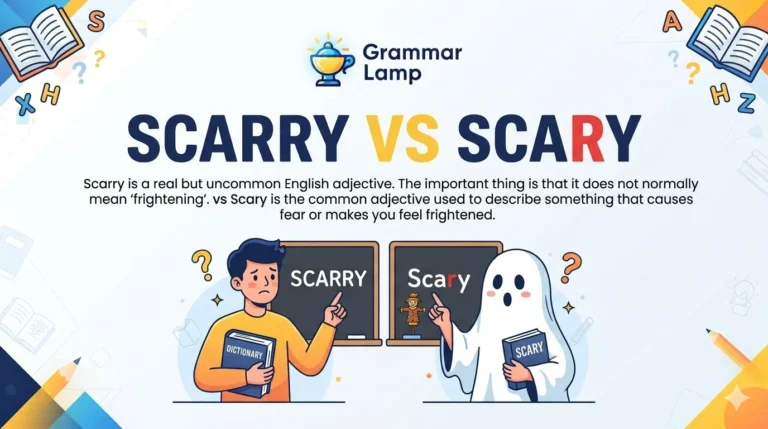
Scarry is a real but uncommon English adjective. The important thing is that it does not normally mean “frightening.”
Modern dictionaries give scarry two main adjective meanings. One meaning is marked with scars or bearing scars. The other describes a place that is steep, rocky, or full of precipitous rocks.
This makes scarry quite different from scary.
For example, you might see a description such as:
The animal had a scarry body covered with old marks.
Here, scarry is related to scar, not scare.
It can also appear in descriptions of land or mountains:
They followed a narrow path through a scarry mountain region.
Here, scarry refers to rough, steep, rocky land.
When Should You Use “Scarry”?
For most English learners, the simple answer is: almost never in ordinary conversation.
The word exists, but it is rare and has specialized meanings. In normal daily English, people are much more likely to say scarred, rocky, steep, or another clearer word.
For example:
- The old building was covered with scars.
- The soldier had a scarred face.
- We walked along a rocky path.
- They climbed a steep mountain trail.
These choices are usually clearer than scarry.
Grammar Rule for “Scarry”
Scarry is an adjective. It can describe a noun.
It can come before a noun:
a scarry surface
Or after a linking verb:
The landscape was scarry.
The adjective has comparative and superlative forms such as scarrier and scarriest, according to dictionary entries.
However, these forms are also very uncommon in everyday English.
7 Examples of “Scarry”
Here are examples that show the unusual meanings of scarry:
- The old wall had a scarry surface after years of damage.
- The animal’s skin was badly scarry from old wounds.
- They crossed a scarry mountain path covered with sharp rocks.
- The climbers entered a scarry region with very steep slopes.
- The cliff was so scarry that they moved very carefully.
- The abandoned structure had a strange, scarry appearance because of its many old marks.
- The guide warned us about the scarry terrain ahead.
These examples are possible because scarry relates to scars or rocky/steep terrain, not ordinary fear.
A Common Learner Confusion
The biggest mistake is writing:
❌ That was a scarry movie.
A learner may think scarry means frightening because the word contains scar and looks like scary.
The correct sentence is:
✅ That was a scary movie.
The two words have different meanings, even though they look and sound very similar.
What Does “Scary” Mean?
Scary is the common adjective used to describe something that causes fear or makes you feel frightened.
Oxford defines scary as frightening, while Collins also gives “causing fear or alarm” as its main meaning.
You can use scary for people, animals, places, sounds, movies, stories, experiences, situations, and many other things.
For example:
That movie was scary.
The movie causes fear, so scary is correct.
The dog looked scary.
The dog appeared frightening, so scary is correct.
Driving in that storm was scary.
The experience made the speaker feel afraid, so scary works naturally.
When Should You Use “Scary”?
Use scary when you want to describe the thing, person, event, or situation that causes fear.
Common examples include:
a scary movie
a scary story
a scary noise
a scary dream
a scary place
a scary experience
a scary situation
The word is common in everyday English. Oxford marks it as informal, but that does not mean it is wrong or only suitable for very casual speech. It is a normal everyday adjective.
Grammar Rule for “Scary”
Scary is an adjective.
It can appear directly before a noun:
It was a scary experience.
Or after a linking verb:
The experience was scary.
It can also follow verbs such as look, seem, or become:
The house looked scary.
The situation seemed scary.
Things became scary very quickly.
The related forms are:
scary → scarier → scariest
Oxford lists scarier and scariest as the comparative and superlative forms.
8 Examples of “Scary”
- That horror movie was really scary.
- I heard a scary noise outside my room.
- The abandoned house looks scary at night.
- It was a scary experience for everyone.
- That dog is not dangerous, but it looks scary.
- The storm became scary after midnight.
- She told us a scary story around the fire.
- Walking home alone in the dark can feel scary.
A Useful Related Difference
Do not confuse scary with scared.
Scary describes the thing that causes fear.
Scared describes the person or animal that feels fear.
Compare:
The movie was scary.
I was scared.
The movie creates the feeling. I experience the feeling.
This simple difference helps you use many English adjectives correctly.
Difference Between Scarry and Scary (Detailed)
The spelling difference is only one letter, but the meaning can change completely.
| Feature | Scarry | Scary |
|---|---|---|
| Common spelling for fear | ❌ No | ✅ Yes |
| Main everyday meaning | Not frightening | Frightening |
| Meaning related to scars | ✅ Yes | ❌ No |
| Meaning related to rocky places | ✅ Yes | ❌ No |
| Part of speech | Adjective | Adjective |
| Everyday use | Very rare | Very common |
| Example | a scarry rocky region | a scary movie |
Usage Difference
The easiest way to understand the difference is to ask:
Am I talking about fear?
When the answer is yes, use scary.
a scary film
a scary sound
a scary person
a scary situation
When the word relates to scars or steep, rocky land, scarry can be used, although it is uncommon.
Grammar Logic
Both words are adjectives, so they can modify nouns or appear after linking verbs.
Compare:
a scarry surface
a scary movie
In the first example, scarry is connected with scars.
In the second example, scary means frightening.
The spelling gives you a helpful clue:
scar + y → scarry in the rare adjective related to scars.
scare + -y → scary in the adjective meaning frightening. Etymological sources trace scary to scare + -y.
Sentence Structure Difference
Both words can follow the same basic adjective structures:
Before a noun
a scary movie
a scarry surface
After a linking verb
The movie was scary.
The rocky area was scarry.
The grammar pattern is similar. The meaning is what changes.
Meaning Comparison
Think of the words this way:
Scary = causes fear
Scarry = has scars or is steep and rocky
So:
The movie was scary. ✅
But:
The movie was scarry. ❌
That would not normally mean the movie frightened you.
And:
The old wall was scarry. ✅
Here, you could be describing its scarred surface.
Grammar Rules You Must Remember
Rule 1: Use “scary” for something that causes fear
When something frightens you, write scary.
That was a scary dream.
The road looked scary at night.
Do not add the second r.
❌ a scarry dream
✅ a scary dream
Rule 2: “Scary” is an adjective
You can put scary before a noun or after a linking verb.
Before a noun:
It was a scary story.
After a verb:
The story was scary.
Both are correct because scary describes the noun or situation.
Rule 3: Do not confuse “scary” with “scarry” because they sound alike
In ordinary speech, you may not hear the spelling difference.
That means pronunciation cannot help you very much when you are writing.
You might hear:
scary
and accidentally type:
scarry
This is why it is important to remember the spelling instead of trying to spell the word only from its sound.
Rule 4: Use “scarry” only for its rare dictionary meanings
There are genuine dictionary uses of scarry, but they are uncommon. It can describe something marked by scars or a steep, rocky place.
For normal everyday English, avoid using scarry when you mean frightening.
Write:
✅ The haunted house was scary.
Not:
❌ The haunted house was scarry.
Explore More Posts
Any Way vs Anyway: What’s the Difference? Complete Guide for 2026
Choose vs Chose: Difference, Meaning, Rules & Examples (2026)
At the Weekend or On the Weekend then? Which Is Correct in 2026?
Similar to vs Similarly to: Meaning, Grammar, and Examples (2026)
Common Mistakes Students Make
Mistake 1: Writing “scarry” for “frightening”
This is the most common error.
❌ The movie was very scarry.
✅ The movie was very scary.
The writer is thinking about the sound of the word instead of its standard spelling.
Mistake 2: Thinking Two “r” Letters Make Sense Because of Other Words
English has many words with double letters:
carry
marry
sorry
furry
Because of these patterns, some learners naturally write scarry.
But English spelling does not always work by simple visual patterns.
The standard adjective for “frightening” is scary. Oxford and Collins use that spelling.
Mistake 3: Confusing “Scary” With “Scared”
This is a grammar mistake rather than a spelling mistake.
❌ I am scary of spiders.
✅ I am scared of spiders.
Here, I experience the fear, so scared is the natural word.
But:
✅ Spiders are scary.
Spiders cause the feeling, so scary is correct.
Mistake 4: Adding an Extra “R” While Typing Quickly
Because scary and scarry look so similar, the extra letter can easily appear during fast typing.
A quick check before publishing can help:
SCARY = one R
Mistake 5: Assuming “Scarry” Is Always Completely Fake
This is a slightly different mistake.
Some websites simply say that scarry is not a word at all. That is too broad. Major dictionary sources do record scarry with meanings connected to scars and rocky terrain.
The better rule is:
Scarry is a real but rare word; it is not the normal spelling of scary.
That distinction is much more accurate.
Easy Trick to Remember the Difference
Here is a simple classroom trick:
SCARY = SCARE + Y
Think about the verb scare.
The noise scared me.
Now describe the noise:
The noise was scary.
The word connected with fear is scary, with only one r.
You can also memorize this small sentence:
A scary thing makes me scared.
That gives you two related words:
scary → causes the fear
scared → feels the fear
Now where does scarry fit?
Think of the word scar:
scar → scarry
This rare word is associated with scars or rocky places, not with ordinary fear. Collins traces one form of scarry to scar + -y.
Real-Life Memory Example
Imagine watching a horror movie.
The movie:
scary
You:
scared
The spelling:
scary — one R
Now imagine an old wall covered in marks.
The wall has a scarry surface.
This second example is unusual in normal conversation, which makes it easier to remember that the everyday fear word is scary.
Daily Life Examples
Here are natural examples you may hear or use in real conversations.
Example 1: Talking About a Movie
Ali: How was the movie?
Sara: It was really scary!
The movie caused fear, so scary is correct.
Example 2: Hearing a Noise
A: Did you hear that noise?
B: Yes. That was scary.
The sound frightened the speaker.
Example 3: Talking About a Place
A: Why don’t you go into that house?
B: It looks scary at night.
Again, the house looks frightening.
Example 4: Talking About a Dream
A: You woke up suddenly. What happened?
B: I had a scary dream.
The dream caused fear.
Example 5: Talking About a Storm
A: How was the storm?
B: It was pretty scary for a while.
The situation caused fear.
Example 6: Talking About an Animal
A: Is that dog dangerous?
B: I don’t know, but it looks scary.
The dog appears frightening.
Example 7: Comparing Two Movies
A: Which movie was scarier?
B: The second one was scarier.
Remember:
scary → scarier → scariest
Example 8: Talking About a Dangerous Situation
A: Were you nervous during the flight?
B: Yes. The turbulence was scary.
The experience created fear.
Example 9: Using “the scariest”
A: What is the scariest movie you’ve seen?
B: I don’t remember the title, but it was extremely frightening.
Here scariest is the superlative form of scary. Oxford lists scarier and scariest as its comparative forms.
Example 10: Talking About the Rare Word
A: What does “scarry” mean in this old description?
B: Here it seems to describe something covered with scars.
This is an unusual dictionary-style use, not the normal everyday meaning.
Practice Section
Choose the correct option in each sentence.
1. That was a very ___ movie.
A. scarry
B. scary
2. I heard a ___ sound outside.
A. scary
B. scarry
3. The old animal had a ___ body covered with marks.
A. scary
B. scarry
4. Which sentence is correct?
A. The situation was scary.
B. The situation was scarry.
5. Which word normally means “frightening”?
A. scarry
B. scary
Answers
1. B — scary
That was a very scary movie.
2. A — scary
I heard a scary sound outside.
3. B — scarry
In this unusual sentence, scarry relates to scars or marks.
4. A — scary
The situation was scary.
It means the situation caused fear.
5. B — scary
Scary is the everyday adjective meaning frightening.
More Helpful posts
Is It Correct to Say “Repeat Again”? 2026 Grammar Guide
John and Me vs Me and John: Which Is Correct? 2026 Grammar Guide
As Soon As vs As Early As: Easy Difference, Rules & Examples in 2026
Imbalanced vs Disbalanced: What Is the Difference? (2026)
FAQs
What is the difference between scarry and scary?
Scary is the common adjective meaning frightening or causing fear. Scarry is a rare dictionary word connected with scars or steep, rocky places.
Which is correct: scarry or scary?
For the meaning “frightening,” use “scary.” For example, “That was a scary movie.” Scarry should not be used as the normal spelling when you mean something frightening.
Is scarry a real English word?
Yes, but it is uncommon. Dictionaries record scarry as an adjective meaning marked with scars and, in another sense, steep or rocky. It should not automatically be treated as another spelling of scary.
Can we use scary in questions?
Yes. Scary is completely natural in questions.
For example:
“Was the movie scary?”
“Is that place scary at night?”
“What was the scariest part?”
Is scary formal or informal?
Oxford labels scary as informal, but it is a very common everyday English word. In more formal writing, words such as frightening or alarming may sometimes sound more formal, depending on the sentence.
Why do people spell scary as scarry?
The mistake usually happens because the two spellings look very similar and sound the same in ordinary speech. Learners may also be influenced by familiar words such as carry and marry. The best solution is to memorize scary as the standard spelling for “frightening.”
Conclusion
The difference between scarry vs scary becomes much easier once you focus on meaning.
Scary is the word you need when you mean frightening, causing fear, or making someone feel afraid. It is a common adjective used for movies, stories, sounds, people, places, experiences, and situations. Standard learner dictionaries give scary the meaning “frightening.”
Scarry, on the other hand, is a real but rare word. Dictionary sources use it for things connected with scars or steep, rocky places.
So remember this simple line:
Scary = frightening.
And remember that the everyday spelling has one R.
The next time you want to write “a scary movie,” “a scary dream,” or “a scary situation,” choose scary. A little spelling practice will make the choice automatic.

Liam Derren is a language writer at GrammarLamp, creating simple, helpful content about grammar, words, and everyday English. He makes language learning clear, practical, and easy to understand.