
English learners often get confused by different and differently because both words come from the same basic idea: something is not the same.
They look almost identical, but they do different jobs in a sentence. One small ending, -ly, changes the grammar and the way the word works.
For example, we can say, “Your answer is different.” But we can also say, “You answered differently.”
Both sentences talk about a difference, but the first sentence describes an answer, while the second describes how someone answered.
This difference is important in everyday English. You may hear these words at school, at work, in conversations, in emails, and while talking about people’s ideas, actions, choices, or behavior. Using the wrong form can make a sentence sound unnatural or grammatically incorrect.
The good news is that the rule is easier than it first seems. Different is mainly an adjective, so it describes a noun or pronoun. Differently is an adverb, so it usually describes a verb or tells us how an action happens.
By the end, you will understand when to use each word, how their sentence structures work, the mistakes learners often make, and a simple trick that can help you remember the difference.
More Useful posts
Feel vs Felt: Complete Grammar Guide With Examples (2026)
Role Call or Roll Call? The Correct Spelling and Meaning in 2026
Into or Onto: Complete Difference, Rules, and Examples for 2026
Sole vs Soul: What’s the Difference? Easy Guide With Examples 2026
What Does “Different” Mean?
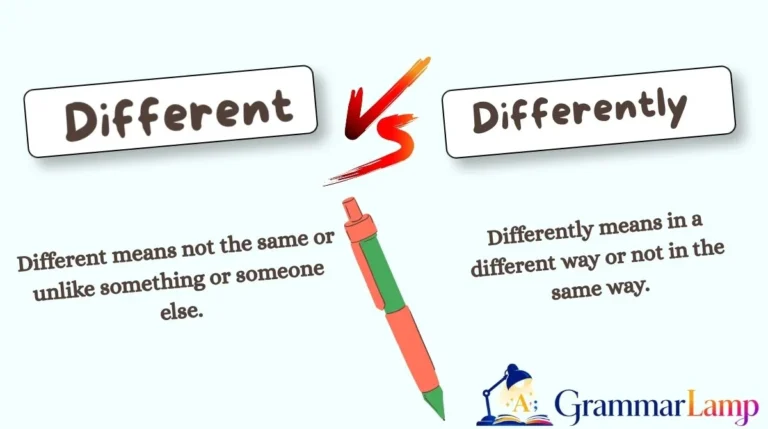
Different means not the same or unlike something or someone else.
It is mainly an adjective. An adjective gives information about a person, place, thing, idea, or situation.
Look at this sentence:
My phone is different.
Here, different describes the phone. It tells us that the phone is not the same as another phone or the one being discussed.
When Do We Use “Different”?
We use different when we want to describe a noun or pronoun.
For example:
- a different idea
- a different person
- a different answer
- a different way
- a different color
- a different place
We can also use different after linking verbs such as be, seem, look, feel, become, and appear.
For example:
This book is different.
Your new haircut looks different.
I feel different today.
In each case, different describes the subject.
Grammar Rule for “Different”
The basic pattern is:
Subject + linking verb + different
Examples:
The new plan is different.
Her opinion seems different.
This room looks different.
Another common pattern is:
different + noun
Examples:
I need a different answer.
She chose a different dress.
We went to a different restaurant.
8 Examples of “Different”
- My new job is different from my old job.
- We have different opinions about the movie.
- She chose a different dress for the party.
- This computer looks different from mine.
- His answer is completely different.
- I want to try something different today.
- The two brothers have very different personalities.
- Your new idea sounds different from the first one.
Notice that different is describing a person, thing, idea, or situation in these sentences.
“Different From,” “Different Than,” or “Different To”?
You will often see different from:
My answer is different from yours.
This is widely accepted and is a safe choice for learners.
You may also hear different than, especially in American English:
The situation is different than I expected.
Different to is also common, especially in British English:
This one is different to the other one.
For learners, different from is a simple and reliable choice in most situations.
Common Learner Confusion
A common mistake is using differently when an adjective is needed.
Incorrect:
Your answer is differently.
Correct:
Your answer is different.
Why? Because is is a linking verb here, and we need an adjective to describe answer. Different is the adjective.
What Does “Differently” Mean?
Differently means in a different way or not in the same way.
It is an adverb. Adverbs can describe verbs and tell us how an action happens.
Compare these two sentences:
She is different.
She works differently.
In the first sentence, different describes she. In the second sentence, differently describes the action works.
When Do We Use “Differently”?
Use differently when you are talking about how an action is performed.
It often answers the question:
How?
For example:
How did he solve the problem?
He solved it differently.
The word differently tells us how he solved the problem.
Grammar Rule for “Differently”
A common structure is:
Subject + verb + differently
Examples:
People think differently.
She speaks differently now.
We handled the problem differently.
Another common structure is:
Subject + verb + object + differently
Examples:
She answered the question differently.
He prepared the food differently.
They organized the meeting differently.
8 Examples of “Differently”
- I would do it differently.
- She thinks differently from her brother.
- People learn differently.
- He answered the question differently.
- We need to approach this problem differently.
- My new teacher explains things differently.
- They handled the situation differently.
- You look at things differently now.
In all these examples, differently tells us something about an action or the way something happens.
A Very Important Point
Differently does not simply mean “different.”
It usually means “in a different way.”
For example:
She dresses differently.
This means:
She dresses in a different way.
But:
Her clothes are different.
Here, different describes her clothes.
This small difference can help you choose the correct word.
Difference Between Different and Differently
The main difference is their part of speech and the job they do in a sentence.
Different is mainly an adjective.
Differently is an adverb.
Here is a simple comparison:
| Word | Part of Speech | Main Meaning | Usually Describes | Example |
|---|---|---|---|---|
| Different | Adjective | Not the same | Noun/pronoun | Your answer is different. |
| Differently | Adverb | In a different way | Verb/action | You answered differently. |
1. Different Describes a Person or Thing
Look at:
Your method is different.
The word different describes method.
Another example:
She has a different opinion.
Here, different describes opinion.
The word tells us that the opinion is not the same as another opinion.
2. Differently Describes an Action
Now look at:
She explained the idea differently.
The word differently describes the verb explained.
It tells us that her way of explaining was not the same as another person’s way.
Compare:
Her explanation is different.
She explains it differently.
The first sentence describes the explanation.
The second sentence describes how she explains.
3. Different Can Come Before a Noun
This is very common:
I bought a different car.
We need a different plan.
He gave me a different answer.
The structure is:
different + noun
You cannot normally replace different with differently here.
Incorrect:
I bought a differently car.
Correct:
I bought a different car.
4. Differently Usually Goes With a Verb
For example:
They work differently.
She speaks differently.
He thinks differently.
We solved the problem differently.
The adverb gives information about the action.
You can often think of differently as meaning:
“in another way.”
So:
They work differently.
means:
They work in another way.
Same Idea, Different Grammar
These pairs make the difference especially clear:
His style is different.
He works differently.
Their approach is different.
They approach the problem differently.
Her answer is different.
She answered differently.
The new system is different.
The new system works differently.
The meaning is connected, but the grammar is not the same.
Explore More Posts
Ardor vs Ardour: Meaning, Difference, Spelling & Examples (2026)
Fillet vs Filet: What’s the Difference? Meaning, Spelling, and Examples in 2026
Complaint vs Complain: Meaning, Difference, Grammar Rules & Examples (2026)
Differential vs Deferential: Meaning, Difference, Examples, and Grammar Rules (2026)
Grammar Rules You Must Remember
Rule 1: Use “Different” to Describe a Noun or Pronoun
When you are describing a person, thing, idea, or situation, use different.
This book is different.
I have a different idea.
Their answers are different.
A useful question is:
What am I describing?
If you are describing a thing or person, different is often the correct choice.
Rule 2: Use “Differently” to Describe an Action
When you are explaining how someone does something, use differently.
She speaks differently.
He thinks differently.
They solved the problem differently.
Ask yourself:
How did the action happen?
If the answer is “in a different way,” differently is usually the right word.
Rule 3: After a Linking Verb, Use “Different”
Linking verbs connect the subject with information that describes it.
Common linking verbs include:
be, seem, look, feel, become, appear, sound
For example:
You look different today.
The plan seems different.
This feels different.
Your voice sounds different.
Not:
You look differently today.
There are situations where look differently can be correct, but the meaning changes. For example:
You need to look differently at the problem.
Here, look means the action of viewing or considering something, so differently describes how you look at it.
Rule 4: “Differently” Often Means “In a Different Way”
This is one of the easiest ways to remember the word.
He drives differently.
Think:
He drives in a different way.
She teaches differently.
Think:
She teaches in a different way.
We handled it differently.
Think:
We handled it in a different way.
If “in a different way” fits naturally, differently is probably the word you need.
Common Mistakes Students Make
Learners often make mistakes with these words because they focus on meaning rather than grammar. Both words express the idea of difference, so it is easy to choose the wrong form.
Mistake 1: “You are differently.”
Incorrect:
You are differently today.
Correct:
You are different today.
Here, different describes you.
The verb are is a linking verb, so an adjective is needed.
Mistake 2: “She speaks different.”
Incorrect:
She speaks different.
Correct:
She speaks differently.
Here, speaks is an action. We need to explain how she speaks.
So we use the adverb:
She speaks differently.
In casual speech, especially in some dialects, you may hear speaks different, but standard written English normally uses speaks differently.
Mistake 3: “A differently answer”
Incorrect:
He gave a differently answer.
Correct:
He gave a different answer.
The word before answer needs to describe the noun. Therefore, use the adjective different.
Mistake 4: “I Did It Different”
You may hear this in casual spoken English:
I did it different.
However, in standard English, especially in formal writing, the safer form is:
I did it differently.
Why?
Because differently describes the action did.
Mistake 5: Confusing “Different” With “Differently” After “Look”
This one can be tricky.
You look different.
This means your appearance is not the same.
But:
You need to look differently at this problem.
This means you need to consider the problem in another way.
So the grammar depends on the meaning of look.
If look is a linking verb describing appearance, use different.
If look is an action meaning “view” or “consider,” differently can describe that action.
Easy Trick to Remember the Difference
Here is a simple classroom trick:
Different = What?
Differently = How?
When you see different, ask:
What is different?
When you see differently, ask:
How is it done?
For example:
My car is different.
Ask:
What is different?
Answer:
The car.
So we use different.
Now:
My brother drives differently.
Ask:
How does he drive?
Answer:
In a different way.
So we use differently.
Another Easy Trick
Look at the ending -ly.
Many English adverbs end in -ly:
- slowly
- carefully
- quickly
- quietly
- differently
These words often explain how an action happens.
So when you see differently, think:
“How?” → “In a different way.”
When you see different, think:
“What or who?” → “Not the same.”
This is not a rule that works for every English word ending in -ly, but it is a very useful trick for remembering this pair.
Daily Life Examples
The easiest way to learn the difference is to see how people actually use these words.
Example 1: Talking About Food
Ali: This restaurant is different from the old one.
Ahmed: Yes. The food tastes different too.
Here, different describes the restaurant and the food.
Example 2: Talking About Work
Sara: How do you solve these problems so quickly?
Mina: I solve them differently. I look at the problem first.
Here, differently describes the way Mina solves the problems.
Example 3: Talking About Clothes
Brother: Your new jacket looks different.
Sister: Yes. I wanted something different this time.
Both examples use different because the word describes appearance or a thing.
Example 4: Talking About Learning
Student: Why did you get the answer so quickly?
Friend: I think about these questions differently.
Here, differently describes how the friend thinks.
Example 5: Talking About Cooking
Mother: This rice tastes different today.
Daughter: I cooked it differently this time.
The rice is different, while the method of cooking was done differently.
Example 6: Talking About a Teacher
Student: Our new teacher is different.
Friend: Yes. She explains grammar differently.
The first sentence describes the teacher. The second describes how she explains grammar.
Example 7: Talking About a Plan
Manager: This plan is different from the first one.
Employee: Yes, because we are approaching the problem differently.
The plan is different, but the approach is done differently.
Example 8: Talking About Friends
Tom: You seem different these days.
John: Maybe I see things differently now.
Different describes Tom’s impression of John. Differently describes how John sees things.
Example 9: Talking About Driving
Dad: Your brother drives differently from you.
Son: I know. We have very different driving styles.
The first sentence describes how someone drives. The second describes the noun styles.
Example 10: Talking About Opinions
A: We have different opinions about the movie.
B: That’s okay. People can think differently.
Different describes the opinions, while differently describes the way people think.
Practice Section
Choose different or differently in each sentence.
1. Your new phone looks ______ from your old one.
A. different
B. differently
2. She answered the question ______.
A. different
B. differently
3. We need a ______ plan.
A. different
B. differently
4. People learn ______.
A. different
B. differently
5. His opinion is ______ from mine.
A. different
B. differently
Answers
1. Different
“Different” describes the phone’s appearance.
2. Differently
“Differently” describes how she answered.
3. Different
“Different” comes before and describes the noun “plan.”
4. Differently
“Differently” describes how people learn.
5. Different
“Different” describes his opinion.
A quick check can help with every question:
Is the word describing a thing/person? → different
Is it describing an action/how something happens? → differently
More Helpful posts
Favourite vs Favorite: Meaning, Difference, Spelling & Usage Guide 2026
By Which vs In Which: Easy Difference, Rules, Examples & Practice (2026)
No Thank You vs No, Thank You: Which Is Correct in 2026?
Creek vs Creak: Meaning, Difference, Examples & Easy Rules (2026)
FAQs
What is the difference between “different” and “differently”?
Different is mainly an adjective and means “not the same.” It describes a person, thing, idea, or situation. Differently is an adverb and usually means “in a different way.” It describes an action or verb.
Can we use “different” in questions?
Yes. Different can be used naturally in questions.
For example:
How is this different from the old one?
Why is your answer different?
It can also come before a noun:
Do you want a different color?
Can we use “differently” in questions?
Yes. Differently is common in questions when asking about the way an action happens.
For example:
Why do you think differently?
How would you do it differently?
What could we do differently next time?
In these questions, differently explains the way an action is performed.
Is “different” an adjective or an adverb?
Different is mainly an adjective.
For example:
She has a different idea.
The two answers are different.
It describes a noun or subject. In standard English, it is not normally used as the adverb in formal writing.
Is “differently” an adjective or an adverb?
Differently is an adverb.
It normally describes a verb or action:
He thinks differently.
She works differently.
They handled the problem differently.
It often has the meaning “in a different way.”
Is “I did it different” correct?
In standard English, especially in formal writing, “I did it differently” is the safer choice.
Differently describes the action did, so it means “I did it in a different way.”
You may hear “I did it different” in informal speech or certain dialects, but learners should generally use “I did it differently.”
Which is correct: “You look different” or “You look differently”?
Both can be correct, but they have different meanings.
You look different means your appearance is not the same.
You look differently at the problem means you consider or view the problem in another way.
So the correct choice depends on what look means in the sentence.
Conclusion
The difference between different and differently becomes much easier when you focus on the job each word does.
Different is mainly an adjective. It means not the same, and it describes a person, thing, idea, or situation.
The two answers are different.
Differently is an adverb. It usually means in a different way, and it describes an action.
They answered the questions differently.
Remember the simple question:
Different = What is not the same?
Differently = How is something done?
When you describe a noun, use different. When you describe how an action happens, use differently.
Do not worry if you mix them up at first. English learners need time to notice these small grammar differences.
Try making a few sentences about your daily life, such as how you work, study, eat, drive, or solve problems. With regular practice, choosing between different and differently will start to feel natural.

Liam Derren is a language writer at GrammarLamp, creating simple, helpful content about grammar, words, and everyday English. He makes language learning clear, practical, and easy to understand.