
Some English words look almost the same but have different meanings and uses. Bourgeois and bourgeoisie are two words that often confuse English learners.
They come from French and are closely connected to social class, money, lifestyle, and society.
The main reason for this confusion is that both words describe ideas related to the middle class and people who have money or property.
However, they do not play the same role in a sentence. One is usually an adjective or a noun used to describe a person, while the other is a noun that refers to a social group.
You may come across these words in books, news articles, history lessons, political discussions, or conversations about lifestyle and social status. They are especially common when people talk about wealth, social values, and differences between classes.
Understanding the difference will help you read more confidently and use these words correctly in writing and speech.
The good news is that the grammar is simple once you learn the basic rule. Bourgeois describes a person, lifestyle, attitude, or thing associated with the middle class. Bourgeoisie refers to the social class itself.
By the end, you will know their meanings, grammar rules, common mistakes, and everyday examples. You will also learn an easy way to remember which word to use.
More Useful posts
Breath vs Breathe: Easy Difference, Meaning, Examples & Rules in 2026
No Longer Exist vs No Longer Exists: Which Is Correct? (2026 Guide)
Favourite vs Favorite: Meaning, Difference, Spelling & Usage Guide 2026
By Which vs In Which: Easy Difference, Rules, Examples & Practice (2026)
What Does “Bourgeois” Mean?
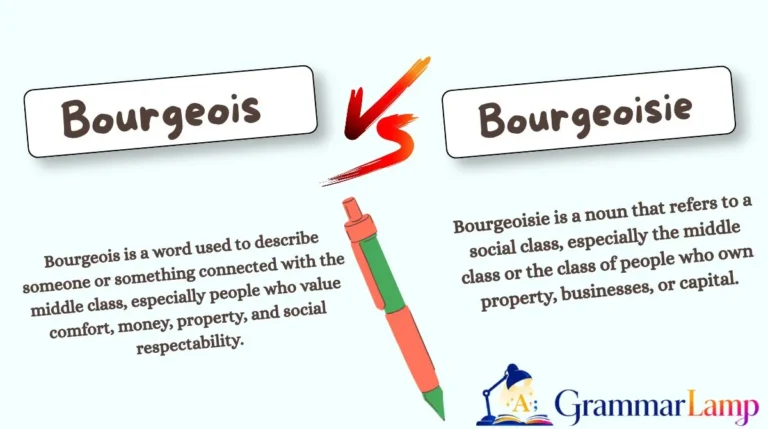
Bourgeois is a word used to describe someone or something connected with the middle class, especially people who value comfort, money, property, and social respectability.
It can be used as an adjective or a noun.
As an adjective, it describes a person, lifestyle, attitude, taste, or belief associated with the middle class.
As a noun, it can refer to a person who belongs to the bourgeois class.
In modern English, the word can sometimes sound critical. A speaker may use it to suggest that someone cares too much about money, comfort, possessions, or traditional social values.
However, the word is not always negative. In history and social studies, it can simply describe a particular social class or its way of life.
When Should You Use Bourgeois?
Use bourgeois when you want to describe:
- A middle-class person or social position
- A lifestyle focused on comfort and respectability
- A taste or attitude linked to middle-class values
- Something related to the bourgeois social class
For example, you can say “a bourgeois lifestyle” because the word describes the type of lifestyle.
You can also say “He is bourgeois” when describing a person.
Grammar Rule for Bourgeois
Bourgeois can work as both an adjective and a noun.
As an adjective:
Bourgeois + noun
Examples:
- bourgeois values
- bourgeois lifestyle
- bourgeois family
- bourgeois society
As a noun:
Subject + be + bourgeois
Example:
- He is a bourgeois.
The plural noun can be bourgeois or bourgeois people, depending on the sentence and style. In ordinary English, “bourgeois people” is often clearer.
8 Examples of Bourgeois
- They live a comfortable, bourgeois lifestyle.
- His parents have traditional bourgeois values.
- She dislikes bourgeois ideas about success.
- The film makes fun of bourgeois society.
- He comes from a bourgeois family.
- Their home looks very bourgeois.
- Some people consider expensive hobbies bourgeois.
- The writer criticized the bourgeois attitude toward money.
Common Learner Confusion
Many learners think bourgeois is only a noun because it can describe a person.
But it is very often an adjective.
For example:
Correct: She enjoys a bourgeois lifestyle.
Incorrect: She enjoys a bourgeoisie lifestyle.
The second sentence is incorrect because bourgeoisie is a noun referring to a social class. It does not normally work as an adjective before another noun.
Remember that bourgeois describes something, while bourgeoisie names a group.
What Does “Bourgeoisie” Mean?
Bourgeoisie is a noun that refers to a social class, especially the middle class or the class of people who own property, businesses, or capital.
The word is especially common in history, economics, and political discussions.
In traditional Marxist theory, the bourgeoisie refers more specifically to the class that owns the means of production, such as factories, businesses, and capital. This meaning is narrower than simply “middle class.”
In everyday English, people sometimes use bourgeoisie to mean wealthy or socially comfortable middle-class people.
The word is usually treated as a singular collective noun or as a group name. It refers to the class as a whole, not to one individual.
When Should You Use Bourgeoisie?
Use bourgeoisie when you are talking about:
- A social class as a group
- People who own property or businesses
- The middle class in historical discussions
- The capitalist class in Marxist theory
- The role of a social class in society
For example, “The bourgeoisie gained political power” refers to a social group.
You would not normally say “She is a bourgeoisie” to describe one person.
Grammar Rule for Bourgeoisie
The bourgeoisie + verb
Examples:
- The bourgeoisie was powerful.
- The bourgeoisie supported the new policy.
Because bourgeoisie refers to a class considered as one group, it often takes a singular verb in standard American English.
In some varieties of English, collective nouns may take plural verbs when the speaker focuses on the individual members. However, singular agreement is a safe choice for learners.
You can also use:
Members of the bourgeoisie + plural verb
Example:
- Members of the bourgeoisie were wealthy.
This structure clearly refers to individual people within the class.
8 Examples of Bourgeoisie
- The bourgeoisie played an important role in the industrial revolution.
- The book discusses the power of the bourgeoisie.
- The bourgeoisie owned many factories.
- The workers challenged the bourgeoisie.
- The rise of the bourgeoisie changed European society.
- The bourgeoisie gained influence in politics.
- The author examines the relationship between the bourgeoisie and the working class.
- Some historians study how the bourgeoisie became wealthy.
Common Learner Confusion
The biggest mistake is using bourgeoisie to describe one person or one thing.
Incorrect: He is a bourgeoisie.
Correct: He is bourgeois.
Also correct: He is a member of the bourgeoisie.
Another common mistake is using bourgeoisie before a noun as if it were an adjective.
Incorrect: They have a bourgeoisie lifestyle.
Correct: They have a bourgeois lifestyle.
Think of bourgeoisie as the name of a group, similar to “the working class” or “the upper class.”
Difference Between Bourgeois and Bourgeoisie
The main difference is their grammatical role and meaning.
Bourgeois describes a person, thing, attitude, or lifestyle connected with the middle class.
Bourgeoisie names the social class itself.
Although the words are closely related, they cannot usually replace each other in a sentence.
Comparison Table
| Feature | Bourgeois | Bourgeoisie |
|---|---|---|
| Part of speech | Adjective or noun | Noun |
| Main meaning | Middle-class in style, values, or social position | A social class |
| Refers to | A person, quality, lifestyle, or thing | A group of people |
| Common use | Describing | Naming a class |
| Example | A bourgeois family | The bourgeoisie |
| Can describe one person? | Yes | Not normally |
| Can come before a noun? | Yes | Not normally |
| Common context | Lifestyle, attitude, culture | History, society, politics |
1. Usage Difference
Bourgeois is used when you want to describe something.
For example:
“She has bourgeois tastes.”
Here, bourgeois describes the kind of tastes she has.
Bourgeoisie is used when you want to name a group.
For example:
“The bourgeoisie controlled many businesses.”
Here, bourgeoisie refers to a social class.
2. Grammar Logic
Bourgeois works like an adjective in many sentences. It answers the question “What kind?” or “What type?”
- What kind of lifestyle? A bourgeois lifestyle.
- What kind of values? Bourgeois values.
Bourgeoisie works as a noun. It answers the question “Who?” or “What group?”
- Which class gained power? The bourgeoisie.
- Which group owned the businesses? The bourgeoisie.
This difference is similar to other word pairs in English where one word describes something and another names a group or concept.
3. Sentence Structure Difference
Common structures with bourgeois:
- a bourgeois lifestyle
- bourgeois values
- bourgeois society
- He is bourgeois.
- They are bourgeois people.
Common structures with bourgeoisie:
- the bourgeoisie
- members of the bourgeoisie
- the rise of the bourgeoisie
- the power of the bourgeoisie
- The bourgeoisie was influential.
Notice that bourgeois often comes before a noun, while bourgeoisie usually appears as the main noun in a sentence.
4. Meaning Comparison
Consider these two sentences:
The bourgeois family bought a large house.
This sentence describes the family as middle-class or associated with bourgeois values.
The bourgeoisie bought many properties.
This sentence refers to the social class as a group.
The first sentence focuses on a family and describes it.
The second sentence focuses on a class of people.
5. Can They Be Used in the Same Sentence?
Yes. In fact, using both words in one sentence can make their difference very clear.
Example:
“The bourgeoisie often supported bourgeois values.”
Here:
- bourgeoisie = the social class
- bourgeois = the values associated with that class
Another example:
“Some members of the bourgeoisie preferred a bourgeois lifestyle.”
The first word names the group. The second describes the lifestyle.
Explore More Posts
Dialog vs Dialogue: What’s the Difference? A Simple English Guide for 2026
Learned vs Learnt: What’s the Difference? A Simple Guide for 2026
It’s vs Its: Simple Difference, Rules, Examples & Practice (2026)
Enamor vs Enamour: What’s the Difference? Meaning, Usage & Examples in 2026
Grammar Rules You Must Remember
Rule 1: Use Bourgeois Before a Noun When Describing Something
When bourgeois acts as an adjective, it usually comes before the noun it describes.
Examples:
- bourgeois culture
- bourgeois habits
- bourgeois family
- bourgeois taste
Correct: They live in a bourgeois neighborhood.
Incorrect: They live in a bourgeoisie neighborhood.
Tip: If you are describing a lifestyle, attitude, or quality, choose bourgeois.
Rule 2: Use Bourgeoisie to Name a Social Class
Bourgeoisie is a noun. It refers to the class as a whole.
Examples:
- The bourgeoisie gained power.
- The bourgeoisie owned the factories.
- The bourgeoisie influenced politics.
Correct: The bourgeoisie was wealthy.
Incorrect: The bourgeois was wealthy. (If you mean the entire class.)
However, “a bourgeois” can be correct when you mean one person.
Rule 3: Use “A Bourgeois” for One Person, Not “A Bourgeoisie”
Bourgeois can be used as a noun for an individual.
Examples:
- He is a bourgeois.
- She comes from a bourgeois family.
- They are bourgeois people.
Bourgeoisie refers to the class, so it is not normally used with “a” to mean one person.
Correct: He is a bourgeois.
Correct: He is a member of the bourgeoisie.
Incorrect: He is a bourgeoisie.
Rule 4: Remember That Bourgeoisie Is Usually a Collective Noun
When you talk about the class as one group, use a singular verb in standard American English.
Example:
“The bourgeoisie was influential.”
When you want to focus on the people within the class, use “members of the bourgeoisie” with a plural verb.
Example:
“Members of the bourgeoisie were influential.”
This structure is especially useful when you are unsure about verb agreement.
Common Mistakes Students Make
English learners often confuse these words because they look similar and share the same root.
They also come from a topic that may feel unfamiliar: social class and political history.
Here are the most common mistakes and how to correct them.
Mistake 1: Using Bourgeoisie as an Adjective
Incorrect: He has a bourgeoisie lifestyle.
Correct: He has a bourgeois lifestyle.
Why? Bourgeois describes the lifestyle. Bourgeoisie names the class.
Correction tip: Before a noun like lifestyle, values, or taste, use bourgeois.
Mistake 2: Using Bourgeoisie for One Person
Incorrect: My uncle is a bourgeoisie.
Correct: My uncle is bourgeois.
Also correct: My uncle is a member of the bourgeoisie.
Why? Bourgeoisie refers to the social class, not one individual.
Mistake 3: Confusing the Class With Its Members
Incorrect: The bourgeois was powerful. (when referring to the entire class)
Correct: The bourgeoisie was powerful.
Why? Bourgeois can refer to an individual, while bourgeoisie refers to the class.
Mistake 4: Using the Wrong Verb
Incorrect: The bourgeoisie were wealthy. (in standard American English when treated as one group)
Correct: The bourgeoisie was wealthy.
Another correct option:
The members of the bourgeoisie were wealthy.
Why? The collective noun is treated as singular when the group is viewed as one unit.
Mistake 5: Thinking Bourgeois Always Means Rich
Bourgeois is often connected with money and property, but it does not simply mean “rich.”
It can describe middle-class values, tastes, habits, or attitudes.
For example:
“She has bourgeois tastes.”
This may refer to her preference for comfort and traditional respectability, not necessarily extreme wealth.
Correction tip: Think about social class and values, not just how much money someone has.
Easy Trick to Remember the Difference
Here is a simple memory trick:
Bourgeois = describes.
Bourgeoisie = the group.
The word bourgeois often describes a person, lifestyle, attitude, or thing.
The word bourgeoisie names a social class.
Try this example:
“The bourgeoisie enjoys a bourgeois lifestyle.”
In this sentence:
- bourgeoisie = the class
- bourgeois = describes the lifestyle
You can also remember the ending -ie in bourgeoisie as the name of a group or class.
This is only a memory trick, not a grammar rule, but it can help you remember the difference quickly.
Real-Life Logic
Imagine a group of business owners who belong to a particular social class.
You can describe their lifestyle as bourgeois.
You can call the social class itself the bourgeoisie.
The same idea works with other social groups:
- The working class = a group
- Working-class values = a description
- The bourgeoisie = a group
- Bourgeois values = a description
Once you understand this pattern, the two words become much easier to use.
Daily Life Examples
These examples show how the words may appear in conversations, news, books, and ordinary writing.
Example 1: Talking About Lifestyle
A: Why does he always buy expensive furniture?
B: He enjoys a bourgeois lifestyle.
Here, bourgeois describes his lifestyle.
Example 2: Talking About a Family
A: What kind of family did she grow up in?
B: She came from a bourgeois family.
The word describes the family’s social background.
Example 3: Talking About History
A: Who became powerful during the industrial revolution?
B: The bourgeoisie gained power.
The word names a social class.
Example 4: Talking About Politics
A: Which class owned many factories?
B: The bourgeoisie owned many factories.
The word refers to the class as a group.
Example 5: Talking About Taste
A: Do you like his home decoration?
B: It looks a little bourgeois to me.
Here, bourgeois describes the style or taste.
Example 6: Talking About Society
A: What does this book say about social classes?
B: It explains how the bourgeoisie influenced society.
The word names the social class.
Example 7: Talking About Values
A: Why did the writer criticize their beliefs?
B: He thought they had bourgeois values.
The word describes the type of values.
Example 8: Talking About Business Owners
A: Who controlled the businesses in that period?
B: The bourgeoisie controlled many of them.
The word refers to the group.
Example 9: Talking About a Person
A: How would you describe his attitude?
B: He seems very bourgeois.
Here, bourgeois describes the person’s attitude or social outlook.
Example 10: Using Both Words
A: What does the author say about the middle class?
B: He says the bourgeoisie often promoted bourgeois ideas.
The first word names the group. The second describes the ideas.
Practice Section
Choose the correct word: bourgeois or bourgeoisie.
- The ______ gained political influence during that period.
- They prefer a ______ lifestyle.
- He comes from a ______ family.
- The book discusses the power of the ______.
- She thinks those ideas are too ______.
Answers
- Bourgeoisie
- Bourgeois
- Bourgeois
- Bourgeoisie
- Bourgeois
Quick Explanation
Use bourgeoisie when you mean the social class.
Use bourgeois when you describe a lifestyle, family, idea, or attitude.
More Helpful posts
I’ve Added vs I Added: Easy Difference, Rules & Examples (2026)
This Is She or This Is Her? The Correct Choice in English in 2026
Jewel vs Joule: Meaning, Difference, Examples & Easy Rules (2026)
Foul or Fowl: Meaning, Difference, Examples & Easy Rules for 2026
FAQs
1. What is the difference between bourgeois and bourgeoisie?
Bourgeois is usually an adjective that describes a person, lifestyle, attitude, or thing connected with the middle class.
Bourgeoisie is a noun that refers to the social class itself.
Example: “bourgeois values” and “the bourgeoisie.”
2. Can bourgeois be used as a noun?
Yes. Bourgeois can refer to one person who belongs to the bourgeois class.
Example: “He is a bourgeois.”
However, in everyday English, “a bourgeois person” may sound clearer and more natural to some readers.
3. Can we use bourgeoisie in a sentence about one person?
Not normally by itself.
You can say “He is a member of the bourgeoisie” when referring to one person who belongs to that class.
Do not say “He is a bourgeoisie.”
4. Is bourgeois formal or informal?
Bourgeois is mainly used in formal, academic, cultural, and political discussions.
However, it can also appear in casual conversation when someone describes a lifestyle or attitude as middle-class or conventional.
Its meaning may be neutral or critical depending on the context.
5. Is bourgeoisie always the middle class?
Not exactly.
In everyday English, it may refer to the middle class.
In Marxist theory, it more specifically refers to the class that owns capital and the means of production.
The exact meaning depends on the topic and context.
6. Is “bourgeois lifestyle” correct?
Yes, “bourgeois lifestyle” is grammatically correct.
Bourgeois is an adjective describing the lifestyle.
“Bourgeoisie lifestyle” is generally incorrect because bourgeoisie is a noun naming a social class.
Conclusion
Bourgeois and bourgeoisie are closely related words, but they have different meanings and grammatical uses.
Bourgeois is mainly an adjective. It describes a person, lifestyle, attitude, taste, or thing connected with the middle class. It can also be used as a noun for an individual.
Bourgeoisie is a noun that refers to a social class, especially the middle class or, in certain political theories, the class that owns capital and businesses.
The easiest way to remember the difference is this: bourgeois describes something, while bourgeoisie names a group.
For example, “The bourgeoisie supported bourgeois values” uses both words correctly.
When you read these words in books, news articles, or history lessons, pay attention to whether the sentence is describing something or naming a class. That small check will help you choose the correct word.
Keep practicing with your own sentences. The more you use these words in context, the more natural they will feel.

Liam Derren is a language writer at GrammarLamp, creating simple, helpful content about grammar, words, and everyday English. He makes language learning clear, practical, and easy to understand.