
Many English learners stop when they see the words nobody and no one. Both seem to say the same thing, and most of the time, they do.
This can make the choice confusing. Should you say, “Nobody called me,” or “No one called me”? Is one sentence more correct than the other?
The good news is that you do not need to learn two completely different grammar rules. Nobody and no one are indefinite pronouns, and both mean “not any person” or “no person.” Cambridge Grammar and Oxford Learner’s Dictionaries both treat them as equivalent in meaning.
Still, there are a few useful differences to know. Nobody is one word, while no one is written as two words.
In British English, no-one may also be seen with a hyphen. Cambridge notes that nobody is a little less formal, while no one is more common in writing. Oxford also notes that nobody is more common in spoken English.
Understanding this difference will help you write naturally, speak more confidently, avoid double negatives, and choose the right verb after these words.
Explore More Posts
Better Understand vs Understand Better: Meaning, Grammar, and Correct Usage (2026)
Hear vs Here: Meaning, Difference, Grammar Rules & Examples in 2026
Hasn’t vs Haven’t: Easy Grammar Rules, Examples & Differences in 2026
Smooth vs Smoothe: Which Spelling Is Correct? Complete Guide for 2026
What Does “Nobody” Mean?
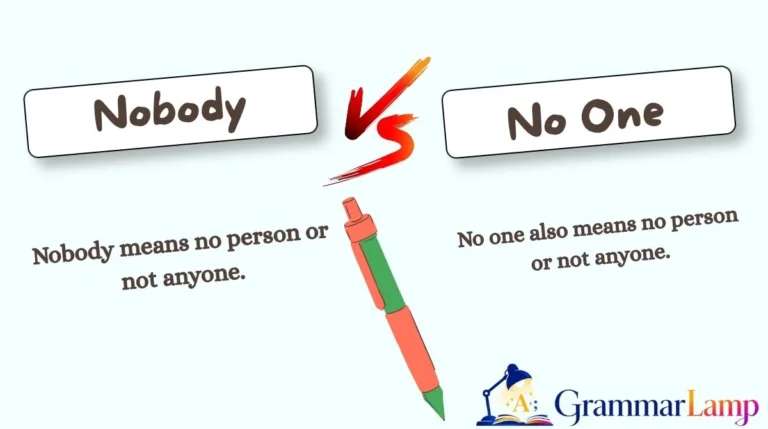
Nobody means no person or not anyone.
It is an indefinite pronoun because it refers to people without naming a specific person. The word does not tell us exactly who the people are because the meaning is that there are zero people involved.
For example:
Nobody called me yesterday.
This means that no person called me yesterday.
Nobody knows the answer.
This means that there is not a single person who knows the answer.
When should you use “nobody”?
Use nobody when you want to say that no person did something, knew something, saw something, or was present.
It is especially natural in everyday conversation.
You might hear:
Nobody is here.
Nobody answered the phone.
Nobody wants to wait.
Nobody told Sarah about the meeting.
According to Oxford Learner’s Dictionaries, nobody is more common than no one in spoken English.
Grammar rule for “nobody”
Because nobody is an indefinite pronoun, it normally takes a singular verb.
So we say:
Nobody is ready.
Nobody knows what happened.
Nobody has the key.
Not:
Nobody are ready.
Not:
Nobody know what happened.
Even though nobody refers to many possible people, grammatically it means not one person, so the verb is singular. Cambridge and the British Council both explain that nobody and similar indefinite pronouns take singular verbs.
Examples with “nobody”
- Nobody answered the door.
- Nobody knows where my phone is.
- Nobody wants to miss the train.
- Nobody was waiting outside.
- Nobody remembered his name.
- Nobody can solve this problem.
- Nobody has called me today.
- Nobody noticed the mistake.
A common confusion with “nobody”
Some learners think nobody should be used with another negative word because its meaning is negative.
For example, they may say:
Nobody didn’t come.
This is usually incorrect in standard English because it creates a double negative.
The natural sentence is:
Nobody came.
Similarly:
I know nobody.
or:
I don’t know anybody.
Both can express a similar idea, but standard English does not normally put nobody after another negative such as don’t in the same clause. The British Council and Cambridge Grammar both warn against this pattern.
What Does “No One” Mean?
No one also means no person or not anyone.
It has exactly the same basic meaning as nobody. Cambridge defines no one as “no person,” and Oxford lists nobody as its equivalent.
For example:
No one called me yesterday.
This means:
Nobody called me yesterday.
The meaning is the same.
When should you use “no one”?
You can use no one in almost all of the same situations as nobody.
It works well in conversation and writing:
No one knows the truth.
No one was home.
No one wanted to leave.
No one helped me.
Oxford notes that no one is much more common than nobody in written English, while nobody is more common in spoken English.
That does not mean nobody is wrong in formal writing. It is perfectly grammatical. It simply means that no one often sounds slightly more natural in formal or careful writing.
Grammar rule for “no one”
Just like nobody, no one takes a singular verb.
Correct:
No one is perfect.
No one knows the answer.
No one has arrived.
Incorrect:
No one are perfect.
No one know the answer.
The reason is the same: no one means not one person.
Examples with “no one”
- No one was at home.
- No one knows the real story.
- No one answered my question.
- No one has seen my wallet.
- No one wants to work late tonight.
- No one remembered the password.
- No one can predict the future.
- No one noticed that I was late.
Common learner confusion
One of the biggest mistakes is writing “noone.”
That spelling is incorrect in standard English.
Write:
no one
not:
noone
Cambridge specifically notes that no one is written as two separate words, although no-one may also be used with a hyphen in some British usage.
For most learners, the easiest form to remember is simply:
no one
Difference Between Nobody and No One
The most important fact is this:
Nobody and no one have the same basic meaning.
Both mean “no person.”
So these sentences mean the same thing:
Nobody called me.
No one called me.
And:
Nobody was in the office.
No one was in the office.
The difference is mainly about form, style, and frequency, not meaning.
Comparison Table
| Feature | Nobody | No one |
|---|---|---|
| Basic meaning | No person | No person |
| Word form | One word | Two words |
| Part of speech | Indefinite pronoun | Indefinite pronoun |
| Refers to | People | People |
| Verb | Usually singular | Usually singular |
| Everyday speech | Very common | Very common |
| Formal writing | Acceptable | Often preferred |
| Common writing style | Natural | Very common |
| Correct spelling | nobody | no one |
| Alternative British form | — | no-one |
Cambridge describes nobody as a little less formal than no one, while Oxford says no one is more common in written English and nobody is more common in spoken English.
Usage difference
There is no major difference in what the two words mean.
You can say:
Nobody helped me.
or:
No one helped me.
You can also say:
I told nobody.
or:
I told no one.
The meaning remains the same.
The small style difference becomes more noticeable when you are writing something formal. For example, in a report, academic paragraph, or formal letter, no one may sound slightly more formal or careful.
In everyday speech, nobody is extremely natural:
“Who came to the party?”
“Nobody.”
That one-word answer sounds perfectly normal.
Grammar logic
Both words belong to the group of indefinite pronouns. The British Council lists nobody and no one with words such as somebody, somebody, everybody, and anyone. These pronouns refer to people without naming a particular person.
Because they represent one grammatical unit, they take a singular verb:
Nobody likes being ignored.
No one likes being ignored.
The people being discussed could be numerous, but the grammar treats the negative pronoun as singular.
Sentence structure difference
The structures are almost identical.
Nobody + verb
Nobody knows me.
No one + verb
No one knows me.
Both can also be used after a verb:
I saw nobody.
I saw no one.
They can come after prepositions too:
She spoke to nobody.
She spoke to no one.
And they can form possessives:
Nobody’s phone was ringing.
No one’s phone was ringing.
So there is no major sentence-pattern difference to memorize.
Meaning comparison
In normal modern English:
Nobody = no one = no person
For example:
Nobody understood the question.
No one understood the question.
Both mean that not a single person understood the question.
Cambridge directly states that nobody and no one mean the same thing.
More Useful posts
Mine as Well or Might as Well? The Correct Phrase Explained in Simple English (2026)
Alternative of vs Alternative for vs Alternative to: Which Is Correct? 2026 Guide
Realise or Realize: Which Spelling Is Correct in 2026?
Berth vs Birth: Meaning, Difference, Examples & Easy Rules for 2026
Grammar Rules You Must Remember
Rule 1: Both words take a singular verb
This is one of the most important rules.
Say:
Nobody is here.
No one has the answer.
Nobody knows him.
No one wants to leave.
Do not use a plural verb simply because you are thinking about many people.
Incorrect:
Nobody are here.
Correct:
Nobody is here.
The same rule applies to no one.
Rule 2: Do not use a double negative
Do not normally combine nobody or no one with another negative such as didn’t, don’t, or never in the same clause.
Incorrect:
Nobody didn’t call.
Correct:
Nobody called.
Incorrect:
I didn’t see nobody.
Correct:
I didn’t see anybody.
Or:
I saw nobody.
English usually expresses one negative idea with one negative form in a standard clause. Cambridge and the British Council both identify this as an important usage rule.
Rule 3: “No one” is always two words
Remember the spelling:
no one
Not:
noone
You may also see:
no-one
especially in British English, but no one is the easiest standard form for learners to use consistently.
Rule 4: Use “anyone” after another negative
Compare these:
Nobody came.
No one came.
But:
I didn’t see anyone.
She never talks to anyone.
He hardly knows anyone.
Do not write:
I didn’t see nobody.
She never talks to no one.
Cambridge explains that after words with negative meaning, such as not, never, and hardly, English normally uses anyone/anybody rather than another negative pronoun.
Common Mistakes Students Make
Learners often make mistakes with these words because the meaning feels plural. There can be several people in the situation, so they naturally want to use a plural verb. Another problem is that students may treat no one as if it were one combined word.
Mistake 1: Using a plural verb
Wrong:
Nobody are listening.
Correct:
Nobody is listening.
Wrong:
No one know my name.
Correct:
No one knows my name.
A good correction tip is to mentally replace the word with not one person.
Nobody = not one person
So:
Not one person is listening.
That makes the singular verb easier to understand.
Mistake 2: Writing “noone”
Wrong:
Noone called me.
Correct:
No one called me.
Think of it visually:
no + one = no one
Keep the two words separate.
Mistake 3: Using a double negative
Wrong:
Nobody didn’t help us.
Correct:
Nobody helped us.
Wrong:
I don’t know no one here.
Correct:
I don’t know anyone here.
Or:
I know no one here.
Both can be correct, but the structure changes.
Mistake 4: Thinking “nobody” and “no one” have different meanings
Some learners think one means “few people” and the other means “zero people.”
That is not the normal distinction.
Nobody came.
means:
No one came.
Both mean zero people came.
Mistake 5: Confusing “nobody” with the noun “a nobody”
There is another use of nobody worth knowing.
When nobody is a pronoun, it means “no person”:
Nobody called me.
But a nobody can be a noun meaning an unimportant or unknown person.
For example:
He was treated like a nobody.
This is a different meaning. Oxford lists this noun use separately from the pronoun.
For learners, the easiest way to spot the difference is to look at the context.
Easy Trick to Remember the Difference
Here is a very simple memory trick:
Nobody = one word
No one = two words
That is the main form difference.
For meaning, use this trick:
Nobody = no person
No one = no person
So if you can use one, you can usually use the other.
Imagine your teacher asks:
“Who is in the classroom?”
You look around and see zero students.
You can answer:
Nobody.
Or:
No one.
Both answers work.
Now imagine you are writing a formal report:
No one was available to answer the question.
That sounds natural and slightly more formal.
Imagine you are chatting with a friend:
Nobody was home.
That also sounds very natural.
You do not need to worry about finding a completely different grammar rule. Instead, remember the small style difference: nobody is especially common in everyday speech, while no one is especially common in writing.
Daily Life Examples
These examples show how both forms work in normal conversations.
Example 1: At home
A: Is anyone in the kitchen?
B: No, nobody is there.
You could also say:
No one is there.
Example 2: At work
A: Who answered the customer’s email?
B: Nobody answered it.
Or:
No one answered it.
Example 3: At school
Teacher: Who knows the answer?
Student: Nobody knows the answer.
The singular verb knows is important here.
Example 4: On the phone
A: Did you call the office?
B: Yes, but nobody answered.
You could also say:
Yes, but no one answered.
Example 5: At a restaurant
A: Who ordered this table?
B: No one ordered it. Maybe they made a mistake.
Example 6: At a party
A: Did you know anyone there?
B: No. I knew nobody.
This is correct, although in everyday conversation many speakers would simply say:
I didn’t know anyone.
Example 7: Looking for a missing item
A: Did anybody see my keys?
B: No one saw them.
Example 8: During a meeting
Manager: Why was the task not finished?
Employee: Nobody told me about the deadline.
Example 9: At home late at night
A: Did someone open the door?
B: No. Nobody was outside.
Example 10: Talking about a surprise
A: Who knew about the party?
B: Nobody knew. It was a complete surprise.
These examples show that the choice between nobody and no one is usually not about changing the meaning. It is mostly about which form sounds natural in the situation.
Practice Section
Choose the correct option in each sentence. In some cases, both options may be grammatically possible. Pay special attention to the verb and spelling.
1. ___ knows where the teacher went.
A. Nobody
B. Nobody are
C. No one are
2. I didn’t tell ___ about the surprise.
A. nobody
B. anyone
C. no one
3. ___ was waiting outside the building.
A. No one
B. Noone
C. No one were
4. ___ called me after the meeting.
A. Nobody did
B. Nobody
C. Nobody were
5. ___ wanted to leave early.
A. No one
B. Noone
C. No one are
Answers
1. A — Nobody knows where the teacher went.
Nobody is singular, so knows is correct.
2. B — I didn’t tell anyone about the surprise.
The clause already contains didn’t, so standard English uses anyone rather than another negative pronoun.
3. A — No one was waiting outside the building.
No one is written as two words and takes the singular verb was.
4. B — Nobody called me after the meeting.
There is no need for another negative word.
5. A — No one wanted to leave early.
No one is correct, and the singular verb is wanted.
Explore More Posts
Insight vs Incite: What’s the Difference? Easy Guide for 2026
In the Same Day vs On the Same Day: Which Is Correct? A Simple Guide for 2026
Licence or License: Which Spelling Is Correct in 2026?
I’ve Added vs I Added: Easy Difference, Rules & Examples (2026)
FAQs
What is the difference between nobody and no one?
There is almost no difference in basic meaning. Both mean “no person” or “not anyone.” The main difference is style and word form. Nobody is one word, while no one is normally two words. Cambridge says nobody is a little less formal than no one.
Can we use “nobody” in questions?
Yes, nobody can be used in questions.
For example:
Is nobody coming to the meeting?
This is grammatically correct. Depending on the situation, the question may suggest surprise or that the speaker expected someone to come.
You can also say:
Is no one coming to the meeting?
Both are possible.
Is “nobody” informal?
Nobody is not incorrect or strongly informal. It is standard English and is commonly used in everyday speech. Cambridge describes it as slightly less formal than no one, and Oxford says it is more common in spoken English.
For very formal writing, no one may be a more natural choice.
Is “no one” formal or informal?
No one works in both formal and informal English. It is very common in writing and is completely normal in conversation too.
For example:
No one has the right to enter.
This can appear in formal writing without sounding unusual.
Should I say “Nobody is” or “Nobody are”?
Use “nobody is.”
For example:
Nobody is ready.
Nobody is listening.
The pronoun nobody is grammatically singular, so it takes a singular verb. The same rule applies to no one.
Is “noone” a correct spelling?
No. The standard spelling is no one, written as two words.
In some British English writing, you may see no-one with a hyphen. Cambridge lists both forms but does not recognize noone as the standard spelling.
Can “nobody” and “no one” be used in the same sentence?
Yes, grammatically they can appear in the same sentence when they have different roles or are used for emphasis, but there is usually no reason to repeat the same idea.
For example:
Nobody knew, and no one had any idea what to do.
Here, the two expressions have the same basic meaning, but the repetition adds emphasis and natural rhythm.
Conclusion
Nobody and no one are much easier than they first appear. Both are indefinite pronouns that mean “no person” or “not anyone.” In most sentences, you can use either one without changing the basic meaning.
The biggest differences are simple. Nobody is written as one word and is especially common in spoken English.
No one is normally written as two words and is very common in writing. Cambridge also describes nobody as slightly less formal than no one.
Remember one important grammar rule: both expressions normally take a singular verb.
Nobody knows.
No one knows.
Also avoid double negatives such as “Nobody didn’t come.”
The easiest way to become comfortable with these words is to notice them in real conversations, emails, books, and everyday English. After a little practice, choosing between nobody and no one will feel completely natural.

Liam Derren is a language writer at GrammarLamp, creating simple, helpful content about grammar, words, and everyday English. He makes language learning clear, practical, and easy to understand.