
English has many word pairs that look almost the same but do completely different jobs. Prophecy vs prophesy is one of those pairs.
The only visible difference is the final letter: prophecy ends in -cy, while prophesy ends in -sy. That small spelling change also changes the word’s grammar, pronunciation, and role in a sentence.
Many English learners confuse these two words because both are connected with the idea of saying or knowing what may happen in the future.
Dictionaries define prophecy as a statement about what will happen in the future, while prophesy is a verb meaning to say what you believe will happen in the future.
The difference becomes much easier when you focus on one basic grammar question: Are you talking about the prediction itself, or are you talking about the action of making the prediction?
For example, you can say, “The prophecy came true.” Here, you are talking about the prediction. But you would say, “The old man prophesied that it would happen.” Here, you are talking about the act of making that prediction.
Once you understand the noun-and-verb difference, these words become much easier to use. You will also learn how to pronounce them, how their verb forms work, which common mistakes to avoid, and how to remember the difference without memorizing a complicated rule.
More Useful posts
Creek vs Creak: Meaning, Difference, Examples & Easy Rules (2026)
Ardor vs Ardour: Meaning, Difference, Spelling & Examples (2026)
Fillet vs Filet: What’s the Difference? Meaning, Spelling, and Examples in 2026
Complaint vs Complain: Meaning, Difference, Grammar Rules & Examples (2026)
What Does “Prophecy” Mean?
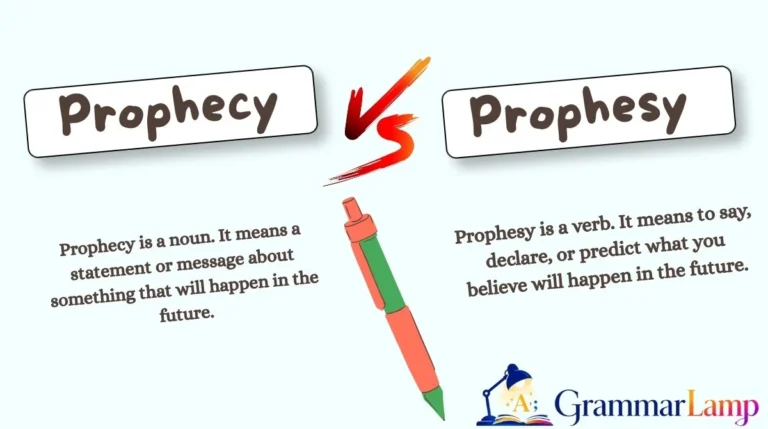
Prophecy is a noun. It means a statement or message about something that will happen in the future. It is often used in religious, historical, literary, or serious discussions, but it can also appear in modern English.
Oxford defines prophecy as a statement that something will happen in the future, especially one connected with religious or supernatural belief. Cambridge also gives the broader meaning of a statement about what is going to happen in the future.
The important point is that prophecy is the thing being said or predicted. It is not the action of making the prediction.
Think about the difference between these two:
The prophet made a prophecy.
The prophet prophesied.
In the first sentence, prophecy names the message. In the second, prophesied describes the action.
Because prophecy is a noun, it can work as the subject or object of a sentence. You can say a prophecy, the prophecy, his prophecy, or several prophecies.
Its plural form is prophecies, not “prophecys.” The spelling changes from -y to -ies, just as it does with some other nouns ending in a consonant + y.
Examples of “Prophecy”
- The prophecy came true many years later.
- The book contains several ancient prophecies.
- She believed that the prophecy would be fulfilled.
- The king was afraid of the prophecy.
- His prophecy about the storm surprised everyone.
- The story includes a prophecy about the future.
- The old manuscript describes a strange prophecy.
- They spent years studying the prophecy.
Notice that the word fits naturally after determiners such as a, the, this, or his, or after quantity words such as several.
You can also see prophecy in the common expression self-fulfilling prophecy. This describes a situation in which a belief or expectation helps cause the result it predicts. Oxford lists this as a common use of the noun.
Grammar Rule for “Prophecy”
The simple rule is:
Prophecy = noun
Use it when you need the name of the prediction, message, statement, or idea about the future.
For example:
- The prophecy was famous.
- I heard a prophecy.
- They studied the prophecy.
- Her prophecy became well known.
A useful test is to ask:
“Can I put a/an/the before the word?”
Usually, yes:
- a prophecy
- the prophecy
- this prophecy
- his prophecy
That is a strong clue that you are using the noun.
Common Learner Confusion
Some learners write:
The prophet made a prophesy.
This is incorrect when you mean “a prediction.” The correct sentence is:
The prophet made a prophecy.
The confusion happens because prophesy also relates to predicting the future. However, English separates the thing from the action.
The thing is a prophecy.
The action is to prophesy.
That one distinction can solve most spelling problems.
What Does “Prophesy” Mean?
Prophesy is a verb. It means to say, declare, or predict what you believe will happen in the future. Cambridge lists it as a verb that can be used with or without an object, and Oxford gives forms such as prophesies, prophesied, and prophesying.
The easiest way to understand it is:
Prophesy = to make a prophecy.
For example:
The prophet prophesied that the city would fall.
The verb tells us what the person did.
Because prophesy is a verb, it changes according to tense and subject. This is an important difference from prophecy.
Examples of “Prophesy”
- The prophet prophesied that the kingdom would fall.
- Nobody could prophesy what would happen next.
- She prophesied that the team would win.
- He claims that he can prophesy the future.
- The writer prophesied major changes in society.
- They prophesied disaster if the plan continued.
- Few people could have prophesied such a dramatic change.
- The old man prophesied that peace would return.
The verb can appear in several useful sentence structures.
“Prophesy that…”
This structure is common when you want to explain what someone predicted.
She prophesied that the company would succeed.
He prophesied that the weather would change.
“Prophesy something”
You can also use a noun after the verb.
They prophesied a victory.
The writer prophesied a major crisis.
“Prophesy what/when/how…”
The verb can also introduce a question word.
Nobody can prophesy what will happen next.
It is difficult to prophesy how the situation will develop.
Cambridge specifically shows prophesy being used with that, with question words, and in structures where the verb takes an object.
Verb Forms of “Prophesy”
This is where many learners notice the difference even more clearly.
The main forms are:
- Base form: prophesy
- He/she/it: prophesies
- Past tense: prophesied
- -ing form: prophesying
Oxford lists these forms directly in its dictionary entry.
Examples:
They prophesy about the future.
She prophesies that something unusual will happen.
He prophesied a great change.
They were prophesying disaster.
Remember that the past tense is prophesied, not “prophercied” or “prophesyd.”
Difference Between Prophecy and Prophesy
The main difference is grammatical and very simple:
Prophecy is a noun. Prophesy is a verb.
Both words are connected to predictions about the future, but they cannot normally replace each other in a sentence.
| Word | Part of speech | Basic meaning | Example |
|---|---|---|---|
| prophecy | Noun | A prediction or statement about the future | The prophecy came true. |
| prophesy | Verb | To predict or say what will happen | She prophesied that it would happen. |
Usage Difference
Use prophecy when you are talking about the prediction itself.
This prophecy is very old.
Use prophesy when you are talking about the act of making a prediction.
They prophesy about the future.
A simple way to separate them is:
Prophecy = the prediction
Prophesy = make the prediction
That is the grammar logic behind the pair.
Sentence Structure Difference
Because prophecy is a noun, it can appear in noun positions.
The prophecy was written centuries ago.
We studied the prophecy.
Her prophecy frightened the villagers.
Because prophesy is a verb, it normally needs a subject and can describe an action.
The prophet prophesied about the future.
She prophesied that the war would end.
They prophesy disaster.
Look at the difference:
He made a prophecy.
He prophesied.
Both sentences describe the same general idea, but the grammar is different.
The first uses a noun after made.
The second uses a verb after the subject he.
Meaning Comparison
There is a close relationship between these words, so it is helpful to think of them as members of the same word family.
- Prophet = the person
- Prophesy = the action
- Prophecy = the prediction or message
- Prophetic = an adjective describing something connected with predicting or correctly anticipating the future
For example:
The prophet made a prophecy.
The prophet prophesied about the future.
His words seemed prophetic years later.
Cambridge defines prophetic as describing something that correctly says what will happen in the future.
This word family can make the difference easier to understand.
Grammar Rules You Must Remember
Rule 1: Use “prophecy” as a noun
When the word is the name of a prediction or message, use prophecy.
The prophecy was written in an old book.
We learned about a famous prophecy.
Do not use prophesy as the noun when you mean “prediction.”
Wrong:
The old book contains a prophesy.
Correct:
The old book contains a prophecy.
Rule 2: Use “prophesy” as a verb
When someone is making a prediction, use prophesy.
They prophesy that the city will grow.
She prophesied that prices would rise.
The exact form depends on the tense.
Present:
He prophesies about the future.
Past:
He prophesied about the future.
Continuous:
He is prophesying about the future.
Rule 3: “Prophecy” changes to “prophecies” in the plural
The plural of prophecy is:
prophecies
Examples:
The book contains many prophecies.
Ancient prophecies are discussed in the story.
Several prophecies were recorded.
This spelling is important because learners sometimes assume they can simply add -s.
Not:
prophecys
Correct:
prophecies
Rule 4: Pronunciation helps you remember the spelling
The two words are usually pronounced differently at the end.
Prophecy ends with a sound like “see.”
Prophesy ends with a sound like “sigh.”
Cambridge gives prophecy as /ˈprɒf.ə.si/ in British English and /ˈprɑː.fə.si/ in American English, while prophesy ends with the /saɪ/ sound.
You can think of them this way:
prophecy → “pro-fuh-see”
prophesy → “prof-uh-sigh”
Pronunciation is not a complete grammar rule, but it is a useful memory aid.
Explore More Posts
Feel vs Felt: Complete Grammar Guide With Examples (2026)
Role Call or Roll Call? The Correct Spelling and Meaning in 2026
Into or Onto: Complete Difference, Rules, and Examples for 2026
Sole vs Soul: What’s the Difference? Easy Guide With Examples 2026
Common Mistakes Students Make
One of the biggest reasons learners make mistakes with these words is that both have the same general topic: the future. They also look almost identical when written quickly.
Another problem is that many learners understand the meaning but do not notice the part of speech.
Mistake 1: Using “prophesy” as a noun
Wrong:
It was an old prophesy.
Correct:
It was an old prophecy.
Why?
Because you are naming a prediction. You need the noun prophecy.
Mistake 2: Using “prophecy” as a verb
Wrong:
The man prophecy that the city would fall.
Correct:
The man prophesied that the city would fall.
Why?
The sentence needs a verb after the man. Prophecy is a noun, so it cannot fill that verb position.
Mistake 3: Forgetting the verb ending
Wrong:
She prophecy that it will happen.
Correct:
She prophesies that it will happen.
With he, she, or it in the simple present, the verb becomes prophesies.
Mistake 4: Using “prophecy” after “to”
Wrong:
They want to prophecy the future.
Correct:
They want to prophesy about the future.
After to, use the base form of the verb. Since the action is predicting, the verb is prophesy.
Mistake 5: Confusing “prophesied” and “prophecy”
Wrong:
He prophecy the result yesterday.
Correct:
He prophesied the result yesterday.
The word yesterday shows past time, so the verb needs its past form: prophesied.
Easy Correction Tip
Whenever you are unsure, ask:
“Am I naming a prediction, or am I describing an action?”
If you are naming it, choose prophecy.
If you are describing the act of predicting, choose prophesy.
That question is usually enough to make the right choice.
Easy Trick to Remember the Difference
Here is a simple memory trick:
“C = Creation, S = Saying”
Think of propheCy as the prediction or message that exists.
Think of prophesy as the action of saying what will happen.
Another easy trick is to connect each word with a familiar sentence:
The prophecy came true.
She prophesied that it would happen.
The first sentence talks about a thing.
The second talks about an action.
You can also remember the sounds:
Prophecy → SEE
Prophesy → SIGH
The word ending in -cy sounds like “see,” while the verb ending in -sy sounds like “sigh.”
Real-Life Logic
Imagine a teacher says:
“I think the team will win tomorrow.”
That prediction is a prophecy if you are describing it as such.
The teacher prophesied when you describe the action of making that prediction.
So:
What was said? → prophecy
What did the person do? → prophesy
This small question can help you choose the correct word quickly.
Daily Life Examples
These examples show how the two words can work naturally in everyday English.
Example 1
A: Did you hear his prediction about the company?
B: Yes. His prophecy about rapid growth surprised me.
Here, prophecy is a noun because it names the prediction.
Example 2
A: What did the old writer say?
B: He prophesied that the city would become very important.
Here, prophesied is a verb because it describes what the writer did.
Example 3
A: Is that an old prophecy?
B: Yes. People have discussed it for generations.
Example 4
A: Can anyone prophesy what will happen next year?
B: Nobody can know for certain.
This is a useful question because the verb describes the action of predicting.
Example 5
A: Why are they talking about that book?
B: It contains several ancient prophecies.
Example 6
A: What did she say about the match?
B: She prophesied a surprising victory.
Example 7
A: Do you believe his prophecy?
B: I’m not sure. We will have to wait and see.
Example 8
A: What is he doing?
B: He is prophesying about the future.
Example 9
A: Why was the story so interesting?
B: Because one prophecy seemed to predict later events.
Example 10
A: Could you prophesy what the results will be?
B: I can make a guess, but I cannot know the future.
These examples show that the difference is not about two completely different ideas. It is mainly about grammar and function.
Practice Section
Choose the correct word in each sentence: prophecy or prophesy.
1. The ancient ______ became famous after the event happened.
A. prophesy
B. prophecy
2. Nobody can ______ exactly what will happen tomorrow.
A. prophecy
B. prophesy
3. She ______ that the business would become successful.
A. prophesied
B. prophecy
4. The story contains several strange ______.
A. prophecies
B. prophesies
5. The writer’s words seemed ______ many years later.
A. prophecy
B. prophetic
Answers
1. B — prophecy
It is the prediction itself, so you need the noun.
2. B — prophesy
The sentence needs a verb after “can.”
3. A — prophesied
The sentence describes an action that happened in the past.
4. A — prophecies
This is the plural noun form of prophecy.
5. B — prophetic
Prophetic is the adjective used to describe something that correctly anticipates or relates to the future.
More Helpful posts
Sole vs Soul: What’s the Difference? Easy Guide With Examples 2026
Ax vs Axe: Which Spelling Is Correct in 2026?
Married To vs Married With 2026: Which One Is Correct?
Seel vs Seal: Meaning, Difference, and Correct Usage in 2026
FAQs
What is the difference between prophecy and prophesy?
Prophecy is a noun that means a prediction or statement about the future. Prophesy is a verb meaning to predict or say what you believe will happen. A simple way to remember it is: a prophecy is the prediction; to prophesy is to make the prediction.
Can we use “prophesy” in questions?
Yes. Prophesy is a verb, so it can naturally appear in questions.
For example: “Can you prophesy what will happen?” or “Who prophesied that this would occur?” The form changes according to tense and subject.
Is “prophecy” formal or informal?
Prophecy is more common in serious, religious, historical, literary, or figurative contexts than in casual everyday conversation. In ordinary speech, people often use words such as prediction, guess, or forecast depending on the situation.
Is “prophesy” a noun?
No. Prophesy is a verb. The noun is prophecy. For example, “The prophet prophesied about the future” uses the verb, while “The prophet made a prophecy” uses the noun.
What is the plural of prophecy?
The plural is prophecies. Do not write “prophecys.” The y changes to -ies, as in many English nouns ending in a consonant followed by y.
Are prophecy and prophesy pronounced differently?
Yes. Prophecy normally ends with a sound like “see,” while prophesy ends with a sound like “sigh.” Cambridge lists the corresponding pronunciation difference in its dictionary entries.
Conclusion
The difference between prophecy vs prophesy is much easier once you stop looking only at the spelling and start looking at grammar.
Prophecy is a noun. It refers to a prediction, statement, or message about the future.
Prophesy is a verb. It means to make that prediction or say what you believe will happen.
So remember this simple pair:
A prophecy is something.
To prophesy is to do something.
For example:
The prophecy became famous.
The writer prophesied that it would happen.
Also remember the useful spelling and pronunciation clues. Prophecy sounds like it ends in “see,” while prophesy ends in a sound like “sigh.” With a little practice, the difference will start to feel natural.
When you see either word while reading, pause for a second and ask whether the sentence needs a noun or a verb.
That small habit can prevent many spelling and grammar mistakes. Keep practicing with short sentences, and you will soon be able to choose the correct word without thinking twice.

Liam Derren is a language writer at GrammarLamp, creating simple, helpful content about grammar, words, and everyday English. He makes language learning clear, practical, and easy to understand.