
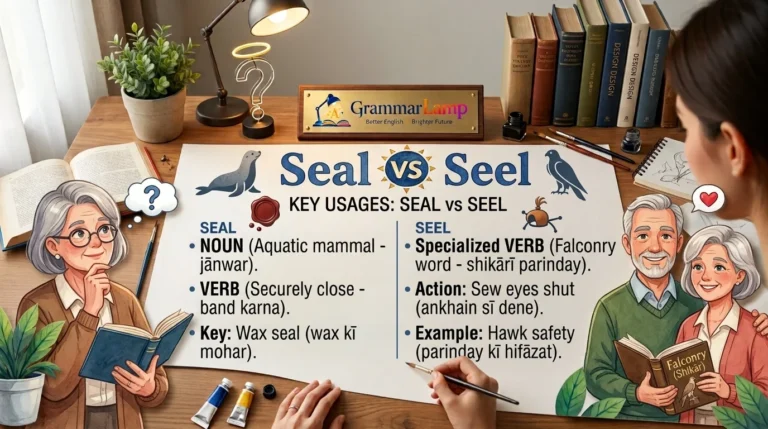
English has many words that sound exactly the same but have different spellings and meanings.
Seel vs seal is one of those confusing word pairs. When you hear either word in a conversation, the sound usually does not tell you which spelling to choose.
That can be a problem for English learners, especially when writing emails, school assignments, messages, or professional documents.
The confusion becomes even greater because seal is a common modern English word, while seel is a real word that is extremely rare today.
Dictionaries record seel mainly as a specialized or old verb connected with falconry. It has been used for the historical practice of sewing or closing the eyelids of a hawk or falcon.
It can also have an obsolete meaning related to closing or blinding the eyes.
By contrast, seal is an everyday English word with several useful meanings. You can seal an envelope, seal a bottle, seal a crack, seal an agreement, or talk about a seal of approval. It can also refer to the sea animal called a seal.
The important point is simple: seal is the spelling you normally need in modern English. Seel should only appear when its rare historical meaning is actually intended.
More Useful posts
Afterward or Afterwards? Meaning, Difference, and Correct Usage in 2026
A MA or an MA Degree? The Correct Grammar Rule in 2026
A or an: Easy Rules, Examples, and Common Mistakes in 2026
From My End or From My Side? Which Is Correct in English? (2026 Guide)
What Does “Seel” Mean?
Seel is a real English word, but it is not a normal everyday word. Modern dictionaries describe it as a verb used mainly in the specialized language of falconry. It refers to sewing or closing the eyelids of a hawk or falcon. Older uses can mean to close the eyes or to blind.
This is very different from the common meanings of seal.
The word seel has a long history. Collins traces it back through Middle French to Latin words connected with the eyelid or eyelash. Because this word belongs mostly to historical or specialized vocabulary, most English learners will almost never need it in normal conversation.
When should you use “seel”?
You would use seel only when you are talking about its specific historical meaning. For example, a book about traditional falconry might use the word when describing an old practice involving a bird’s eyelids.
For everyday actions such as closing an envelope, closing a container, or making an agreement final, seel is not the correct spelling.
Grammar rule for “seel”
Seel is a transitive verb, which means it normally takes an object.
A simple structure is:
seel + object
For example:
- The falconer seel the young bird.
- Historical texts describe methods used to seel falcons.
- The old record explains how the birds were seel’d.
In modern writing, however, you are unlikely to need this verb at all.
Examples of “seel”
Here are some examples based on its specialized or historical meaning:
- The old falconry book describes how to seel a hawk.
- The text explains the practice of seeling a falcon.
- The historian found an account of birds that had been seeled.
- Some old writers used seel when talking about closing a bird’s eyes.
- The museum display explains how the term seel was used in falconry.
- The historical document mentions the practice of seeling hawks.
- The old vocabulary list includes the verb seel.
- Modern readers may find the word seel unfamiliar.
These examples show an important point: seel is connected with eyes and historical falconry, not with envelopes, packages, bottles, or agreements.
Common learner confusion with “seel”
The biggest problem is pronunciation.
Seel and seal are pronounced alike or very nearly alike in standard English, so you cannot usually hear the difference. Cambridge gives seal as /siːl/ in British and American English, while Collins also records seel with essentially the same sound, with a regional difference in notation.
That means spelling must come from meaning and context.
If someone says:
“Please ___ the envelope.”
The answer is seal, not seel.
If a historical book says:
“The falconer would ___ the bird’s eyes.”
the rare word seel may be intended.
What Does “Seal” Mean?
Seal is a common and very useful English word. It can be a noun or a verb, and it has several meanings in modern English.
As a verb, seal can mean to close something tightly so that air, liquid, or another substance cannot get in or out. It can also mean closing an envelope or making an agreement final.
As a noun, seal can mean a covering or device that closes something. It can also mean an official mark or stamp. And, of course, a seal is also an animal that lives near the sea.
When should you use “seal”?
Use seal when you are talking about:
- closing an envelope
- closing a package or container
- stopping air or liquid from escaping
- covering a crack or opening
- making an agreement final
- an official mark or stamp
- a sea animal
- a protective covering around an opening
This makes seal much more common than seel.
Grammar rules for “seal”
Because seal can be both a noun and a verb, its grammar depends on the sentence.
As a verb:
Subject + seal + object
- I sealed the envelope.
- She sealed the package.
- They sealed the agreement.
As a noun:
a/the + seal
- The bottle has a seal.
- The document has the official seal.
- We saw a seal at the beach.
The main verb forms are:
- base form: seal
- he/she/it: seals
- past: sealed
- past participle: sealed
- -ing form: sealing
Oxford lists these forms and documents uses such as sealing envelopes, closing containers, protecting surfaces, making something definite, and preventing access through an area.
Examples of “seal”
- Please seal the envelope before you send it.
- We need to seal the box carefully.
- She sealed the bottle with a tight lid.
- The workers sealed the crack in the wall.
- They finally sealed the deal.
- The document carries an official seal.
- The jar has a broken seal.
- We saw a seal swimming in the water.
Notice how different these meanings are. The context tells you which meaning of seal is being used.
Cambridge also records uses such as seal something off, meaning to prevent people from entering an area, and seal an agreement, meaning to make the agreement formal or certain.
Difference Between Seel and Seal
The difference between these two words is mainly about meaning, frequency, and context.
| Feature | Seel | Seal |
|---|---|---|
| Part of speech | Verb | Noun and verb |
| Common in modern English? | No, very rare | Yes |
| Main meaning | Historical falconry term | Close, secure, mark, finalize, or sea animal |
| Used for envelopes? | No | Yes |
| Used for containers? | No | Yes |
| Used for agreements? | No | Yes |
| Can mean a sea animal? | No | Yes |
| Connected with falconry? | Yes | No |
| Common in daily conversation? | Almost never | Very common |
| Pronunciation | Approximately /siːl/ | /siːl/ in standard English |
The biggest thing to remember is this:
Seel is a rare historical word. Seal is the normal modern word.
Usage difference
Suppose you are writing a sentence about a letter.
Correct:
Please seal the envelope.
Not:
Please seel the envelope.
Now suppose you are talking about a bottle.
Correct:
Make sure the bottle is sealed.
Again, seel is wrong for this modern meaning.
Now think about a sea animal:
We saw a seal near the rocks.
There is no modern everyday use of seel for this animal.
Grammar logic
The two words are not simply two spelling choices for the same word. They are different words with different histories and meanings.
This is why replacing one with the other can change the meaning or make the sentence incorrect.
For most modern English writing, the normal pattern is:
seal → sealed → sealing → seal
For example:
- seal the box
- sealed the box
- sealing the box
- the seal on the box
You should not create these ordinary forms with seel.
Sentence structure difference
Seel is normally an old transitive verb:
The falconer seeled the bird’s eyes.
Seal has many sentence patterns:
She sealed the envelope.
The workers sealed the opening.
They sealed the agreement.
The bottle has a broken seal.
We watched a seal in the sea.
This variety is one reason why seal appears so often in everyday English.
Meaning comparison
Think of the difference this way:
Seel = a rare historical word connected with closing a bird’s eyes.
Seal = a common modern word connected with closing, securing, marking, finalizing, or the sea animal.
Once you connect each spelling with its main meaning, the pair becomes much easier.
Explore More Posts
Honor or Honour: What Is the Difference? A Simple Guide for 2026
Collaborate vs Corroborate: Meaning, Difference, and Examples in 2026
Sleeve vs Sleave: Which Is Correct? Meaning, Difference, and Examples in 2026
Time off vs time-off: The Complete Grammar Guide for 2026
Grammar Rules You Must Remember
Rule 1: Use “seal” for envelopes and letters
When you close an envelope by sticking its flap down, use seal.
Correct:
Please seal the envelope before mailing it.
Correct:
She sealed the letter and added a stamp.
Oxford and Collins both list this exact everyday use of seal.
Do not write:
Please seel the envelope.
That is not the standard modern spelling for this meaning.
Rule 2: Use “seal” for containers and openings
When you close something tightly to stop air, liquid, gas, or another substance from entering or escaping, use seal.
Examples:
The workers sealed the pipe.
The lid is sealed tightly.
We need to seal the crack before the rain comes.
Cambridge defines this use as closing a container or opening so that material cannot enter or leave.
This is one of the most common modern uses of the word.
Rule 3: Use “seal” for agreements and expressions such as “seal the deal”
Seal can also mean to make something final, certain, or official.
Examples:
They sealed the agreement with their signatures.
Her answer sealed the deal.
The final payment sealed the contract.
Oxford specifically records the meaning of making something definite and gives examples involving contracts, deals, friendship, and fate.
So when you mean “make an agreement final,” the word is seal.
Rule 4: Use “seel” only for its rare historical meaning
Do not treat seel as a casual alternative spelling of seal.
Use it only when the special meaning is intended, especially in historical or falconry writing.
For example:
The old text describes how falconers seeled the birds’ eyes.
Collins and Dictionary.com both identify this as a specialized falconry verb and also record older meanings related to closing or blinding the eyes.
For normal English writing, seal is almost always the word you need.
Common Mistakes Students Make
Many learners make mistakes with seel and seal because they learn English mainly through listening.
When you hear /siːl/, you may imagine the spelling seel because English has other words such as feel, heel, and peel. However, English spelling does not always follow one simple sound pattern.
Another reason is that seel is a genuine dictionary word. A learner may see it somewhere and think:
“Maybe seel and seal are just two spellings of the same thing.”
They are not.
Mistake 1
❌ Please seel the package.
✅ Please seal the package.
Here, the meaning is “close the package tightly,” so seal is correct.
Mistake 2
❌ We saw a seel at the aquarium.
✅ We saw a seal at the aquarium.
The animal is spelled seal.
Mistake 3
❌ They seeled the deal yesterday.
✅ They sealed the deal yesterday.
The common expression is seal the deal.
Mistake 4
❌ The bottle’s seel is broken.
✅ The bottle’s seal is broken.
Here, seal is a noun meaning the material or closure that keeps the container closed.
Mistake 5
❌ The official paper has the government seel.
✅ The official paper has the government seal.
An official mark or design is called a seal.
Easy correction tip
Before choosing the spelling, ask yourself:
What am I talking about?
If the answer is an envelope, container, agreement, official mark, protective closure, or sea animal, choose seal.
Only think about seel when the sentence is about the old or specialized falconry meaning.
Easy Trick to Remember the Difference
Here is a simple memory trick:
“Sea” is inside “seal”
Think about the sea animal:
SEA + L = SEAL
A seal lives in or near the sea.
Now use that same spelling for the common verb:
- seal an envelope
- seal a bottle
- seal a crack
- seal a deal
So whenever you are talking about normal modern English, remember:
SEA → SEAL
The word seel is the unusual one. You do not need it in normal daily English unless you are reading or writing about old falconry or historical language.
Another useful thought is:
Seal = secure
Both words begin with the same sound, but seal is connected with the idea of making something closed or secure.
For example:
Seal the box.
The box becomes secure.
Seal the agreement.
The agreement becomes final.
That simple idea can help you remember the common word.
Daily Life Examples
These examples show how seal naturally appears in everyday conversations.
Example 1: At the post office
Ali: Did you put the letter in the envelope?
Hassan: Yes, but I haven’t sealed it yet.
Ali: Okay. Seal it before you give it to the clerk.
Example 2: Packing a parcel
Sara: Is the box ready?
Mina: Almost. I need to seal it with tape.
Sara: Good. Make sure it is sealed properly.
Example 3: Cooking
Dad: Why did you put the food in this container?
Son: I want to keep it fresh.
Dad: Then seal the container tightly.
Example 4: Fixing a leak
Worker: There is a small crack in the pipe.
Owner: Can you fix it?
Worker: Yes. I will seal the crack so the water cannot escape.
Example 5: Business conversation
Manager: Did the two companies sign the contract?
Employee: Yes. They finally sealed the deal yesterday.
Manager: Great. That’s good news.
Example 6: Official documents
Student: Why is there a round mark on the certificate?
Teacher: That is the school’s official seal.
Student: So it shows that the document is genuine?
Teacher: Exactly.
Example 7: At the beach
Child: Look! What is that animal in the water?
Mother: That’s a seal.
Child: It is swimming so fast!
Example 8: Buying a new product
Customer: How do I know nobody has opened this bottle?
Shopkeeper: Look at the seal around the top.
Customer: Oh, I see. It is still unbroken.
Example 9: Construction work
Engineer: Is the window ready?
Worker: Yes. We sealed the edges this morning.
Engineer: Good. That should stop the rain from getting inside.
Example 10: A simple question about spelling
Student: Is it “seel the envelope” or “seal the envelope”?
Teacher: It is seal the envelope.
Student: What about “seel”?
Teacher: That is a rare historical word. You normally do not need it in everyday English.
Practice Section
Choose the correct word: seel or seal.
1. Please ___ the envelope before you send it.
a) seel
b) seal
2. We saw a ___ swimming near the boat.
a) seel
b) seal
3. The workers need to ___ the hole in the wall.
a) seel
b) seal
4. The old falconry text mentions how to ___ a bird’s eyes.
a) seel
b) seal
5. The two companies finally ___ the deal.
a) seeled
b) sealed
Answers
1. b) seal
You close an envelope by sealing it.
2. b) seal
The animal is a seal.
3. b) seal
You seal a hole or opening to prevent air or water from passing through.
4. a) seel
This is the rare historical falconry use of seel.
5. b) sealed
The normal expression is sealed the deal.
More Helpful posts
I’m vs I Am: Complete Difference, Rules, Examples & Usage Guide 2026
Sun vs Son: Meaning, Difference, Rules, and Examples (2026)
A Majority of vs The Majority of: Easy Grammar Guide for 2026
Tomatoes or Tomatos: Which Spelling Is Correct? [2026]
FAQs
What is the difference between seel and seal?
Seal is a common modern English word. It can mean to close something, secure a container, make an agreement final, refer to an official mark, or name the sea animal.
Seel is a rare historical verb mainly associated with falconry and closing the eyelids of a hawk or falcon.
Can we use “seel” in everyday English?
Usually, no.
Seel is a genuine dictionary word, but it is extremely uncommon in normal conversation and modern general writing. Most learners should use seal for everyday meanings such as closing packages, letters, bottles, or agreements.
Can “seal” be used as a verb?
Yes. Seal is very commonly used as a verb.
For example:
Please seal the box.
She sealed the envelope.
They sealed the agreement.
It is also used in phrases such as seal off, seal in, and seal the deal.
Is “seel” formal or informal?
The word is not simply a formal version of seal.
Instead, it is a rare, specialized, and historical word. Its main recorded use is in falconry, with older meanings related to closing or blinding the eyes.
Is “seal” used only for closing things?
No. Seal has several meanings.
It can describe an animal, an official mark, a protective closure, or the action of closing something. It can also mean making an agreement definite or final.
Why do seel and seal sound the same?
Both words are pronounced with essentially the same long “ee” sound followed by “l.” Cambridge lists seal as /siːl/, and Collins gives the same basic pronunciation for seel, with regional pronunciation notation.
Because they sound alike, learners have to depend on context and spelling, not pronunciation alone.
Conclusion
The difference between seel vs seal becomes much easier when you focus on meaning instead of sound.
Seal is the normal modern English word. Use it for closing envelopes, packages, bottles, cracks, and openings. Use it for agreements, official marks, and the sea animal as well. It is a common word that appears in everyday conversations, school writing, business English, and many other situations.
Seel is very different. It is a rare historical verb mainly associated with falconry and the closing of a hawk or falcon’s eyelids. Older dictionaries also record meanings connected with closing or blinding the eyes.
So, when you are unsure, remember the simple rule:
For normal modern English, use “seal.”
You can seal a letter, seal a bottle, seal a deal, and see a seal near the sea.
Keep practicing these small spelling differences. Once you connect a word with its meaning and context, confusing English pairs become much easier to remember.

Liam Derren is a language writer at GrammarLamp, creating simple, helpful content about grammar, words, and everyday English. He makes language learning clear, practical, and easy to understand.