
Rumor and roomer look and sound surprisingly similar, but they have completely different meanings. This is especially confusing for English learners because the only visible difference is the extra “o” in roomer, while the pronunciation can also be easy to miss in fast conversation.
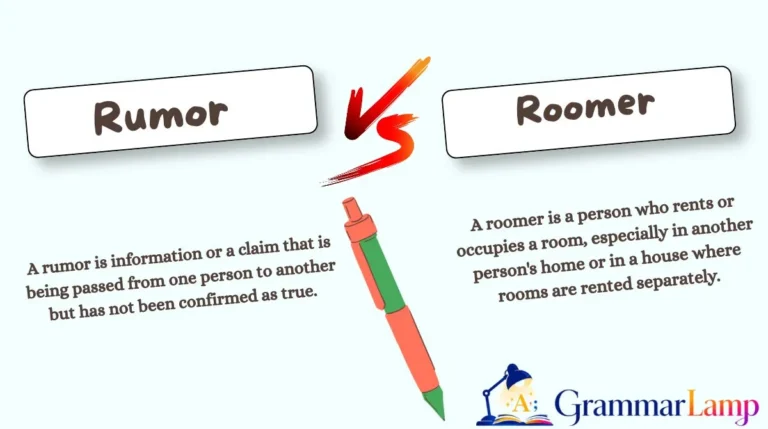
A rumor is a piece of information or a story that people are talking about even though it has not been confirmed as true. A roomer, by contrast, is a person who rents or occupies a room, especially in someone else’s house or in a lodging arrangement.
Consider these two sentences:
There is a rumor that the company will move.
The roomer pays rent every Friday.
The first sentence is about unconfirmed information. The second is about a person living in or renting a room.
The distinction matters because using the wrong word can completely change the meaning of a sentence. If you write roomer when you mean rumor, readers may think you are talking about a person who rents a room rather than unverified news.
There is also a useful pronunciation and spelling connection to remember. Rumor comes from the idea of something being reported or repeated, while roomer is built from room + -er, meaning a person associated with a room.
This guide explains the meanings, grammar, pronunciation, spelling, common mistakes, and everyday uses of rumor vs roomer. By the end, you should be able to recognize the difference quickly and use both words naturally.
More Useful posts
Who’s vs Whose (2026): What’s the Difference? Easy Grammar Rules, Examples, and Common Mistakes
Compare to vs Compare with: Easy Grammar Guide for 2026
Apportion vs Portion vs Proportion: Meaning, Differences, and Easy Examples (2026)
Case in Point vs Case and Point: Which Is Correct? (2026)
What Does “Rumor” Mean?
A rumor is information or a claim that is being passed from one person to another but has not been confirmed as true.
For example:
There is a rumor that the restaurant is closing.
This does not tell us that the restaurant really is closing. It only tells us that people are saying it might close.
In American English, the usual spelling is rumor. In British English, you will often see rumour.
Both spellings refer to the same word and the same basic idea.
When do we use “rumor”?
Use rumor when talking about information that is circulating among people without reliable confirmation.
It is common when discussing:
- celebrities
- businesses
- schools
- relationships
- politics
- sports
- workplaces
- future plans
- possible changes
- unexpected events
For example:
- I heard a rumor about the new manager.
- There is a rumor that the company will open another office.
- The rumor spread quickly through the school.
- She denied the rumor about her resignation.
- We shouldn’t believe every rumor we hear online.
- A strange rumor started circulating yesterday.
- The newspaper reported a rumor about the possible deal.
- He refused to comment on the rumor.
Notice that a rumor is not automatically false. The important point is that its truth has not been established or confirmed.
“Rumor” as a countable noun
In everyday English, rumor is normally a countable noun.
You can say:
a rumor
two rumors
several rumors
many rumors
For example:
I heard a rumor at work.
Several rumors are circulating about the company.
This is useful to remember when forming sentences.
Common structures with “rumor”
Several patterns are particularly common.
1. “There is a rumor that…”
There is a rumor that the store will close.
This is one of the most natural structures.
2. “I heard a rumor that…”
I heard a rumor that Sarah is moving abroad.
The speaker is reporting information they heard but are not presenting it as confirmed fact.
3. “A rumor about…”
There was a rumor about his resignation.
Here, about introduces the subject of the rumor.
4. “Rumors spread”
Rumors spread quickly on social media.
This focuses on how unconfirmed information moves from person to person.
5. “Rumor has it…”
Rumor has it that the restaurant will reopen next month.
This is an informal expression meaning that people are saying something, although it has not necessarily been confirmed.
What is the difference between a rumor and a fact?
This is an important distinction.
A fact is something established as true or supported by reliable evidence.
A rumor is information whose truth is uncertain or unverified.
Compare:
The company announced that it will open a new branch.
This presents the information as confirmed.
Now:
There is a rumor that the company will open a new branch.
This tells us that people are talking about the possibility, but confirmation is missing.
A rumor may eventually turn out to be true. It may also turn out to be completely false.
Common learner confusion
English learners sometimes use rumor to mean any piece of information they have heard.
That is not always accurate.
If your friend tells you:
“The meeting starts at 9 because the manager just confirmed it.”
that is not necessarily a rumor. It is information presented as confirmed.
But if your friend says:
“I heard the manager might cancel tomorrow’s meeting, but I’m not sure.”
that is much closer to a rumor.
The key idea is uncertainty or lack of confirmation.
What Does “Roomer” Mean?
A roomer is a person who rents or occupies a room, especially in another person’s home or in a house where rooms are rented separately.
The word comes from:
room + -er → roomer
The suffix -er often creates a word for a person who performs an action or has a particular relationship with something.
In this case, a roomer is someone associated with occupying or renting a room.
For example:
The homeowner has two roomers living upstairs.
This means two people rent or occupy rooms in the house.
When do we use “roomer”?
Roomer is used when you need to describe a person who rents or occupies a room rather than an entire private home or apartment.
Examples:
- The house has three roomers.
- Each roomer pays rent at the beginning of the month.
- The homeowner interviewed a potential roomer.
- The roomer moved out at the end of the summer.
- She has been a roomer in that house for two years.
- The landlord gave each roomer a key.
- The roomer shares the kitchen with the homeowner.
- A new roomer moved into the upstairs bedroom.
The word is understandable in English, but it is less common in everyday conversation than words such as roommate, tenant, lodger, or boarder, depending on the exact situation.
Roomer vs roommate
These words are related but not identical.
A roommate is someone who shares a home, apartment, or room with another person.
For example:
My roommate and I share a two-bedroom apartment.
A roomer is specifically someone who rents or occupies a room, often in someone else’s home.
For example:
The homeowner has a roomer who rents the upstairs bedroom.
A person can sometimes be described using more than one term depending on the living arrangement, but the words emphasize different things.
Roommate emphasizes shared living.
Roomer emphasizes occupying or renting a room.
Roomer vs tenant
A tenant is a person who rents property from a landlord or property owner.
That property might be:
- a room
- an apartment
- a house
- an office
- another type of rented space
So tenant is a broader term.
A person renting a room could potentially be called a tenant, depending on the legal and housing arrangement, while roomer specifically highlights the room-based arrangement.
Roomer vs lodger
Lodger is another useful word.
A lodger traditionally refers to someone who rents a room in a house where the owner or another household also lives.
In British English, lodger can be more familiar than roomer for this situation.
For example:
She has a lodger staying in the spare bedroom.
The exact terminology can depend on local housing practices and legal definitions, so roomer should not automatically be treated as identical to lodger in every context.
Common learner confusion
The biggest problem with roomer is often not its definition but its rarity.
Many learners know room, roommate, and rumor, but have rarely encountered roomer.
Because roomer looks like a spelling variation of rumor, learners sometimes think the two words are connected.
They are not.
Rumor is about unconfirmed information.
Roomer is about a person who occupies or rents a room.
Difference Between Rumor and Roomer
The simplest distinction is:
Rumor = unconfirmed information
Roomer = a person who rents or occupies a room
The words belong to different semantic categories and normally appear in completely different types of sentences.
Comparison Table
| Feature | Rumor | Roomer |
|---|---|---|
| Basic meaning | Unconfirmed information or story | Person who rents or occupies a room |
| Word type | Noun | Noun |
| Main subject | Information/news | Person |
| Related word | Rumor / rumour | Room |
| Common context | News, gossip, workplaces, social media | Housing and renting |
| Example | I heard a rumor. | The roomer paid rent. |
| Can be plural? | rumors | roomers |
| Commonness | Very common | Less common |
| American spelling | rumor | roomer |
| British equivalent/spelling | rumour | roomer is still possible, but lodger may be more familiar |
Meaning difference
Consider:
The rumor was false.
The sentence says something about information.
Now:
The roomer was late with the rent.
The sentence says something about a person.
They cannot be substituted for each other.
Grammar difference
Both words are countable nouns, so you can use articles and plural forms.
With rumor:
a rumor
the rumor
several rumors
With roomer:
a roomer
the roomer
several roomers
However, the words usually occur with very different verbs.
Common verbs with rumor include:
- hear
- spread
- deny
- confirm
- investigate
- repeat
- circulate
- start
Examples:
I heard a rumor.
The rumor spread quickly.
Common verbs with roomer include:
- rent
- pay
- move
- live
- house
- interview
- accommodate
Examples:
The roomer paid the rent.
The roomer moved out last week.
This is a useful grammatical clue when you are reading quickly.
Sentence structure difference
A common structure with rumor is:
hear + a rumor
I heard a rumor yesterday.
Another is:
there is + a rumor + that-clause
There is a rumor that the store will close.
With roomer, the structure is usually more straightforward because it is a person:
the roomer + verb
The roomer paid the rent.
or:
a roomer + verb
A roomer moved into the house last month.
Pronunciation difference
The words can be distinguished by their vowel sounds.
Rumor is commonly pronounced approximately:
ROO-mer
The first syllable has the long oo sound found in words such as room or food.
Roomer is also approximately:
ROO-mer
This is why the pair can be particularly confusing in speech: they are essentially pronounced the same or extremely similarly in many varieties of English.
The spelling and context therefore become especially important.
This is a crucial point for learners. Unlike word pairs where pronunciation clearly separates the meanings, rumor and roomer may be homophones or near-homophones depending on accent and pronunciation.
If you hear:
I heard a ROO-mer.
you need to use context to determine which word was intended.
If the speaker is discussing gossip or unconfirmed news, it is rumor.
If they are discussing a person renting a bedroom, it is roomer.
Explore More Posts
Work Alongside You vs Work Alongside With You (2026): Which One Is Correct in English?
Lets vs Let’s (2026): What’s the Difference? Easy Grammar Guide with Examples
Based Out of vs Based In (2026): What’s the Difference? Easy Grammar Guide with Examples
Crews vs Cruise (2026): What’s the Difference? Easy Grammar Guide with Examples
Grammar Rules You Must Remember
Rule 1: Use “rumor” for unconfirmed information
If people are talking about something that has not been verified, rumor is the appropriate word.
There is a rumor that the company will move its headquarters.
The sentence does not confirm that the company will actually move.
Rule 2: Use “roomer” for a person
If you are talking about someone who rents or occupies a room, roomer is the correct noun.
The roomer pays rent every month.
The word refers to the person, not the room itself.
Rule 3: Do not confuse “roomer” with “room”
A room is a physical space.
A roomer is a person associated with renting or occupying that space.
Compare:
The room is clean.
The roomer keeps the room clean.
The first sentence describes the space. The second describes the person.
Rule 4: Remember the spelling when listening
Because rumor and roomer can sound alike, context matters.
If the sentence concerns:
- gossip
- unconfirmed news
- claims
- speculation
think rumor.
If it concerns:
- rent
- bedrooms
- landlords
- shared housing
- people living in a house
think roomer.
Common Mistakes Students Make
Mistake 1: Writing “roomer” when they mean “rumor”
Incorrect:
I heard a roomer about the company.
Correct:
I heard a rumor about the company.
Why? Because the speaker is talking about unconfirmed information, not a person renting a room.
Mistake 2: Writing “rumor” when they mean “roomer”
Incorrect:
The rumor pays $700 in rent every month.
Correct:
The roomer pays $700 in rent every month.
The sentence is describing a person, so roomer is required.
Mistake 3: Assuming the extra “o” is only a spelling detail
It is tempting to think:
rumor / roomer = almost the same word
But the spelling difference reflects two completely unrelated words.
Rumor is associated with information being repeated.
Roomer is built from room and refers to a person.
Mistake 4: Confusing “roomer” with “roommate”
A learner may write:
My roomer and I share an apartment.
This may not express what they intend.
If you mean someone who shares your living space with you, roommate is often the natural word.
My roommate and I share an apartment.
If you mean someone who rents a room in a house, especially from the owner, roomer may be appropriate.
Mistake 5: Treating every unverified statement as a rumor
Not every uncertain statement is necessarily a rumor.
For example:
I think it might rain tomorrow.
That is a prediction or personal opinion.
But:
There’s a rumor that the school will close next month.
This suggests that information is circulating among people without confirmation.
Easy correction tip
When you are unsure, identify the thing being discussed.
Ask:
Is it information?
→ rumor
Is it a person renting or occupying a room?
→ roomer
That simple question handles most cases.
Easy Trick to Remember the Difference
There is a very simple spelling trick.
ROOMER contains ROOM
Look at the word:
ROOMer
You can see the word ROOM right inside it.
That gives you the clue:
room → roomer → person connected with a rented/occupied room
Now look at:
RUMOR
It does not contain room.
Think of rumor as information that runs from person to person.
Someone hears it, tells another person, and then another person repeats it.
So remember:
ROOMER → ROOM → person living in/renting a room
RUMOR → repeated information → unconfirmed story
A real-life mental picture
Imagine a house with a spare bedroom.
A person pays rent to live there.
That person is the roomer.
Now imagine two neighbors standing outside the same house saying:
“I heard the owner is selling it.”
That unconfirmed story is a rumor.
The person is the roomer.
The information is the rumor.
That little picture makes the difference much easier to remember.
Another useful clue
If the sentence contains words such as:
- rent
- landlord
- bedroom
- house
- tenant
- lease
- roommate
you may be dealing with roomer.
If it contains words such as:
- gossip
- claim
- report
- news
- speculation
- deny
- confirm
- spread
you are probably dealing with rumor.
Daily Life Examples
1. Talking about workplace gossip
A: Have you heard anything about the company?
B: Yes. I heard a rumor that the office may move.
The word rumor refers to unconfirmed information.
2. Talking about a person renting a room
A: Who lives upstairs?
B: We have a roomer who rents the spare bedroom.
Here, roomer refers to a person.
3. Celebrity news
A: Is it true that the actor is leaving the show?
B: I don’t know. It’s just a rumor.
The information has not been confirmed.
4. Paying rent
Landlord: Did the new roomer pay the rent?
Manager: Yes, the payment came this morning.
The roomer is the person renting the room.
5. School gossip
Student A: Why is everyone talking about the principal?
Student B: There’s a rumor that he is retiring.
Again, rumor means an unconfirmed story.
6. Sharing a house
A: Does your family live alone?
B: No. We have a roomer who rents the upstairs room.
The word identifies the person living in the rented room.
7. Correcting online information
A: Someone posted that the store is closing tomorrow.
B: Don’t believe it yet. It could just be a rumor.
The speaker is warning that the information may not be verified.
8. A new person moves in
A: Who moved into the spare room?
B: A new roomer arrived last weekend.
The context is clearly about housing.
9. Asking about a possible change
A: Is the manager really leaving?
B: It’s only a rumor as far as I know.
The speaker has no confirmed evidence.
10. Comparing the two words naturally
A: I heard a rumor about the house.
B: Really? What did you hear?
A: Apparently, the owner is looking for a new roomer.
This short conversation shows why the spelling matters. The rumor is the information, while the roomer is the person who might rent the room.
Practice Section
Choose rumor or roomer in each sentence.
1.
I heard a ___ that the company will close its local office.
2.
The ___ pays rent on the first day of every month.
3.
Nobody knows whether the story is true; it may just be a ___.
4.
The homeowner is looking for a new ___ for the spare bedroom.
5.
The celebrity denied the ___ about her relationship.
Answers
1. rumor — The sentence refers to unconfirmed information.
2. roomer — The sentence refers to a person who rents or occupies a room.
3. rumor — The story has not been confirmed.
4. roomer — The homeowner wants someone to occupy or rent the room.
5. rumor — The celebrity is denying an unconfirmed claim or story.
More Helpful posts
Upmost vs Utmost: Meaning, Difference, and Correct Usage in 2026
Seam vs Seem: Difference, Meaning, Examples & Grammar Rules (2026)
All the Time vs Every Time: Meaning, Difference, Rules & Examples (2026)
Afterward or Afterwards? Meaning, Difference, and Correct Usage in 2026
FAQs
What is the difference between “rumor” and “roomer”?
A rumor is an unconfirmed story or piece of information that people are discussing.
A roomer is a person who rents or occupies a room, especially in someone else’s home or in a room-rental arrangement.
The two words have completely different meanings.
Are “rumor” and “roomer” pronounced the same?
In many varieties of English, rumor and roomer are pronounced the same or very similarly.
This makes context especially important when listening. If the conversation is about gossip or unconfirmed news, the word is likely rumor. If it is about renting a room, roomer is likely intended.
Is “roomer” the same as “roommate”?
Not necessarily.
A roommate is someone who shares a home or living space with another person. A roomer specifically refers to someone who rents or occupies a room, often in another person’s home.
The exact housing arrangement determines which word sounds most natural.
Is “roomer” a common English word?
Roomer is a real English word, but it is much less common in everyday conversation than rumor or roommate.
Depending on the situation and region, you may hear tenant or lodger instead. When writing, choose the term that accurately describes the housing arrangement.
Can “rumor” be true?
Yes. A rumor is not necessarily false.
The word mainly indicates that information is unconfirmed, uncertain, or circulating without established proof. A rumor may later be confirmed as true, or it may turn out to be false.
Is “rumour” the same as “rumor”?
Yes.
Rumor is the common American English spelling, while rumour is standard British English spelling.
The meaning is the same. The spelling difference is similar to other American and British spelling differences, such as color/colour.
Conclusion
Rumor and roomer are easy to mix up because they look similar and can sound almost identical in ordinary speech. But once you focus on their meanings, the difference is straightforward.
A rumor is unconfirmed information or a story that is being passed from person to person. You can hear a rumor, spread a rumor, deny a rumor, or investigate a rumor.
A roomer, on the other hand, is a person who rents or occupies a room, especially as part of a room-rental arrangement. You might have a roomer in your house, collect rent from a roomer, or look for a new roomer.
The easiest memory trick is right inside the spelling: ROOMer contains ROOM, so think about a person living in or renting a room. RUMOR is the word for unconfirmed information.
When you hear these words in conversation, don’t rely only on pronunciation. Listen to the context. If people are discussing gossip, news, or an unverified claim, choose rumor. If they are discussing bedrooms, rent, or housing, choose roomer.
A little attention to context will make this pair much easier to use correctly.

Liam Derren is a language writer at GrammarLamp, creating simple, helpful content about grammar, words, and everyday English. He makes language learning clear, practical, and easy to understand.