
English has many words that look almost the same but have completely different meanings. Tinder and tender are a good example. They differ by only one letter, but you cannot use them in the same way.
Learners often confuse these words because their spelling is very similar. When you say them quickly, the difference in the middle vowel can also be easy to miss.
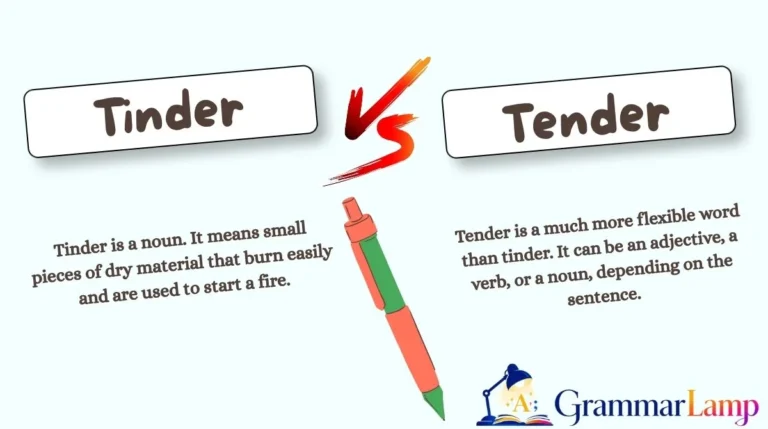
However, the meaning changes completely. Tinder is mainly a noun for a dry material that burns easily and is used to start a fire.
Tender, on the other hand, has several common meanings. It can describe something soft, gentle, caring, painful to touch, or young. It can also be a verb meaning to formally offer something, or a noun meaning a formal offer.
This difference matters because using the wrong word can make a sentence confusing or even funny. Imagine someone saying, “This chicken is tinder.” They probably mean tender, because they are talking about soft food.
By the end, you will know exactly when to use tinder and when to use tender. You will also learn their pronunciation, grammar, common mistakes, easy memory tricks, and natural examples from everyday English.
Explore More Posts
Lies Ahead vs Lays Ahead: Which Is Correct? (2026 Guide)
Grisly vs Grizzly: Meaning, Difference, and Examples You Need in 2026
Emaculate vs Immaculate 2026: Which Spelling Is Correct?b
Fit vs Fitted: What’s the Difference? Easy Grammar Guide for 2026
What Does “Tinder” Mean?
Tinder is a noun. It means small pieces of dry material that burn easily and are used to start a fire. Dry grass, tiny pieces of wood, paper, bark, or other easily burned material can be used as tinder. Cambridge Dictionary defines tinder as small pieces of something dry that burns easily and is used for lighting fires.
The word is connected with the idea of starting a fire. When you are making a campfire, large pieces of wood may not catch fire easily. You usually need something that burns quickly first. That material is called tinder.
For example, dry grass can catch a small flame quickly. Once the tinder is burning, it can help ignite small sticks and then larger pieces of wood.
When should you use “tinder”?
Use tinder when you are talking about material that helps start or maintain a fire.
You might see this word in conversations about:
- camping
- fireplaces
- survival skills
- outdoor activities
- forests and wildfires
- starting a fire
The word is normally used as an uncountable noun. We usually say “some tinder” rather than “a tinder.”
Grammar rule for “tinder”
Tinder is mainly an uncountable noun.
You can say:
- some tinder
- dry tinder
- a piece of tinder
- use tinder
- collect tinder
You normally would not say “a tinder” when you mean one piece of material.
Examples of “tinder”
- We collected dry grass to use as tinder.
- The campers looked for some tinder before lighting the fire.
- Dry leaves can work well as tinder.
- He placed the tinder under the small sticks.
- The wood was wet, so we needed dry tinder to start the fire.
- She gathered pieces of bark for tinder.
- Always keep your tinder dry when you are camping.
- The spark quickly caught the tinder and started the fire.
These examples all have the same basic idea: tinder helps something burn and starts a fire.
Common learner confusion with “tinder”
There are two main reasons learners may hesitate over this word.
First, tinder looks very similar to tender. Changing just one vowel changes the word completely.
Second, many learners know Tinder as the name of the dating app. That is a proper noun and is written with a capital T. In the traditional English vocabulary word tinder, however, the meaning is dry material used to start a fire.
So context matters.
The campers collected tinder.
Here, “tinder” means fire-starting material.
She met him on Tinder.
Here, “Tinder” is the name of a dating app.
What Does “Tender” Mean?
Tender is a much more flexible word than tinder. It can be an adjective, a verb, or a noun, depending on the sentence.
As an adjective, tender can mean soft and easy to cut or chew, especially when talking about food. It can also mean gentle, loving, or kind. Another common meaning is painful or sore when touched. The word can also describe someone as young or inexperienced in the phrase “at the tender age of…”
For example:
The chicken is tender.
Here, “tender” means soft and easy to eat.
She gave her baby a tender kiss.
Here, “tender” means gentle and loving.
My knee is still tender after the injury.
Here, “tender” means painful or sensitive when touched.
When should you use “tender”?
Use tender when the meaning fits one of its different uses.
You can use it to talk about:
Soft food
- tender meat
- tender chicken
- tender vegetables
Gentle feelings or actions
- a tender smile
- a tender moment
- a tender kiss
Pain or sensitivity
- a tender arm
- a tender spot
- tender skin
Young age
- at the tender age of ten
You can also use tender as a verb in more formal English, especially when someone formally offers something, such as a resignation, payment, or business proposal. Cambridge gives examples such as “tender a resignation” and “tender for a job.”
Grammar rules for “tender”
There is no single grammar rule for tender because it has several grammatical roles.
As an adjective:
subject + be + tender
- The meat is tender.
- Her skin is tender.
- The moment was tender.
Before a noun:
- tender meat
- tender plants
- a tender smile
As a verb:
tender + noun
- He tendered his resignation.
- The company tendered a formal offer.
As a noun, it can mean a formal offer, especially in British English:
- The company submitted a tender.
- The council invited tenders for the project.
Cambridge notes that this noun meaning is mainly British, while American English often uses bid for the same business idea.
Examples of “tender”
- The steak was so tender that I could cut it with a fork.
- These vegetables become tender after ten minutes of cooking.
- She gave her child a tender smile.
- He showed tender care toward his injured friend.
- My shoulder is still tender after the fall.
- The doctor checked a tender area on my leg.
- She started acting professionally at the tender age of fourteen.
- He tendered his resignation last Friday.
These sentences show why tender can be confusing. Its meaning depends strongly on the situation.
Difference Between Tinder and Tender
The most important point is simple:
Tinder is connected with fire. Tender is usually connected with softness, gentleness, pain, youth, or a formal offer.
They are not interchangeable.
| Word | Part of Speech | Main Meaning | Example |
|---|---|---|---|
| tinder | Noun | Dry material used to start a fire | We gathered tinder for the campfire. |
| tender | Adjective | Soft, gentle, painful, or young | The meat was tender. |
| tender | Verb | To formally offer something | He tendered his resignation. |
| tender | Noun | A formal offer, especially for work | The company submitted a tender. |
Usage difference
Use tinder when something helps a fire begin.
The dry leaves were used as tinder.
Use tender when you mean soft food.
The chicken was tender and juicy.
Use tender for a gentle or loving action.
She gave him a tender smile.
Use tender for an area that hurts when touched.
My arm is tender after the injection.
Use tender in formal business language when someone makes an official offer.
Several companies tendered for the contract.
Grammar logic
The two words behave differently because they belong to different grammatical categories.
Tinder is generally a noun. You use it to name a material.
Tender is more versatile. It can work as an adjective, verb, or noun.
This is an important lesson for English learners: two words may look almost identical, but their grammar can still be very different.
Sentence structure difference
With tinder, the sentence often follows patterns such as:
subject + use + tinder
- We used tinder to start the fire.
Or:
subject + collect/find + tinder
- They collected dry tinder.
With the adjective tender, common patterns include:
subject + be + tender
- The meat is tender.
- My knee is tender.
Or:
tender + noun
- tender meat
- tender skin
- a tender moment
As a verb, you may see:
subject + tender + object
- She tendered her resignation.
As a noun:
submit + a tender
- The company submitted a tender.
Meaning comparison
Think about the main images behind these words.
Tinder → fire
Tender → softness or care
That one simple mental picture can prevent many mistakes.
More Useful posts
Shudder vs Shutter: Meaning, Difference, Examples, and Grammar Rules in 2026
Message vs messege: Correct Spelling, Meaning & Usage in 2026
Manuel vs Manual: Meaning, Difference & Correct Usage in 2026
Scarry vs Scary in 2026: Which Spelling Is Correct and What Is the Difference?
Grammar Rules You Must Remember
Rule 1: Use “tinder” for fire-starting material
When you mean something dry that burns easily and helps start a fire, use tinder.
Correct:
We need some tinder to start the campfire.
Incorrect:
We need some tender to start the campfire.
The second sentence changes the meaning and does not express the intended idea. Cambridge specifically defines tinder as dry material used for lighting fires.
Rule 2: Use “tender” for soft food
When food is soft and easy to cut or chew, use tender.
Correct:
The beef is tender.
Incorrect:
The beef is tinder.
The spelling matters because “tinder” has nothing to do with the softness of cooked meat.
You can use tender for meat and vegetables.
The chicken became tender after slow cooking.
These carrots are tender now.
Rule 3: Use “tender” for gentleness, care, or pain
Tender can describe kind or gentle feelings.
She gave the child a tender hug.
It can also describe something that hurts when touched.
My ankle feels tender today.
These meanings may seem unrelated at first, but they are both established uses of the adjective tender.
Rule 4: “Tender” can also be a formal business word
In formal English, tender can be used as a verb meaning to formally offer something. It can also be a noun meaning a formal offer for work or a contract.
For example:
The company tendered for the construction project.
They submitted a tender for the new contract.
This use is more common in formal and business English than in casual conversation.
Common Mistakes Students Make
These mistakes are easy to understand because the spellings are so close.
Mistake 1: Using “tender” when talking about fire
Wrong:
We used dry tender to light the fire.
Correct:
We used dry tinder to light the fire.
The word connected with fire is tinder.
A useful correction is to ask yourself: “Am I talking about something that burns?”
If the answer is yes, tinder may be the word you need.
Mistake 2: Using “tinder” for soft food
Wrong:
The steak was very tinder.
Correct:
The steak was very tender.
Food that is soft and easy to chew is tender.
Ask yourself: “Am I describing food?”
When you mean soft food, choose tender.
Mistake 3: Confusing “tender” with “tinder” because of pronunciation
The vowel sound is different.
tinder is pronounced approximately TIN-der.
tender is pronounced approximately TEN-der.
Cambridge gives the pronunciations as /ˈtɪn.dər/ for tinder and /ˈten.dər/ for tender in British English.
Practice them slowly:
TIN-der
TEN-der
Then use them in short sentences:
Dry tinder starts a fire.
The meat is tender.
Mistake 4: Thinking every meaning of “tender” is about kindness
This is another common problem. A learner may learn that “tender” means “gentle” and then become confused when hearing:
The meat is tender.
Or:
My skin is tender.
Remember that words can have several meanings. Tender can mean gentle, soft, painful, young, or formally offered, depending on context.
Easy Trick to Remember the Difference
Here is a very simple trick:
Tinder has “fire” in its meaning
Think:
TINDER → FIRE
You can imagine dry grass catching a spark.
Picture a campfire. You place dry grass or small dry material under the sticks. That material is the tinder.
Tender has “soft” in its meaning
Think:
TENDER → SOFT
Imagine a piece of perfectly cooked chicken. It is soft and easy to cut.
The chicken is tender.
You can also connect “tender” with gentle care:
a tender touch
a tender smile
So remember these two pictures:
🔥 Tinder = something that helps fire start
🍗 Tender = soft food, gentle feelings, or something sensitive
There is one more helpful trick.
Look at the vowel:
tInder → fire
tEnder → soft
This is not a formal grammar rule, of course. It is simply a memory trick. But small tricks like this can make confusing vocabulary much easier to remember.
Daily Life Examples
Here are natural examples you may hear or use in real conversations.
Example 1: Camping
Ali: Do we have everything for the campfire?
Sara: We have wood, but we need some dry tinder.
Ali: I found some dry grass over there.
Example 2: Cooking
Ali: How is the chicken?
Sara: It is really tender.
Ali: Great. I was worried it would be too dry.
Example 3: Talking about an injury
Ali: Why are you touching your arm?
Sara: It is still tender after the injection.
Ali: I hope it feels better soon.
Example 4: A gentle moment
Emma: Did you see how he looked at his daughter?
John: Yes. It was such a tender moment.
Here, tender describes warmth and affection.
Example 5: Starting a fire
Tom: The wood isn’t catching.
Jack: Try putting some tinder underneath it.
Tom: Good idea. The dry leaves should work.
Example 6: Cooking vegetables
Mom: Are the carrots ready?
Son: Almost. They aren’t tender yet.
Mom: Give them another five minutes.
Example 7: Talking about a young person
The teacher: She began performing at the tender age of nine.
Here, tender age means a very young age. This is a somewhat literary expression.
Example 8: Business English
Manager: Have the companies submitted their offers?
Assistant: Yes. Three companies have submitted tenders.
Here, tender is a formal business term for an offer to do work for an agreed price.
Example 9: Talking about meat
Customer: How was your steak?
Friend: It was perfectly tender.
Customer: Mine was a little tough.
Example 10: Outdoor survival
A: What do we need first?
B: Find some tinder. Without something dry to catch the spark, starting the fire may be difficult.
This example shows the basic difference very clearly: tinder belongs to the world of fire, while tender has several other meanings.
Practice Section
Choose the correct word: tinder or tender.
1. We collected dry leaves to use as ______.
A) tender
B) tinder
2. The beef was soft and very ______.
A) tinder
B) tender
3. My finger is still ______ after the injury.
A) tender
B) tinder
4. The campers looked for ______ before lighting the fire.
A) tender
B) tinder
5. She gave her baby a ______ kiss.
A) tinder
B) tender
Answers
1. Tinder
Dry leaves can be used as material to help start a fire.
2. Tender
Soft, easy-to-chew meat is described as tender.
3. Tender
A body part that is painful or sensitive when touched can be tender.
4. Tinder
Tinder is used to help start a fire.
5. Tender
A gentle or loving action can be described as tender.
A good way to check your answers is to focus on the meaning, not just the spelling. Ask what the sentence is talking about.
Explore More Posts
Cleverer vs More Clever: Which One Is Correct in 2026?
Wear vs Were vs We’re vs Where: Easy Difference Guide for 2026
Disenroll vs Unenroll: Which Word Is Correct in 2026?
Listen to Music vs Listen to the Music: Difference, Rules & Examples (2026)
FAQs
What is the difference between tinder and tender?
Tinder is a noun that means dry material used to start a fire. Tender has several meanings and can be an adjective, verb, or noun. As an adjective, it can mean soft, gentle, painful, or young.
Can “tender” be used in questions?
Yes. You can use tender naturally in questions.
For example: “Is the meat tender?” or “Is your arm still tender?”
The word works just like other adjectives in these question structures.
Is “tender” formal or informal?
It depends on the meaning. Tender is normal in everyday English when talking about soft food, pain, or gentle feelings. Its business meaning, such as tender for a contract, is more formal.
Is “tinder” only used for fire?
The traditional English word tinder refers to dry material that burns easily and helps start a fire.
However, Tinder with a capital letter is also the name of a dating app. The capitalized proper noun and the lowercase vocabulary word have different meanings.
Can tender be a noun and a verb?
Yes. As a noun, tender can mean a formal offer, especially for work or a contract. As a verb, to tender can mean to formally offer something, such as a resignation, payment, or a bid for work.
Why do learners confuse tinder and tender?
The main reason is their similar spelling and pronunciation. They have the same ending, but their middle vowel sound is different. Tinder has /ɪ/, while tender has /e/ in the Cambridge British pronunciation.
The meanings are also very different, so learning them through short examples is much easier than memorizing the spelling alone.
Conclusion
Tinder and tender look almost identical, but they are very different words. Tinder is mainly a noun that refers to dry material used to start a fire.
Think of dry grass, bark, paper, or other material that catches a spark easily.
Tender is more flexible. It can describe soft food, gentle feelings, something painful to touch, or a young age. It can also be used as a verb or noun in formal business English.
The easiest memory trick is simple: tinder = fire, while tender = soft, gentle, sensitive, or formal offer.
Do not worry if you mix them up at first. Read the examples aloud and make a few sentences of your own.
The more you see these words in real English, the more natural the difference will feel. After a little practice, tinder vs tender will become an easy distinction to remember.

Liam Derren is a language writer at GrammarLamp, creating simple, helpful content about grammar, words, and everyday English. He makes language learning clear, practical, and easy to understand.
1 thought on “Tinder vs Tender: Meaning, Difference, Examples, and Grammar Rules in 2026”