English has many words that look almost the same but have completely different meanings. Shudder and shutter are a good example.
Both words begin with shutt- / shudd-, both have two syllables, and their pronunciation is quite close. Because of this, English learners sometimes use one when they actually need the other.
The difference becomes much easier when you focus on the meaning. Shudder is mainly about a sudden shaking movement caused by fear, disgust, cold, excitement, or another strong feeling.
Shutter, on the other hand, is connected with closing or covering something. It can mean a cover for a window, a part of a camera, or the act of closing a place or business.
These words also have different grammar patterns. You can shudder at a thought, shudder with fear, or say that a machine shuddered to a halt. With shutter, you can close the shutters, press the camera shutter, or shutter a factory.
Knowing this difference helps you avoid mistakes in writing and speaking. It is especially useful when talking about photographs, buildings, businesses, scary experiences, and sudden movement.
Once you connect each word with its main idea, the confusion becomes much smaller.
More Useful posts
Favourite vs Favorite: Meaning, Difference, Spelling & Usage Guide 2026
By Which vs In Which: Easy Difference, Rules, Examples & Practice (2026)
No Thank You vs No, Thank You: Which Is Correct in 2026?
Creek vs Creak: Meaning, Difference, Examples & Easy Rules (2026)
What Does “Shudder” Mean?
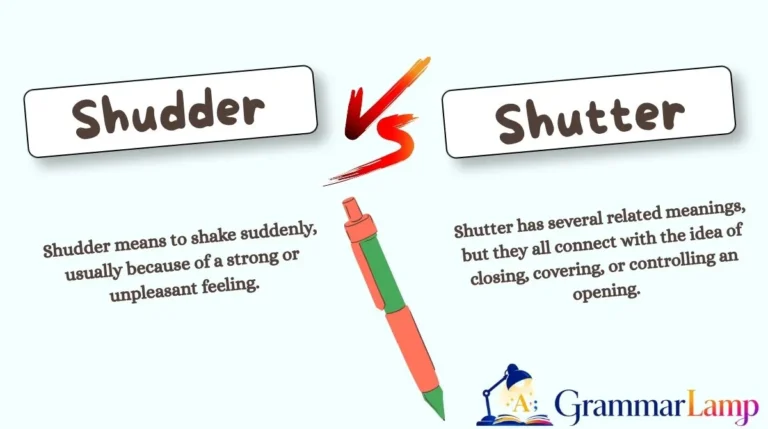
Shudder means to shake suddenly, usually because of a strong or unpleasant feeling. A person may shudder when they feel fear, disgust, horror, or even when they remember something disturbing. A thing, such as a car or a building, can also shudder when it shakes suddenly or violently.
Cambridge Dictionary defines shudder as a sudden shaking movement, especially one caused by an unpleasant thought or feeling. It can be used as both a verb and a noun.
Shudder as a verb
As a verb, shudder describes the action of shaking.
For example:
- I shuddered when I heard the terrible story.
- She shuddered at the thought of falling.
- He shuddered with fear when he saw the snake.
- I still shudder when I remember that accident.
- The old bus shuddered as it climbed the hill.
- The building shuddered after the explosion.
- She shuddered when she touched the cold water.
- The car shuddered to a halt near the gate.
A very common grammar pattern is shudder at + noun or -ing form.
For example:
She shuddered at the idea of sleeping alone.
You can also use shudder with + emotion:
He shuddered with horror.
Another useful pattern is shudder to a halt, which describes something shaking before it stops:
The truck shuddered to a halt.
Shudder as a noun
Shudder can also be a noun. In this form, it means a sudden shaking movement.
For example:
- A shudder went through the crowd.
- She gave a shudder when she heard the noise.
- A cold shudder ran through him.
- I felt a shudder when the door suddenly opened.
- The machine stopped with a shudder.
- The story sent a shudder down my spine.
The expression send a shudder down your spine is common in English. It means something creates a strong feeling of fear or discomfort. Cambridge also lists this expression as an established use of shudder.
A simple way to understand “shudder”
Think about this scene:
You walk into a dark room. Suddenly, you hear a strange sound behind you. Your body reacts. You quickly shake because you are frightened.
That reaction is a shudder.
The word is strongly connected with the idea of shaking.
Common learner confusion with “shudder”
Learners sometimes think shudder means simply “close” because of its similarity to shutter. It does not.
You can say:
I shuddered when I saw the accident.
You cannot use shudder to mean that you closed a window or a shop.
Wrong:
I shuddered the window.
Correct:
I shuttered the window.
The key meaning is simple: shudder = shake suddenly.
What Does “Shutter” Mean?
Shutter has several related meanings, but they all connect with the idea of closing, covering, or controlling an opening.
It can be a noun or a verb. As a noun, a shutter can be a cover on a window or a part of a camera. As a verb, shutter can mean to close a window with shutters or to close down a business, factory, account, or other operation.
Shutter as a noun: window cover
A shutter is often a wooden or metal cover placed over a window. It can help block light, heat, weather, or unwanted entry.
For example:
- The old house has blue shutters.
- Please close the shutters before the storm.
- The shopkeeper lowered the metal shutters.
- Sunlight came through the gap between the shutters.
- We painted the window shutters white.
- The workers repaired the broken shutter.
- The bedroom has large wooden shutters.
- He opened the shutters early in the morning.
Cambridge describes window shutters as covers placed on the outside of windows. Storefronts can also have metal shutters that protect windows and entrances.
Shutter as a noun: camera part
In photography, the shutter is a camera part that opens for a short time to let light reach the film or image sensor. The word is very common when talking about camera settings.
For example:
- The camera has a fast shutter speed.
- Press the shutter button to take the photo.
- The camera shutter opened quickly.
- A slow shutter speed can create motion blur.
- He heard the camera shutter click.
- The photographer changed the shutter speed.
- She pressed the shutter at exactly the right moment.
- The camera uses an electronic shutter.
Cambridge Dictionary lists the camera meaning separately from the window-cover meaning.
Shutter as a verb
As a verb, shutter can mean to close something with a shutter:
They shuttered the windows before the storm.
It can also mean to close down a business, factory, activity, or organization:
The company shuttered its factory.
The store was forced to shutter after years of losses.
This use is especially common in news reports and business writing. Cambridge gives examples of companies shuttering factories and people closing accounts.
Because the verb is normally transitive, it is usually followed by an object:
They shuttered the factory.
Here, the factory is the object.
Common learner confusion with “shutter”
The biggest mistake is using shutter when you mean “shake.”
For example:
Wrong:
She shuttered with fear.
Correct:
She shuddered with fear.
The first sentence suggests closing something, while the second describes a person shaking because of fear.
So remember: shutter is about closing or covering; shudder is about shaking.
Difference Between Shudder and Shutter
The easiest way to separate these words is to remember their central ideas:
Shudder = shake
Shutter = close or cover
Although the spellings are very close, their meanings and grammar are different.
| Word | Main meaning | Common use | Part of speech | Example |
|---|---|---|---|---|
| Shudder | To shake suddenly | Fear, horror, cold, sudden movement | Verb, noun | She shuddered with fear. |
| Shutter | To close or cover | Windows, cameras, businesses | Verb, noun | They shuttered the shop. |
Usage difference
Use shudder when someone or something shakes suddenly.
The child shuddered in fear.
The car shuddered as it stopped.
Use shutter when talking about a window cover, a camera mechanism, or closing something down.
Close the shutters.
Adjust the shutter speed.
The company shuttered the branch.
Grammar logic
The grammar pattern also gives you a useful clue.
Shudder is often an intransitive verb, meaning it can appear without a direct object.
She shuddered.
The ground shuddered.
You can add phrases such as with fear, at the thought, or when she heard the noise.
Shutter, when used as a verb, is usually transitive.
They shuttered the store.
We shuttered the windows.
The verb acts directly on something that is being closed.
Sentence structure difference
With shudder:
Subject + shudder + extra information
He shuddered with fear.
The machine shuddered suddenly.
With shutter:
Subject + shutter + object
They shuttered the factory.
She shuttered the windows.
This difference can help you choose the correct word even when you are unsure about the meaning.
Meaning comparison
Look at these pairs:
The car shuddered to a stop.
The driver shuttered the windows.
The first sentence describes movement. The second describes closing.
Another pair:
She shuddered at the thought of the accident.
The shop was shuttered after the fire.
Again, one word describes a physical or emotional reaction, while the other describes closing something.
Explore More Posts
Ardor vs Ardour: Meaning, Difference, Spelling & Examples (2026)
Complaint vs Complain: Meaning, Difference, Grammar Rules & Examples (2026)
Fillet vs Filet: What’s the Difference? Meaning, Spelling, and Examples in 2026
Differential vs Deferential: Meaning, Difference, Examples, and Grammar Rules (2026)
Grammar Rules You Must Remember
Rule 1: Use “shudder” for sudden shaking
Use shudder when a person, animal, machine, vehicle, building, or other thing shakes suddenly.
The train shuddered as it entered the tunnel.
The shaking can be caused by fear, cold, disgust, a powerful memory, or physical movement.
Rule 2: “Shudder at” is common for unpleasant thoughts or experiences
When a person reacts strongly to an unpleasant idea, use shudder at.
I shudder at the thought of losing my home.
You can also use a verb ending in -ing:
She shuddered at the thought of walking there alone.
This pattern is common in everyday and formal English.
Rule 3: Use “shutter” for windows and cameras
A shutter can be a physical cover on a window or a camera part.
Please close the shutters.
The photographer changed the shutter speed.
The context usually makes the meaning obvious.
Rule 4: “Shutter” as a verb can mean “close down”
English also uses shutter to mean closing a business, factory, account, website, or activity.
The company shuttered two stores last year.
This does not mean the business literally had window shutters. It means the business stopped operating or closed that location. Cambridge recognizes this extended verb meaning.
Common Mistakes Students Make
These words cause mistakes mainly because their spelling and pronunciation are so close. Learners may know both words but still choose the wrong one when writing quickly.
Mistake 1: Using “shutter” for fear
Wrong:
I shutter when I remember that night.
Correct:
I shudder when I remember that night.
You need shudder because the person is shaking from an emotional reaction.
Mistake 2: Using “shudder” for a window
Wrong:
Please shudder the windows.
Correct:
Please shutter the windows.
Here, shutter is used as a verb because the windows are being closed or covered.
Mistake 3: Confusing camera vocabulary
Wrong:
The photographer increased the shudder speed.
Correct:
The photographer increased the shutter speed.
The standard photography term is shutter speed, not shudder speed.
Mistake 4: Confusing “shuttered” with “shuddered”
Look at these examples carefully:
The old building shuddered during the earthquake.
The building shook.
The old building was shuttered for safety.
The building or business was closed.
The spelling is only one letter apart, but the meaning changes completely.
Easy correction tip
When you see the word, ask yourself one question:
“Is something shaking, or is something closing?”
If it is shaking, choose shudder.
If it is closing or being covered, choose shutter.
That one question can prevent most mistakes.
Easy Trick to Remember the Difference
Here is a simple memory trick:
ShUDder = sUDden shaking
The middle UD in shudder can remind you of sudden movement.
Think:
Shudder = shake
You can imagine your body shaking after seeing something frightening.
ShUTTer = something shuts
The middle of shutter looks and sounds close to shut.
Think:
Shutter = shut
A shutter helps shut a window, and as a verb, shutter can mean to close something down.
So:
SHUDDER → SHAKE
SHUTTER → SHUT
This is not a grammar rule. It is simply a memory trick. But it works well because the meanings are easy to connect with everyday actions.
Imagine two pictures in your mind.
Picture one: a frightened person is shaking. That is shudder.
Picture two: someone is closing a shop window with a metal cover. That is shutter.
Once those two pictures become familiar, the words are much easier to remember.
Daily Life Examples
These examples show how native speakers might use the two words in normal situations.
Example 1: Talking about fear
Ali: Did you see that horror movie?
Sara: Yes. I still shudder when I think about the ending.
Here, Sara is reacting emotionally, so shudder is correct.
Example 2: Closing windows
Dad: The storm is getting stronger.
Son: Should I shutter the windows?
Dad: Yes, please close them now.
Here, shutter means cover or close the windows.
Example 3: A bad memory
She shuddered at the memory of the accident.
The word describes her emotional reaction.
Example 4: A camera
Hold the camera steady before you press the shutter button.
Here, shutter is photography vocabulary.
Example 5: A business closes
The restaurant finally shuttered after many difficult months.
Here, shuttered means the restaurant closed its operation.
Example 6: A vehicle shakes
The old bus shuddered every time the driver pressed the brakes.
The bus shakes suddenly, so shuddered is correct.
Example 7: Strong cold
He shuddered when the cold wind hit his face.
Again, the word describes shaking.
Example 8: A store at night
The owner pulled down the metal shutters before going home.
These are physical covers over the store.
Example 9: A frightening story
Just hearing that story makes me shudder.
The speaker has a strong unpleasant reaction.
Example 10: Photography
The photographer chose a slow shutter speed to capture the moving lights.
The subject is camera settings, so shutter is the correct word.
Practice Section
Choose the correct word: shudder or shutter.
1. She ______ when she saw the huge spider.
2. Please close the window ______ before you leave.
3. The photographer changed the ______ speed.
4. The old truck ______ as it came to a stop.
5. The company decided to ______ the factory.
Answers
1. shudder
She shuddered when she saw the huge spider.
2. shutters
Please close the window shutters before you leave.
3. shutter
The photographer changed the shutter speed.
4. shuddered
The old truck shuddered as it came to a stop.
5. shutter
The company decided to shutter the factory.
A useful way to check your answers is to replace the word with a simple idea.
If you can say “shake,” use shudder.
If you can say “shut or close,” use shutter.
More Helpful posts
Feel vs Felt: Complete Grammar Guide With Examples (2026)
Role Call or Roll Call? The Correct Spelling and Meaning in 2026
Into or Onto: Complete Difference, Rules, and Examples for 2026
Sole vs Soul: What’s the Difference? Easy Guide With Examples 2026
FAQs
What is the difference between shudder and shutter?
Shudder means to shake suddenly, often because of fear, disgust, cold, or another strong feeling. Shutter usually refers to a window cover or a camera part, and as a verb it can mean to close something. Their meanings are very different even though their spellings are similar.
Can “shudder” be used in questions?
Yes. Shudder can appear naturally in questions when you are asking about fear, reactions, or sudden movement.
For example:
“Does that thought make you shudder?”
“Did the car shudder when you stopped?”
Is “shutter” formal or informal?
Shutter is a normal English word and can be used in both everyday and formal writing. The business meaning, such as “the company shuttered the factory,” is especially common in news and business contexts.
Is the correct phrase “shutter speed” or “shudder speed”?
The correct photography term is shutter speed. It describes how quickly the camera shutter opens and closes, or more precisely, the amount of time the shutter allows light to reach the image sensor or film.
Can a person shutter?
A person can shutter something as a verb, such as a window, store, factory, or business. However, a person normally shudders when their body shakes because of fear, disgust, cold, or another strong reaction.
For example:
“She shuddered with fear.”
“She shuttered the windows.”
Why are shudder and shutter easy to confuse?
They look almost identical and sound very similar, especially for English learners. The easiest solution is to connect each word with a basic idea: shudder = shake and shutter = shut or close.
Conclusion
Shudder and shutter are two different English words that happen to look and sound very similar.
That small spelling difference can cause big mistakes, but the meanings are actually easy to separate.
Use shudder when you are talking about sudden shaking. A person may shudder because of fear, horror, cold, disgust, or a strong memory. A vehicle, machine, or building can also shudder when it shakes suddenly.
Use shutter for a window cover, a camera part, or the action of closing something. You can close the shutters, adjust the shutter speed, or shutter a business.
The best memory trick is simple: shudder = shake and shutter = shut. Try to use both words in your own sentences today.
A few real examples will make the difference much easier to remember the next time you speak or write English.

Liam Derren is a language writer at GrammarLamp, creating simple, helpful content about grammar, words, and everyday English. He makes language learning clear, practical, and easy to understand.