
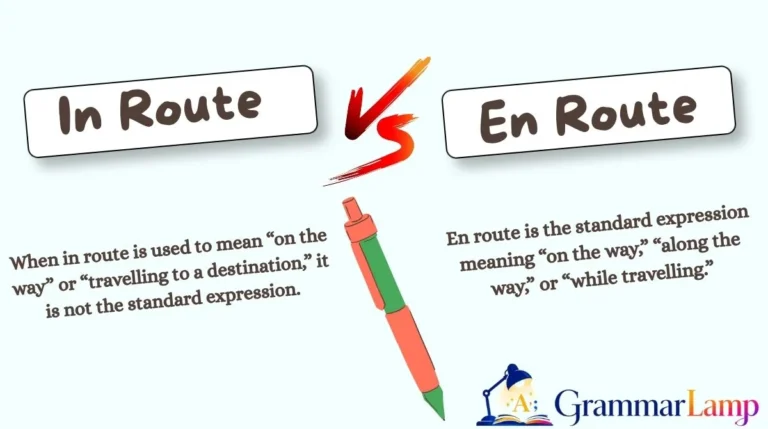
Have you ever typed “in route” because it sounded like “en route”? You are not alone. Many English learners hear this expression before they see it written, so they naturally spell it with the familiar word in.
The confusion is easy to understand because in route and en route look and sound very similar. However, they do not normally have the same job in a sentence.
The standard expression used to mean “on the way” is en route. Cambridge defines it as being on the way to or from somewhere, and Oxford gives the meaning “on the way” or “while travelling from/to a particular place.”
You will often see en route in travel updates, delivery messages, emails, news reports, emergency communication, and everyday speech. For example, you may hear, “The ambulance is en route to the hospital.”
At the same time, the words in and route can appear next to each other in a different grammatical structure. For example, “There was an error in route planning.” In that sentence, in and route are not a fixed phrase meaning “on the way.”
Understanding this small difference will make your writing clearer and help you avoid one of the most common word-choice mistakes around travel expressions.
More Useful posts
Work Alongside You vs Work Alongside With You (2026): Which One Is Correct in English?
Lets vs Let’s (2026): What’s the Difference? Easy Grammar Guide with Examples
Based Out of vs Based In (2026): What’s the Difference? Easy Grammar Guide with Examples
Crews vs Cruise (2026): What’s the Difference? Easy Grammar Guide with Examples
What Does “In Route” Mean?
Is “in route” a standard English expression?
When in route is used to mean “on the way” or “travelling to a destination,” it is not the standard expression. The established form is en route. Major English dictionaries define en route for this travel meaning.
However, this does not mean that the word sequence in route can never occur in English.
The important point is that in and route may sometimes be separate words inside a larger phrase. For example:
- “There was a mistake in route planning.”
- “The company made changes in route selection.”
- “We found an error in route mapping.”
- “The software has a problem in route calculation.”
- “The report showed delays in route approval.”
- “The engineers noticed a weakness in route design.”
- “The update created problems in route scheduling.”
- “The study found a gap in route coverage.”
These sentences are grammatical because in is functioning as a normal preposition. It introduces a larger noun phrase such as route planning, route selection, or route design.
So, when you see in route, do not automatically assume it is the same phrase as en route.
The basic grammar rule
Do not use in route when your intended meaning is:
- on the way
- travelling to a place
- travelling from a place
- during a journey
For those meanings, use en route.
Dictionary.com also explains that en route is the standard phrase meaning “on the way,” while the similar spelling can cause confusion because of pronunciation.
A useful example is:
Wrong for travel: “The driver is in route to Lahore.”
Correct: “The driver is en route to Lahore.”
The second sentence clearly tells us that the driver is travelling toward Lahore.
What Does “En Route” Mean?
En route is the standard expression meaning “on the way,” “along the way,” or “while travelling.” Oxford lists it as an adverb and gives common patterns such as en route, en route to, and en route from … to ….
Cambridge gives the same basic meaning and provides examples involving travel to and from different places.
When do we use “en route”?
Use en route when a person, vehicle, package, aircraft, or another thing is moving toward or from a destination.
For example:
- “I’m en route to the office.”
- “The package is en route to your home.”
- “The ambulance is en route to the hospital.”
- “We stopped for coffee en route to Islamabad.”
- “The plane had a problem en route from Dubai.”
- “She called me en route to work.”
- “The rescue team was already en route to the village.”
- “We took some photos en route to the lake.”
The expression does not have to describe driving. It can be used for a train, plane, ship, delivery, person, or any other journey.
Common sentence patterns
These are the most useful structures to learn:
en route + to + destination
“The driver is en route to the station.”
en route + from + starting point
“The train broke down en route from London.”
en route + from + place + to + place
“We stopped twice en route from Karachi to Lahore.”
en route by itself
“The parcel was damaged en route.”
You can also place en route at the beginning of a sentence:
“En route to school, I called my brother.”
Where did “en route” come from?
One reason learners find the spelling strange is that en route is a French expression borrowed into English. Oxford describes it as coming from French and traces it to the late eighteenth century. Collins also gives French as its origin.
That is why you should learn it as a complete expression rather than trying to build it from English prepositions.
Pronunciation also causes confusion. Cambridge lists different British and American pronunciations, and Dictionary.com gives pronunciations that may sound close to “ahn root” or “en root.”
So, spelling from sound can easily lead to in route, even though the standard travel phrase is en route.
Difference Between “In Route” and “En Route”
The easiest way to understand the difference is to look at the meaning and the grammar around the words.
If you mean “on the way,” choose en route.
If in simply connects another word to a noun phrase such as route planning, then in is acting independently and is not part of the fixed expression en route.
| Feature | In route | En route |
|---|---|---|
| Travel meaning | Not the standard form | Standard expression |
| Basic meaning | Depends on the larger sentence | On the way |
| Used for active travel | No, when intended as “on the way” | Yes |
| Common pattern | in route planning | en route to a place |
| Grammar | Separate in + route structure | Established expression |
| Origin | Normal English words | Borrowed from French |
| Best choice for “on the way” | No | Yes |
Usage difference
Compare these two sentences:
“We are en route to the airport.”
“We made a change in route planning.”
The first sentence is about a journey that is happening now.
The second sentence is about the process of planning a route. No one is being described as travelling.
That is the main difference.
Grammar logic
Think of en route as one established unit.
It behaves like a travel expression and tells us that someone or something is moving or is already on the way.
By contrast, in route planning contains the normal preposition in followed by the noun phrase route planning.
That is why these are not interchangeable:
“The driver is en route to the hotel.”
“There was an error in route planning.”
The first describes movement. The second describes a problem connected with planning.
Sentence structure difference
The most common patterns with en route are:
Subject + be + en route
“The driver is en route.”
Subject + be + en route to + destination
“The driver is en route to the station.”
Subject + be + en route from + place
“The driver is en route from the station.”
En route to + destination, + main sentence
“En route to work, I bought some bread.”
There is no matching travel structure such as:
“Subject + be + in route to + destination.”
For standard English, change that to:
“Subject + be + en route to + destination.”
Explore More Posts
Everything vs Every Thing: Easy Difference, Rules, Examples & Practice (2026)
All Is vs All Are: Which One Is Correct? Complete Grammar Guide for 2026
At the Weekend or On the Weekend? 2026 Guide to British and American English
To Discuss or Discuss About: Which Is Correct? | Easy Grammar Guide 2026
Grammar Rules You Must Remember
Rule 1: Use “en route” when you mean “on the way”
This is the most important rule.
If a person or thing is travelling, en route is the standard choice.
Correct: “The ambulance is en route to the hospital.”
Not standard for this meaning: “The ambulance is in route to the hospital.”
Cambridge and Oxford both define en route in terms of being on the way or travelling.
Rule 2: Use “en route to” for the destination
When you name the place someone is travelling toward, use:
en route to + place
Examples:
- “We are en route to the airport.”
- “She is en route to the meeting.”
- “The package is en route to my address.”
A simple formula can help:
EN ROUTE + TO + DESTINATION
Rule3: Use “en route from” for the starting point
When you want to mention where the journey began, use from.
“The bus was delayed en route from Lahore.”
You can also use both:
“The bus broke down en route from Lahore to Islamabad.”
Oxford specifically gives the en route from … to … pattern.
Rule 4: Check the full phrase before calling “in route” an error
Not every appearance of the two words beside each other is automatically a spelling mistake.
For example:
“There was a problem in route planning.”
This works because in is a preposition and route planning is a noun phrase.
But:
“We are in route to the airport.”
does not use the standard travel expression.
The intended meaning is “We are on the way to the airport,” so the natural form is:
“We are en route to the airport.”
Common Mistakes Students Make
Mistake 1: Writing the word you hear
A learner may hear en route and think the first word is in.
That is a very common reason for the mistake. Dictionary.com points out that pronunciation can make the phrase confusing.
Wrong: “The doctor is in route.”
Correct: “The doctor is en route.”
Easy tip: Learn the spelling together with the meaning.
Mistake 2: Using “in route to”
The combination in route to feels natural if you think about English prepositions one word at a time.
But the standard expression is:
en route to + destination
Wrong: “They are in route to the airport.”
Correct: “They are en route to the airport.”
Mistake 3: Writing “enroute”
Another common problem is joining the two words.
Wrong: “The package is enroute.”
Correct: “The package is en route.”
Major dictionaries list the expression as two words.
Mistake 4: Using “on route”
You may also come across on route in some writing. Collins identifies that spelling as non-standard for the fixed expression.
For standard English, en route is the safer and established choice when you mean “on the way.”
Mistake 5: Thinking “en route” only means driving
That is not true.
You can say:
- “The pilot is en route.”
- “The train is en route.”
- “The package is en route.”
- “The ambulance is en route.”
- “We are en route.”
It can also be used for progress toward an idea or goal. Collins notes this wider use for something that happens as part of a longer process.
Easy Trick to Remember the Difference
Here is the easiest memory trick:
EN ROUTE = ON THE WAY
Do not try to remember a complicated grammar explanation. Just connect the whole phrase to the meaning “on the way.”
Imagine your friend sends you a message:
“Where are you?”
You reply:
“I’m en route.”
Now imagine someone talking about maps:
“We found an error in route planning.”
That sentence is about route planning, not about someone travelling.
So your simple rule becomes:
Travel → en route
Planning/design/selection → check whether “in” is simply a normal preposition
Another useful test is to replace the phrase with on the way.
“We are ___ to the hotel.”
Replace the blank:
“We are on the way to the hotel.”
That sounds right, so the correct expression is:
“We are en route to the hotel.”
This quick test is especially useful during exams, writing, and proofreading.
Daily Life Examples
1. At the office
A: “Has the technician arrived?”
B: “Not yet. He’s en route to the office.”
2. Going to the airport
“We stopped for coffee en route to the airport.”
The stop happened during the journey.
3. Delivery message
“Your package is en route to the local delivery center.”
The package is currently travelling toward that location.
4. Calling a friend
A: “Where are you?”
B: “I’m en route. I’ll be there soon.”
Here, en route simply means “I’m on my way.”
5. Emergency situation
“The ambulance is en route to the hospital.”
The ambulance has started travelling toward the hospital.
6. A family trip
“We found a small café en route to Murree.”
The café was along the journey.
7. Sending a message
“Sorry, I can’t talk right now. I’m en route.”
The speaker is travelling.
8. Train journey
“The train had a technical problem en route from Lahore to Rawalpindi.”
The problem happened during the journey.
9. Route planning
“The team found an error in route planning.”
Here, in is a normal preposition. It does not mean “on the way.”
10. A project goal
“The company faced several problems en route to completing the new system.”
Here, the phrase is used more broadly for progress toward a goal. Collins records this kind of extended use.
Practice Section
Choose the correct option: in route or en route.
1. The driver is ___ to the hotel.
A) in route
B) en route
2. We stopped for lunch ___ to the airport.
A) in route
B) en route
3. The team found an error ___ planning.
A) in route
B) en route
4. The ambulance is ___ to the hospital.
A) in route
B) en route
5. We noticed a problem ___ selection.
A) in route
B) en route
Answers
- B — en route
- B — en route
- A — in route planning
- B — en route
- A — in route selection
The key is to look at the full sentence. Questions 1, 2, and 4 describe travel, so en route is correct.
Questions 3 and 5 contain larger noun phrases: route planning and route selection. In those examples, in is doing its normal grammatical job.
More Helpful posts
Upmost vs Utmost: Meaning, Difference, and Correct Usage in 2026
Seam vs Seem: Difference, Meaning, Examples & Grammar Rules (2026)
All the Time vs Every Time: Meaning, Difference, Rules & Examples (2026)
Afterward or Afterwards? Meaning, Difference, and Correct Usage in 2026
FAQs
What is the difference between “in route” and “en route”?
En route is the standard expression meaning “on the way,” “along the way,” or “while travelling.”
In route is not the normal alternative when you mean that someone or something is travelling.
However, the words in route can appear separately in phrases such as “in route planning.”
Can we use “en route” in questions?
Yes. En route works naturally in questions.
For example: “Are you en route to the station?” or “Is the package en route?”
The meaning stays the same: the person or thing is on the way.
Is “en route” formal or informal?
En route is standard English and can be used in both everyday and formal communication.
It may sound slightly more polished than on the way, but it is not limited to formal writing.
You can use it in a text, email, travel update, or report.
Is “in route” always wrong?
No. The two words can appear together when they have separate grammatical jobs.
For example, “There was an issue in route planning” is possible.
But when you mean “on the way,” the standard expression is en route.
Should I write “enroute” as one word?
No. The standard spelling is en route, with a space between the two words.
Cambridge and Oxford both list the expression in this form.
Learning the spelling as a complete phrase will help you avoid this common error.
What comes after “en route”?
The most common patterns are en route to + destination and en route from + starting point.
You can also use en route by itself when the destination is already understood.
Examples include “en route to work,” “en route from Paris,” and “We are en route.”
Conclusion
The difference between in route and en route becomes simple once you focus on meaning instead of sound.
When you mean “on the way,” “along the way,” or “while travelling,” use en route. It can be followed by to for a destination, from for a starting point, or both when you want to describe a journey from one place to another.
Oxford, Cambridge, and Collins all recognize en route as the established expression for this meaning.
The words in route are different. They may appear together in a larger structure such as in route planning or in route selection, where in is simply a normal preposition.
So keep one easy rule in mind:
EN ROUTE = ON THE WAY
Use that rule when you write messages, emails, assignments, or everyday English. With a little practice, choosing en route will become automatic.

Liam Derren is a language writer at GrammarLamp, creating simple, helpful content about grammar, words, and everyday English. He makes language learning clear, practical, and easy to understand.
1 thought on “In Route vs En Route: Correct Meaning, Usage & Examples in 2026”