
English spelling can be confusing because words do not always look the way they sound. Steer vs stear is a good example.
When you hear the word steer, especially in fast conversation, it may not be obvious whether the middle letters should be ee or ea. This can cause problems when writing emails, schoolwork, messages, or other everyday English.
The good news is that this particular confusion is easier than it first appears. In normal English, the correct word is steer when you mean “to control,” “to guide,” or “to direct.”
You can steer a car, steer a boat, steer someone toward a place, or even steer a conversation in a certain direction. Cambridge also lists steer as both a verb and a noun.
The spelling stear is generally not used as the everyday verb steer. However, stear- does appear in scientific vocabulary, especially in words connected with stearic acid, such as stearate. Collins identifies stear- as a combining form related to stearo-.
By the end of this guide, you will know when to use steer, why stear causes confusion, how the two forms differ, and how to remember the correct spelling without thinking twice.
More Useful posts
Sole vs Soul: What’s the Difference? Easy Guide With Examples 2026
Isle vs Aisle: Meaning, Difference, Examples & Easy Rules (2026)
Filed vs Filled: Meaning, Difference, Examples & Grammar Rules in 2026
You Is vs You Are: Which Is Correct in 2026? Simple Grammar Guide
What Does “Steer” Mean?
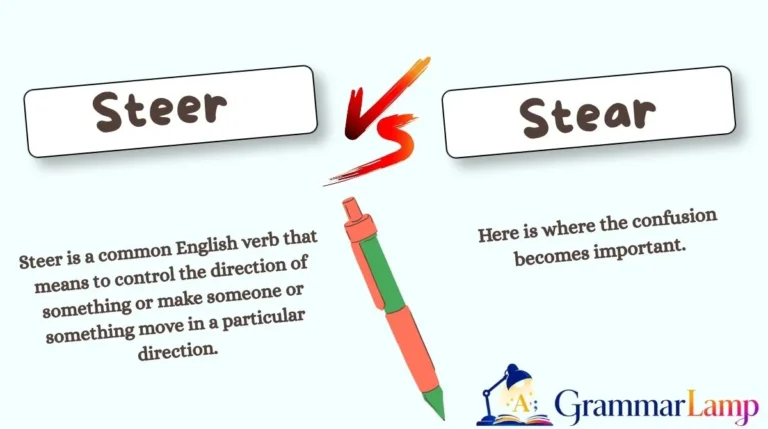
Steer is a common English verb that means to control the direction of something or make someone or something move in a particular direction.
The word is often used with vehicles. For example, when you turn the steering wheel of a car, you are steering the car. The same idea applies to boats and other vehicles.
Cambridge defines steer as controlling the direction of a vehicle. It also uses the word more broadly for guiding people, discussions, situations, or activities in a chosen direction.
Steer as a verb
As a verb, steer can describe physical movement.
For example:
- She learned to steer a car when she was eighteen.
- Please steer the boat toward the shore.
- He carefully steered the bicycle around the hole.
- The driver steered the bus away from the crowded street.
- I tried to steer the car through the narrow road.
- The captain steered the ship toward the harbor.
- She steered the child away from the busy road.
- He steered the conversation back to the main subject.
Notice that steer is not limited to driving. It can also mean guide or direct.
You can steer a person, a discussion, a project, or even a situation.
For instance, a manager might say, “We need to steer the project in a new direction.” Nobody is talking about a steering wheel here. The phrase simply means to guide the project toward a different goal.
Common grammar patterns with steer
The most common pattern is:
steer + object
Examples:
- Steer the car.
- Steer the boat.
- Steer the conversation.
- Steer the team.
You can also use steer + object + toward/to + place or goal.
Examples:
- She steered the car toward the main road.
- He steered the discussion toward the real problem.
- The guide steered us to the correct entrance.
Another common structure is:
steer away from
This means to guide something or someone away from a particular place, subject, or problem.
Example:
- We should steer away from unnecessary arguments.
The phrase steer clear of is also very common. It means avoid something or someone.
Example:
- You should steer clear of that dangerous area.
Cambridge lists steer clear of someone/something as an idiomatic use of the word.
Steer as a noun
Steer can also be a noun, but this meaning is very different.
A steer is a young male cattle animal that has been castrated and is usually raised for meat.
For example:
- The farmer raised a steer on the ranch.
- The steer was kept in a separate field.
- They saw a large steer near the barn.
So, depending on the sentence, steer can be a verb meaning “guide” or a noun referring to a type of cattle.
This second meaning is less common for many English learners, which is why it can be surprising.
What Does “Stear” Mean?
Here is where the confusion becomes important.
In ordinary modern English, stear is not the normal spelling of the verb meaning “to guide or control.” So if you want to write about driving, directing, guiding, or controlling something, stear is not the form you should choose.
However, stear- does appear in scientific vocabulary. Collins lists stear- as a combining form, which means it is a word element used to help form larger technical words rather than a normal everyday word used by itself. One example given is stearate.
This is an important difference.
You may see:
- stearic acid
- stearate
- stearic
- other scientific terms beginning with stear-
But that does not mean you can write stear whenever you mean steer.
Scientific words beginning with stear-
The part stear- is connected with scientific terms related to stearic acid and fats.
For example:
- Stearic acid is a type of fatty acid. Cambridge describes it as a wax-like substance used in products such as candles and some medicines.
- Stearate is a chemical term for a salt or ester of stearic acid.
- Stearic is an adjective related to stearic acid or fat. Dictionary.com traces the word to stear- plus the suffix -ic.
These are real words, but they belong to technical or scientific vocabulary.
You might see sentences such as:
- The product contains stearic acid.
- The scientist studied a particular stearate.
- The label lists stearic compounds.
- Stearic acid is used in some manufacturing processes.
- The chemistry lesson explained the structure of stearates.
- The laboratory report included information about stearic acid.
The important lesson is that stear- can be part of scientific words, but stear is not the ordinary spelling of steer.
Why this causes confusion
The problem comes mainly from spelling and pronunciation.
A learner may hear steer and think the word could be written stear. English has many words with different vowel spellings that can sound similar, so this is an understandable mistake.
But spelling has to be learned from the actual word. In everyday English, remember:
steer = guide or control
Not:
stear = guide or control
Difference Between Steer and Stear: Detailed Explanation
The biggest difference is simple: steer is the standard everyday English word, while stear- is mainly a scientific combining form.
| Feature | Steer | Stear |
|---|---|---|
| Standard everyday English word | Yes | No |
| Common verb | Yes | No |
| Meaning “guide/control” | Yes | No |
| Used for vehicles | Yes | No |
| Used for conversations/situations | Yes | No |
| Can be a noun | Yes | Not in this everyday sense |
| Appears in scientific vocabulary | Sometimes | Yes, mainly as stear- |
| Example | Steer the car | ❌ Stear the car |
Usage difference
If you are talking about driving, navigation, guidance, or direction, use steer.
Correct:
- Please steer the car carefully.
- She steered the boat toward the island.
- Try to steer the conversation back to work.
Incorrect:
- Please stear the car carefully.
- She steared the boat toward the island.
- Try to stear the conversation back to work.
The spelling does not change just because the meaning becomes figurative. You still write steer when you mean to guide an idea, discussion, or situation.
Grammar logic
Steer is a normal verb, so it can appear in different verb forms:
- steer
- steers
- steered
- steering
Examples:
- I steer the car.
- She steers the boat.
- He steered us toward the exit.
- They are steering the project in a new direction.
This is one more reason to learn the base spelling correctly. Once you know steer, the other forms are easy to build.
Sentence structure
A common structure is:
Subject + steer + object
Example:
- She steered the car.
Another useful structure is:
Subject + steer + object + toward/to + destination
Example:
- He steered the boat toward the shore.
You can also say:
steer + away from
Example:
- They tried to steer away from the problem.
For stear, there is no normal everyday sentence structure because it is not being used as the ordinary verb steer.
Meaning comparison
The meaning of steer is connected with direction.
Think about:
- direction
- movement
- guidance
- control
- avoiding something
- leading something toward a goal
For example:
She steered the car around the obstacle.
The car changes direction because the driver controls it.
In a figurative sentence:
The teacher steered the discussion toward the main question.
The teacher is not physically turning the discussion. Instead, the teacher is guiding its direction.
The spelling stear does not carry this everyday meaning.
Explore More Posts
Glueing vs Gluing: Which Spelling Is Correct in 2026?
Phenomenon vs Phenomena: What Is the Difference? (2026)
Nobody vs No One: What’s the Difference? A Simple 2026 Grammar Guide
Tinder vs Tender: Meaning, Difference, Examples, and Grammar Rules in 2026
Grammar Rules You Must Remember
Rule 1: Use “steer” for controlling a vehicle
When you mean controlling the direction of a car, bicycle, boat, or another vehicle, use steer.
Example:
He carefully steered the car around the corner.
This is the most common use for beginner learners.
A simple way to connect the word with driving is steering wheel. The words are related in spelling and meaning.
Rule 2: Use “steer” for guiding people or situations
Steer can describe guidance even when there is no vehicle involved.
Example:
She steered the conversation away from personal questions.
Here, steered means guided.
You can also use it for plans, projects, organizations, and discussions.
Example:
The manager helped steer the team toward its goal.
Rule 3: Use “steer clear of” to mean avoid
One of the most useful expressions is:
steer clear of + noun
It means stay away from or avoid someone or something.
Examples:
You should steer clear of that broken bridge.
I usually steer clear of online arguments.
She told me to steer clear of that neighborhood at night.
Do not write stear clear of. The correct expression always uses steer. Cambridge lists steer clear of as a standard idiom.
Rule 4: “Stear” should not replace “steer”
If your sentence means “guide,” “direct,” “control,” or “avoid,” use steer.
For example:
❌ Can you stear the car?
✅ Can you steer the car?
And:
❌ We should stear the conversation away from politics.
✅ We should steer the conversation away from politics.
The scientific form stear- is a different matter. It appears in words such as stearic and stearate, not as the normal spelling of the verb steer.
Common Mistakes Students Make
Many students make this mistake because they spell the word according to how they hear it.
For example, someone may think:
“I hear a long vowel sound, so perhaps the spelling is stear.”
That reasoning is understandable, but English spelling does not work that simply.
Another problem is that learners already know many words containing ea, so the spelling stear may look natural. A word can look familiar and still be incorrect.
Mistake 1: Using stear for driving
❌ She learned how to stear a car.
✅ She learned how to steer a car.
The word for controlling the direction is steer. Cambridge uses steer specifically for controlling a vehicle.
Mistake 2: Writing stear clear
❌ Stear clear of that road.
✅ Steer clear of that road.
The expression contains steer, not stear.
Mistake 3: Using stear for discussions
❌ The manager tried to stear the meeting toward the main issue.
✅ The manager tried to steer the meeting toward the main issue.
This is a figurative use of steer. It means to guide the direction of the meeting.
Mistake 4: Assuming stear is simply another spelling
In standard everyday English, steer and stear are not two interchangeable spellings of the same verb.
There are some legitimate scientific words that begin with stear-, but that does not make stear a normal alternative for steer. Collins specifically identifies stear- as a combining form.
Easy correction tips
When you are unsure, ask yourself:
Am I talking about direction or guidance?
If the answer is yes, choose steer.
You can then check whether the sentence works with one of these ideas:
- steer a car
- steer a boat
- steer someone toward a place
- steer a conversation
- steer a project
- steer clear of something
These all use steer.
Easy Trick to Remember the Difference
Here is an easy memory trick:
Think about the steering wheel
A car has a steering wheel.
The base word inside steering is steer.
So remember:
Steer → steering wheel → control direction
That gives you a strong connection between the spelling and the meaning.
Imagine sitting in a car. You hold the steering wheel and steer the car.
Now imagine someone writes:
“Can you stear the car?”
The sentence should immediately look wrong because you know the related word steering.
Another memory trick is:
EE in steer = the word you need for direction
You do not need to memorize a complicated spelling rule. Just connect steer with steering.
Real-life logic
Think about a road.
You are driving straight ahead, then the road turns left. You move the steering wheel and steer the vehicle left.
The same idea works in conversation.
Your friend is talking about one topic, and you carefully guide the conversation toward another topic. You steer the conversation.
The physical and figurative meanings are connected by the same basic idea: guiding direction.
This makes the word easier to remember.
Daily Life Examples
Here are simple examples showing how steer works in normal conversation.
1. Talking about a car
A: Can you drive?
B: Yes, but I am still learning to steer properly.
Here, steer means control the direction of the car.
2. Talking about a boat
A: Who is steering the boat?
B: Ahmed is steering it.
The word works naturally with boats as well as cars. Cambridge gives vehicle and ship examples for this meaning.
3. Giving driving advice
A: The road is very narrow.
B: I know. I will steer carefully.
The person means they will control the direction carefully.
4. Talking about a conversation
A: Why did you change the subject?
B: I tried to steer the conversation away from that argument.
This is a figurative use of the verb.
5. Talking about a meeting
A: The meeting was becoming confusing.
B: Yes, so Sara steered the discussion back to the main problem.
Here, steered means guided.
6. Giving a warning
A: Should I take that road?
B: I would steer clear of it. There is a lot of traffic.
The phrase means avoid it.
7. Guiding someone
A: Where is the exit?
B: I will steer you toward it.
The idea is to guide the person in the right direction.
8. Talking about a project
A: The project has changed a lot.
B: Yes. The new manager is trying to steer it in a different direction.
This is a figurative use that means guide or influence the project.
9. Talking about a difficult situation
A: How did the company survive that problem?
B: The director managed to steer the business through a difficult period.
Here, steer means guide something safely through a challenging situation.
10. Talking about animals
A: What is that animal in the field?
B: It is a steer.
In this sentence, steer is a noun, not a verb. It refers to a young male cattle animal of the type described by Cambridge.
Practice Section
Choose the correct option in each sentence.
1. Please ___ the car slowly around the corner.
A. stear
B. steer
2. We should ___ clear of that dangerous road.
A. steer
B. stear
3. The captain had to ___ the ship toward the harbor.
A. stear
B. steer
4. The teacher tried to ___ the conversation back to the lesson.
A. steer
B. stear
5. The farmer raised a large ___ for meat.
A. stear
B. steer
Answers
- B — steer
- A — steer
- B — steer
- A — steer
- B — steer
Notice something important: every ordinary English sentence above uses steer.
The only reason you may see stear- in English is in technical vocabulary such as stearic and stearate. Those words have a different history and meaning.
More Helpful posts
Prophecy vs Prophesy: Meaning, Difference, Examples, and Grammar Rules in 2026
Ax vs Axe: Which Spelling Is Correct in 2026?
Married To vs Married With 2026: Which One Is Correct?
Seel vs Seal: Meaning, Difference, and Correct Usage in 2026
FAQs
What is the difference between steer and stear?
Steer is the standard English word meaning to guide, direct, or control the direction of something. It can also be a noun for a young castrated male cattle animal. Stear-, by contrast, is mainly a scientific combining form seen in words such as stearic and stearate.
Is “stear” the correct spelling of “steer”?
No, not when you mean “guide” or “control.” For example, write “Steer the car carefully,” not “Stear the car carefully.” In normal everyday English, steer is the spelling you need.
Can we use “steer” in questions?
Yes. Steer can be used naturally in questions.
Examples include:
“Can you steer the car?”
“Who is steering the boat?”
“Can you help me steer the conversation?”
The verb works normally in questions just like other English verbs.
Is “steer” formal or informal?
Steer is a normal English word and can be used in both everyday conversation and formal writing. It is common when discussing vehicles, directions, discussions, plans, projects, and situations.
Is “stear” ever a real word?
You may encounter stear- in scientific terminology. Collins lists it as a combining form related to stearo-, and words such as stearate use this element.
However, that does not make stear a normal alternative spelling of steer.
Why do people confuse steer and stear?
The main reason is spelling. The two forms are visually very similar, and their pronunciation can lead learners to guess the wrong vowel letters. English contains many different spelling patterns for similar sounds, so memorizing the correct written form is important.
Conclusion
The steer vs stear confusion becomes much easier once you separate everyday English from scientific vocabulary.
Use steer when you mean to control or guide the direction of a car, boat, person, conversation, project, or situation. You can also use steer as a noun when talking about a young male cattle animal. Cambridge confirms these common meanings and uses.
The spelling stear should not be used as a replacement for steer. You may see stear- at the beginning of scientific words such as stearic and stearate, but that is a different use of the word element.
For everyday writing, keep one simple idea in mind:
You steer a car, and the car has a steering wheel.
That connection makes the spelling easy to remember. With a little practice, you will naturally choose steer whenever you are talking about direction, guidance, or control.

Liam Derren is a language writer at GrammarLamp, creating simple, helpful content about grammar, words, and everyday English. He makes language learning clear, practical, and easy to understand.