
English has many small phrases that look almost the same but do not always work in the same way. “In the agenda” and “on the agenda” are a good example.
Both phrases use the word agenda, so learners often wonder which preposition is correct.
If you say, “The topic is in the agenda,” people may understand you, but in standard English, “The topic is on the agenda” is usually the natural choice.
This is because English speakers normally use on the agenda when talking about a topic, question, or item that is planned for discussion at a meeting.
The confusion becomes easier to understand when you think about how an agenda works.
An agenda is a list of things that people plan to discuss or deal with during a meeting. When something appears as one of those planned items, we normally say it is on the agenda.
You may also hear in the agenda in some situations, especially when someone is talking about information contained inside an agenda document.
So, the two expressions are not always impossible to use. Their meanings and natural usage are different.
By the end of this guide, you will know when to use in the agenda, when to use on the agenda, why on the agenda is much more common, and how to avoid common mistakes in everyday and professional English.
What Does “In the Agenda” Mean?
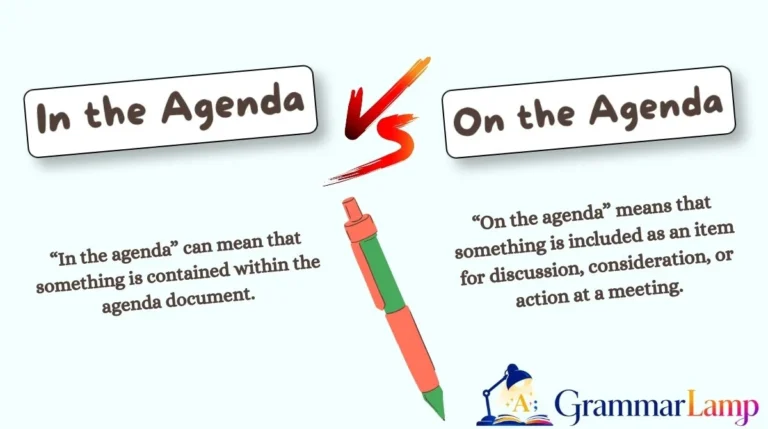
“In the agenda” can mean that something is contained within the agenda document. However, this expression is much less common than “on the agenda” when we are talking about meeting topics.
The word in normally suggests that something is inside something else. For example:
- The information is in the report.
- Her name is in the document.
- There is an important note in the email.
Following this idea, in the agenda can be used when you are focusing on the written contents of an agenda.
For example:
There is a mistake in the agenda.
Here, the speaker is talking about the agenda as a document. Maybe the meeting time is written incorrectly, or a person’s name has been spelled incorrectly.
Another example:
I found the information in the agenda.
The focus here is on information that appears inside the agenda document.
When Should You Use “In the Agenda”?
Use in the agenda when you are specifically talking about something written or contained in the agenda document.
It can work when the agenda is being treated like a document or piece of text.
For example:
- There is a spelling mistake in the agenda.
- I found the meeting time in the agenda.
- The new policy is explained in the agenda.
- I noticed an error in the agenda.
- The details are clearly written in the agenda.
- Her name appears in the agenda.
- There is a useful note in the agenda.
- I read about the changes in the agenda.
In all of these examples, the speaker is focusing on information contained in the written agenda.
A Common Learner Confusion
Many learners think that because an agenda is a list, topics should be in the list and therefore in the agenda.
This seems logical, but English often uses fixed preposition patterns that learners simply need to learn.
When talking about a topic that will be discussed during a meeting, native speakers normally say:
The budget issue is on the agenda.
Not:
The budget issue is in the agenda.
So, remember that in the agenda is possible, but it is not normally the best choice when you mean that a topic is scheduled for discussion.
What Does “On the Agenda” Mean?
“On the agenda” means that something is included as an item for discussion, consideration, or action at a meeting.
This is the standard and much more natural expression when talking about meeting topics.
For example:
The new project is on the agenda.
This means the new project is one of the things people plan to discuss at the meeting.
The word on is commonly used with lists of planned items in English. We say that something is on a list, on the schedule, or on the program. In the same way, a planned meeting item is usually on the agenda.
When Should You Use “On the Agenda”?
Use on the agenda when a topic, issue, question, plan, or task is scheduled for discussion or consideration.
Examples:
- The budget is on the agenda.
- We have three important issues on the agenda.
- Your proposal is on the agenda.
- The manager put the problem on the agenda.
- Is the new project on the agenda?
- The team discussed everything on the agenda.
- Employee safety is on the agenda today.
- We need to add this topic to the agenda.
Notice the last example. We normally say add something to the agenda, not add something in the agenda.
“On the Agenda” in Questions
This phrase is also very common in questions.
For example:
Is the budget review on the agenda?
Is the new policy on the agenda for today’s meeting?
What is on the agenda?
Is there anything important on the agenda?
These are natural expressions in both everyday and professional English.
“On the Agenda” in Business English
You will often see on the agenda in offices, schools, companies, government meetings, and formal discussions.
For example:
The hiring plan is on the agenda for Monday’s meeting.
Several important issues are on the agenda.
We have a lot of items on the agenda today.
The phrase is useful because it clearly tells the listener that something is planned for discussion.
Difference Between “In the Agenda” and “On the Agenda”
The main difference is simple:
On the agenda usually means something is a planned topic or item for a meeting.
In the agenda usually focuses on information contained inside the written agenda document.
| Expression | Main Meaning | Common Usage | Example |
|---|---|---|---|
| on the agenda | A topic is planned for discussion | Very common | The budget is on the agenda. |
| in the agenda | Something is contained in the agenda document | Less common | There is an error in the agenda. |
1. Usage Difference
When you are talking about a subject that people will discuss, choose on the agenda.
The salary issue is on the agenda.
When you are talking about an error, word, date, name, or piece of information inside the document, in the agenda can be appropriate.
There is an error in the agenda.
This small difference is very important.
2. Grammar Logic
The prepositions in and on can have different meanings.
In often suggests being inside something:
in the box
in the book
in the report
in the document
On often suggests being placed on a surface or included on a list:
on the table
on the page
on the list
on the schedule
on the agenda
An agenda works like a list of planned meeting items. That is one reason on the agenda is the normal expression.
3. Sentence Structure
The common structure is:
Subject + be + on the agenda
Examples:
The proposal is on the agenda.
The issue was on the agenda.
The new plan will be on the agenda.
You can also use:
Subject + put/add + object + on/to the agenda
Examples:
She put the issue on the agenda.
We added the topic to the agenda.
The manager wants to put this matter on the agenda.
Notice that the verb can change the preposition.
We usually say:
put something on the agenda
but:
add something to the agenda
4. Meaning Comparison
Compare these two sentences:
There is a mistake in the agenda.
This means the written agenda contains a mistake.
Now compare:
The mistake is on the agenda.
This means the mistake itself is one of the topics planned for discussion.
That difference may look small, but it changes the meaning.
Grammar Rules You Must Remember
Rule 1: Use “On the Agenda” for Meeting Topics
When a topic is planned for discussion, use on the agenda.
Correct:
The budget problem is on the agenda.
Incorrect or unnatural for this meaning:
The budget problem is in the agenda.
The first sentence clearly means that the budget problem will be discussed during the meeting.
Rule 2: Use “In the Agenda” for Information Inside the Document
If you are talking about something written inside an agenda document, in can be used.
Example:
There is a wrong date in the agenda.
Here, you are not saying that the date is a meeting topic. You are saying that the document contains an incorrect date.
Another example:
I noticed a spelling mistake in the agenda.
The mistake exists inside the written document.
Rule 3: Say “Add It to the Agenda”
When you want something included as a meeting item, the natural phrase is add something to the agenda.
Correct:
Please add this issue to the agenda.
Not natural:
Please add this issue in the agenda.
You can also say:
Put this issue on the agenda.
Both expressions are common, but the prepositions are different because the verbs are different.
Rule 4: Use “On the Agenda” in Questions About Meetings
When asking whether a topic is planned for discussion, use on the agenda.
Examples:
Is the project on the agenda?
What is on the agenda today?
Is the budget review on the agenda?
Was this issue on the agenda?
This is the natural pattern for meeting-related questions.
Common Mistakes Students Make
Many English learners make mistakes with these expressions because they translate directly from their first language.
Another reason is that in feels logical because an agenda contains information. However, when the meaning is “a topic planned for discussion,” English normally uses on.
Mistake 1: Using “In” for a Meeting Topic
❌ The new project is in the agenda.
✅ The new project is on the agenda.
The project is a planned meeting item, so on is the natural choice.
Mistake 2: Saying “Add It In the Agenda”
❌ Please add my topic in the agenda.
✅ Please add my topic to the agenda.
After add, we normally use to when something is being included in a list or document.
Mistake 3: Confusing “On the Agenda” With “In the Meeting”
These expressions have different meanings.
The budget is on the agenda.
This means the budget is a planned topic.
The manager is in the meeting.
This means the manager is physically participating in the meeting.
You should not replace one expression with the other.
Mistake 4: Using “In” Because the Agenda Is a Document
Yes, an agenda is a document, but context matters.
You can say:
There is an error in the agenda.
But if you mean:
The team will discuss the error.
Then say:
The error is on the agenda.
Think about whether you mean inside the document or included as a meeting topic.
Easy Correction Tip
Ask yourself one question:
“Is this something people will discuss?”
If the answer is yes, use:
on the agenda
If you mean something physically or textually contained in the written document, in the agenda may work.
Easy Trick to Remember the Difference
Here is a very simple trick:
Think “LIST = ON”
An agenda is basically a list of things planned for a meeting.
We normally say:
on the list
So think:
Agenda = List → Topic = ON the agenda
For example:
The budget is on the list.
The budget is on the agenda.
This connection can help you remember the correct preposition.
Think “DOCUMENT = IN”
When you are looking inside the actual agenda document, in can make sense.
For example:
There is a spelling mistake in the document.
Similarly:
There is a spelling mistake in the agenda.
So the memory trick is:
Topic for discussion → ON the agenda
Information inside the document → IN the agenda
There is another useful pair to remember:
Add TO the agenda
but
Put ON the agenda
For example:
Please add this topic to the agenda.
Please put this topic on the agenda.
These are both natural, but the verb controls the preposition.
Daily Life Examples (Very Important)
These examples show how native and fluent English speakers commonly use these phrases in real situations.
Example 1: Office Meeting
Ali: What are we discussing today?
Sara: The new marketing plan is on the agenda.
Ali: Great. I have some ideas about it.
Here, the marketing plan is a planned meeting topic.
Example 2: Asking About a Topic
Manager: Do we have anything else to discuss?
Employee: Yes. The hiring problem is on the agenda.
The phrase clearly means that the hiring problem is scheduled for discussion.
Example 3: Adding a New Topic
Sara: I want to discuss the customer complaints.
Manager: Sure. I’ll add the topic to the agenda.
This is the natural way to say that the topic will be included in the meeting plan.
Example 4: Putting Something on the Agenda
Ali: Can we discuss the new office rules?
Manager: Yes. I’ll put them on the agenda for Friday.
The manager is adding the topic as a planned discussion item.
Example 5: Finding an Error
Sara: What time does the meeting start?
Ali: It says 10:00 a.m. in the agenda.
Sara: Really? I think that’s wrong.
Here, in the agenda focuses on the written information.
Example 6: Checking the Meeting Plan
Employee: What’s on the agenda today?
Manager: First, we’ll discuss the budget. Then we’ll talk about the new project.
This is a very common workplace question.
Example 7: School Meeting
Teacher: Is the school trip on the agenda for tomorrow’s meeting?
Principal: Yes. We need to discuss the transport arrangements.
The school trip is a planned discussion topic.
Example 8: Team Discussion
John: Are we going to talk about the website problem today?
Mike: Yes, it’s on the agenda.
This is natural spoken English.
Example 9: Checking the Document
Lisa: I can’t find the new policy.
Tom: It’s in the agenda. Look at the second page.
Here, the speaker is directing Lisa to information contained in the agenda document.
Example 10: Professional Meeting
Manager: We have five items on the agenda today.
Employee: Should we start with the budget?
Manager: Yes. That’s the first item.
Again, on the agenda means the items are planned for discussion.
Practice Section
Choose the correct option in each sentence.
1. The new project is ___ the agenda for Monday.
A. in
B. on
C. at
2. There is a spelling mistake ___ the agenda.
A. in
B. on
C. at
3. Please add this topic ___ the agenda.
A. in
B. on
C. to
4. Is the budget problem ___ the agenda?
A. on
B. in
C. at
5. The manager wants to put the issue ___ the agenda.
A. in
B. on
C. to
Answers
1. B — on
The new project is on the agenda for Monday.
The project is a planned discussion item.
2. A — in
There is a spelling mistake in the agenda.
The spelling mistake is contained in the document.
3. C — to
Please add this topic to the agenda.
We normally say add something to a list or document.
4. A — on
Is the budget problem on the agenda?
The question asks whether the problem is planned for discussion.
5. B — on
The manager wants to put the issue on the agenda.
The normal expression is put something on the agenda.
FAQs
What is the difference between “in the agenda” and “on the agenda”?
On the agenda normally means that a topic is planned for discussion at a meeting. In the agenda can mean that information is contained inside the written agenda document. For meeting topics, on the agenda is the natural choice.
Is “on the agenda” grammatically correct?
Yes. On the agenda is a standard and very common English expression. It is used when something is included as a planned topic, issue, or item for discussion at a meeting.
For example:
The budget is on the agenda.
Can I say “in the agenda”?
Yes, but the meaning is usually different. In the agenda can be used when you are talking about something written or contained in the agenda document.
For example:
There is an error in the agenda.
For a meeting topic, however, on the agenda is normally better.
Is “on the agenda” formal or informal?
On the agenda works in both formal and everyday English. It is especially common in business, school, government, and professional meetings, but native speakers also use it in casual conversations.
Should I say “add it to the agenda” or “add it on the agenda”?
The standard expression is add it to the agenda.
For example:
Please add this topic to the agenda.
However, with the verb put, we say:
Please put this topic on the agenda.
What does “What is on the agenda?” mean?
“What is on the agenda?” means “What topics or items are planned for discussion?” It is a very common question in meetings.
For example:
What is on the agenda for today’s meeting?
This asks about the planned meeting topics.
Conclusion
The difference between in the agenda and on the agenda becomes much easier when you focus on meaning.
Use on the agenda when you are talking about a topic, problem, question, or plan that is scheduled for discussion. This is by far the more common expression in meetings and professional English.
Use in the agenda when you are focusing on information contained inside the written agenda document, such as a mistake, date, name, or piece of information.
The easiest rule to remember is:
Meeting topic → on the agenda
Information inside the document → in the agenda
Also remember two useful patterns: add something to the agenda and put something on the agenda.
Once you start noticing these phrases in emails, meetings, and everyday conversations, the difference will feel natural.
Try making a few sentences of your own, and you will quickly become more confident using them.

Liam Derren is a language writer at GrammarLamp, creating simple, helpful content about grammar, words, and everyday English. He makes language learning clear, practical, and easy to understand.