
English learners often get confused by inside and inside of because both can describe something that is within a place, object, or area.
For example, you may hear someone say, “The keys are inside the bag,” while another person says, “The keys are inside of the bag.” Both sentences are understandable, and both can be heard in everyday English.
So, is one wrong? Not always.
The main difference is style, usage, and grammar structure. In most situations, inside is the shorter and more natural choice.
This small difference matters because English learners often want to know not only whether a sentence is grammatically possible, but also which version sounds natural to a native speaker.
By the end of this guide, you will understand when to use inside, when inside of is possible, why native speakers use both, and which form is safer in formal writing.
You will also see simple examples from everyday conversations, common mistakes, and a short practice exercise.
The good news is that the rule is easier than it first appears: when you mean “within,” inside is usually enough.
What Does “Inside” Mean?
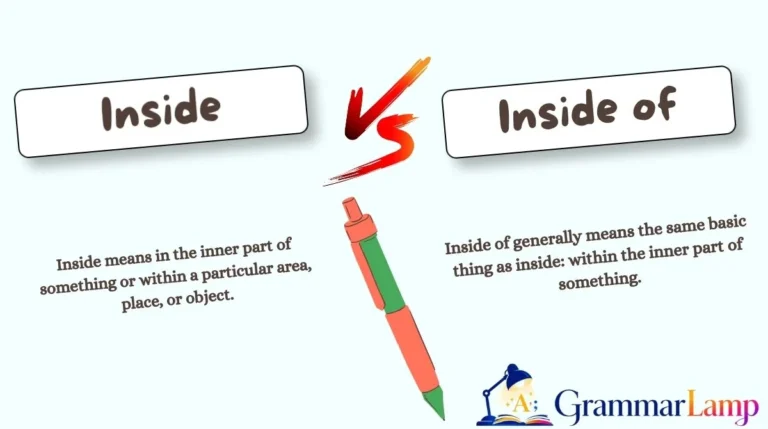
Inside means in the inner part of something or within a particular area, place, or object.
It can be used in several ways. Most commonly, it works as a preposition, adverb, noun, or adjective.
For beginners, the most important use is as a preposition:
inside + noun
For example:
- The phone is inside my bag.
- She is waiting inside the house.
- There is water inside the bottle.
Here, inside tells us where someone or something is.
When should you use “inside”?
Use inside when you want to show that someone or something is within the boundaries of a place or object.
It can describe physical locations:
The children are inside the classroom.
It can also describe something located within an object:
There is a letter inside the envelope.
You can even use it without a noun when the meaning is already clear:
It is cold outside, so come inside.
In that sentence, inside is an adverb. It means “into or in an indoor place.”
Grammar rule for “inside”
When inside is used as a preposition, the basic structure is:
inside + noun/pronoun
Examples:
- The cat is inside the box.
- I left my wallet inside my car.
- There is a surprise inside the package.
- Please wait inside the building.
- She found an old photo inside the book.
- The children are playing inside the house.
- Keep the medicine inside the cabinet.
- Someone is inside the room.
Notice something important: you do not need “of” after inside in these sentences.
Common learner confusion
Some students think that inside of must be used because English often uses combinations such as “in front of,” “because of,” and “instead of.”
But inside does not need of before a noun.
You can simply say:
The money is inside the drawer.
You do not need:
The money is inside of the drawer.
The second sentence is possible in some varieties of English, especially informal American speech, but the first sentence is shorter and more widely accepted as the standard choice.
What Does “Inside of” Mean?
Inside of generally means the same basic thing as inside: within the inner part of something.
For example:
The keys are inside of the drawer.
This means the same as:
The keys are inside the drawer.
The important point is that inside of is not automatically incorrect.
It is a real English expression. However, its use depends on context, dialect, and style.
In everyday American speech, you may hear inside of quite often:
- Come inside of the house.
- There is something inside of the box.
- I left it inside of my car.
In careful or formal writing, however, inside is often preferred because it is more concise.
When should you use “inside of”?
You can use inside of when speaking casually, especially if it sounds natural in your variety of English.
It is common in some American English speech patterns.
Examples:
- The children are inside of the house.
- I found your keys inside of the drawer.
- There is something inside of this box.
- She put the letter inside of the envelope.
- He left his shoes inside of the room.
- What’s inside of the bag?
- I saw something moving inside of the car.
- There was a small note inside of the book.
All of these sentences are understandable. In many cases, you could remove of without changing the meaning.
For example:
What’s inside of the bag?
becomes:
What’s inside the bag?
Both can be heard, but inside the bag is more direct.
Another important use of “inside of”
Inside of can sometimes mean within a period of time.
For example:
Please finish the work inside of two hours.
This means:
Please finish the work within two hours.
However, this use is less common and can sound informal or regional. In formal writing, within two hours is usually the better choice.
Difference Between Inside and Inside of
The easiest way to understand the difference is this:
Inside is the normal, shorter form.
Inside of can have the same meaning, but it is often more conversational, especially in American English.
| Point | Inside | Inside of |
|---|---|---|
| Basic meaning | Within something | Within something |
| Common in speech | Very common | Common in some varieties |
| Formal writing | Preferred | Usually less preferred |
| Length | Short and direct | Longer |
| Meaning before a noun | Usually the same | Usually the same |
| American English | Very common | Also common |
| British English | Very common | Less common in this use |
| Best choice for learners | Yes | Use when natural in context |
Usage difference
Compare these sentences:
The dog is inside the house.
The dog is inside of the house.
The meaning is almost exactly the same.
However, the first sentence is more concise. If you are writing an essay, school assignment, business email, or formal article, inside the house is generally the safer choice.
In casual conversation, you may hear either version.
Grammar logic
The word inside can already function as a preposition. A preposition can connect the location word to a noun:
inside + the room
There is no grammatical requirement to add of.
This is why:
The book is inside the bag.
is perfectly complete.
When speakers add of, they create the phrase inside of, which is also used in English. But the extra word does not usually add a different physical meaning.
Sentence structure difference
The basic structures are:
inside + noun
She is inside the store.
and:
inside of + noun
She is inside of the store.
Both communicate location.
The difference is mostly about usage and style, rather than a major difference in meaning.
Meaning comparison
Consider this example:
There is a gift inside the box.
The listener understands that the gift is within the box.
Now:
There is a gift inside of the box.
The listener gets the same message.
So, if you are unsure, choose inside. It is simple, natural, and widely understood.
Grammar Rules You Must Remember
Rule 1: Use “inside” directly before a noun
When you are describing the location of something, inside + noun is usually enough.
The keys are inside the drawer.
Not every sentence needs of.
More examples:
She is inside the kitchen.
My passport is inside my bag.
The children are inside the classroom.
This is the easiest pattern for English learners.
Rule 2: “Inside of” can be correct, especially in informal speech
Do not think that every sentence containing inside of is grammatically wrong.
For example:
What’s inside of this box?
This is a natural sentence for some speakers, particularly in American English.
However, you can also say:
What’s inside this box?
The shorter version is usually preferable when you want simple, standard English.
Rule 3: Prefer “inside” in formal writing
Formal English usually values clear and concise wording.
So, instead of:
The documents are located inside of the folder.
you can write:
The documents are located inside the folder.
This does not mean that inside of is always grammatically unacceptable in formal writing. It simply means that inside is normally the cleaner choice when both forms have exactly the same meaning.
Rule 4: “Inside” can stand alone
Sometimes inside does not need a noun after it.
For example:
It’s raining. Let’s go inside.
Here, inside is an adverb.
You can also ask:
Is anyone inside?
The location is understood from the situation.
You cannot normally replace this with inside of:
Let’s go inside of. ❌
That sounds incomplete because inside of normally expects something after of in this meaning.
You could say:
Let’s go inside the house.
or simply:
Let’s go inside.
Common Mistakes Students Make
Many mistakes with these expressions happen because learners try to create a fixed rule: “inside of is always wrong” or “inside always needs of.”
Neither idea is correct.
Mistake 1: Thinking “inside of” is always wrong
Wrong idea:
“Native speakers never say inside of.”
They do. It is used in real English, particularly in informal American English.
For example:
What’s inside of the box?
is something you may hear in normal conversation.
The better lesson is not “never use inside of.” It is:
Use inside as your default choice, especially in formal writing.
Mistake 2: Adding “of” automatically
Some learners write:
My phone is inside of my pocket.
This is understandable, but:
My phone is inside my pocket.
is simpler.
Correction tip: When you see inside of + noun, ask yourself whether removing of changes the meaning. Usually, it does not.
Mistake 3: Using “inside of” when “inside” stands alone
Consider:
Please come inside.
This is natural.
But:
Please come inside of. ❌
Here, inside is being used as an adverb. There is no noun after it, so inside of does not work in this structure.
Mistake 4: Confusing “inside of” with “within”
Students sometimes use inside of for every meaning of “within.”
For example:
I will finish it inside of three days.
This can be heard, but for standard formal English, the more natural sentence is:
I will finish it within three days.
So remember that inside of can sometimes express a time limit, but within is often the cleaner choice.
Mistake 5: Thinking the two phrases always have different meanings
Usually, they do not.
Compare:
There is a pen inside the box.
There is a pen inside of the box.
The location is the same.
The main difference is how the sentence sounds and what style the speaker prefers.
Easy Trick to Remember the Difference
Here is a simple classroom trick:
Inside = the short, safe choice.
If you are talking about something being within a place or object, try inside first.
Think:
inside + place
- inside the room
- inside the car
- inside the bag
- inside the house
- inside the box
You do not need to think about of.
What about “inside of”?
Think of it as an extra-word version that you may hear in casual speech.
For example:
inside the box
and
inside of the box
Imagine that of is an optional extra in many everyday uses. It usually does not change the physical meaning.
If you are writing an exam, essay, report, or professional email, the safest choice is:
inside
This trick will help you avoid most mistakes.
Daily Life Examples
These examples show how native and fluent speakers might use the expressions in everyday situations.
1. Looking for a phone
A: Where’s my phone?
B: I think it’s inside your bag.
This is the simple and standard form.
2. Talking about a car
Please leave the shoes inside the car.
You could hear inside of the car in casual speech, but inside the car is shorter.
3. Asking about a box
A: What’s inside this box?
B: Some old photographs.
This is a very natural everyday question.
4. Talking about a house
It’s raining heavily. Everyone is inside the house.
Again, there is no need for of.
5. A child at school
Parent: Where is your brother?
Child: He’s inside the classroom.
The word inside clearly gives the location.
6. Finding something in a drawer
I found your watch inside the drawer.
You might also hear:
I found your watch inside of the drawer.
The meaning is the same.
7. Asking someone to enter
It’s cold outside. Come inside.
Here, inside stands alone. It is an adverb.
8. Talking about a package
A: Is there anything fragile in the package?
B: Yes. There’s a glass bottle inside it.
The word inside works naturally with a pronoun here.
9. Casual American speech
I think there’s something inside of the bag.
This is possible in informal conversation. A speaker may naturally choose inside of.
In more concise writing, however:
I think there’s something inside the bag.
is usually better.
10. Talking about a time limit
We should be able to finish the job inside of two hours.
This means approximately within two hours.
For formal English, you would normally write:
We should be able to finish the job within two hours.
Practice Section
Choose inside or inside of for each sentence.
1.
The children are playing ______ the house.
2.
What’s ______ this envelope?
3.
Please come ______. It’s raining.
4.
I found my keys ______ of the drawer.
5.
There is a small gift ______ the package.
Answers
1. inside
The children are playing inside the house.
2. inside
What’s inside this envelope?
3. inside
Please come inside.
4. inside or inside of
I found my keys inside the drawer.
I found my keys inside of the drawer.
Both are possible, although the first is more concise.
5. inside
There is a small gift inside the package.
The key lesson is not that inside of is always wrong. The important point is that inside is normally the easiest and safest choice.
FAQs
What is the difference between “inside” and “inside of”?
In many sentences, there is little or no difference in meaning. Both can mean “within” something.
Inside is shorter and is generally the preferred choice in standard and formal English. Inside of is also used, especially in informal American English.
Can we use “inside” in questions?
Yes. Inside is very common in questions.
For example:
What’s inside the box?
Who is inside the room?
Is anyone inside?
These are all natural English questions. You do not need of simply because the sentence is a question.
Is “inside of” formal or informal?
Inside of is generally more common in informal speech, especially in American English, when it means “inside.”
It is not automatically incorrect. However, in formal writing, inside is often preferred because it is shorter and more direct.
Is “inside of the house” grammatically correct?
Yes, it can be grammatically correct.
The children are inside of the house.
However, the simpler version is:
The children are inside the house.
Both sentences communicate the same basic location.
Should I use “inside” or “inside of” in an English exam?
As a general rule, choose inside when both versions have the same meaning.
For example:
The keys are inside the bag.
This is clear, standard, and concise. Using inside also avoids questions about regional or conversational usage.
Can “inside of” mean “within a period of time”?
Yes, in some English varieties, inside of can mean within a period of time.
For example:
We need to finish inside of three hours.
However, within three hours is usually more natural in formal or careful English.
Conclusion
The difference between inside and inside of is much easier once you stop treating them as completely different expressions.
In most situations, inside is the best choice. It can work as a preposition before a noun, as an adverb by itself, and in many everyday expressions. For example, we naturally say inside the house, inside my bag, and come inside.
Inside of can also be correct. It is especially common in informal American speech, where speakers may use it before a noun without changing the basic meaning.
So, hearing “inside of the car” does not mean that the speaker is making a serious grammar mistake.
For learners, one simple rule is enough: use inside as your default choice. It is short, clear, natural, and suitable for both everyday English and formal writing.
The best way to remember the difference is to notice these expressions in real conversations and practice making your own sentences. After a little practice, choosing between them will feel natural.

Liam Derren is a language writer at GrammarLamp, creating simple, helpful content about grammar, words, and everyday English. He makes language learning clear, practical, and easy to understand.