
“Not a problem” vs “no problem” is a common source of confusion for English learners.
Both expressions are used in everyday English, and both can sometimes mean “It is okay” or “Don’t worry.” So, why do native speakers use two different expressions?
The answer is mostly about grammar, meaning, and context. The two phrases look very similar, but they are built differently. “Not a problem” uses the negative word not with the noun phrase a problem, while “no problem” uses no directly before the noun.
You may hear these expressions at work, at school, in shops, on the phone, or in friendly conversations.
For example, someone might say, “Sorry I’m late,” and you can reply, “No problem.” You can also say, “Being late is not a problem.”
Both sentences are correct, but they do not always feel exactly the same.
By the end of this guide, you will understand the meaning, grammar, sentence patterns, and everyday use of not a problem and no problem.
What Does “Not a Problem” Mean?
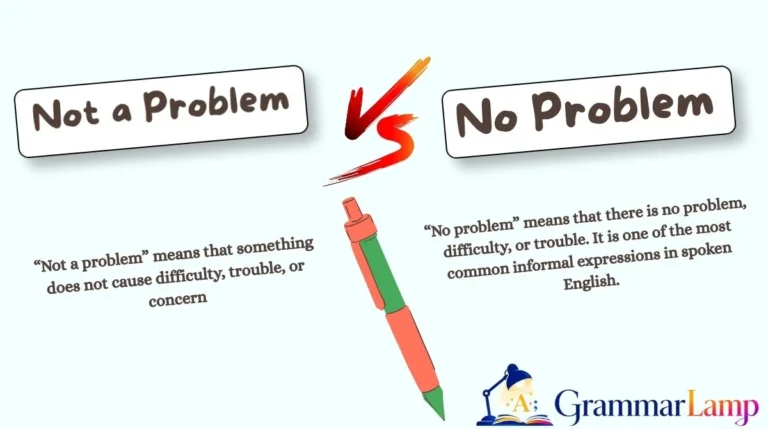
“Not a problem” means that something does not cause difficulty, trouble, or concern. In simple English, it often means “It is okay”, “It is not difficult”, or “There is nothing to worry about.”
The phrase contains three parts:
not + a + problem
Here, not is used to make the statement negative. The noun problem is singular and countable, so it normally needs the article a when used this way.
For example:
Missing one class is not a problem.
This means missing one class does not create a problem.
When should you use “not a problem”?
Use “not a problem” when you are saying that a particular thing does not create an issue.
It can describe a situation, action, delay, mistake, request, or concern.
For example:
- Being five minutes late is not a problem.
- Your small mistake is not a problem.
- It is not a problem if you leave early.
- Money is not a problem for this project.
- The noise is not a problem for me.
- Finding a taxi is not a problem here.
- It’s not a problem to change the meeting time.
- Your age is not a problem for this job.
Notice that “not a problem” can fit naturally inside a complete sentence.
The grammar rule
A useful structure is:
Subject + be + not + a problem
Examples:
- It is not a problem.
- This is not a problem.
- The delay is not a problem.
- Your question is not a problem.
You can also use it after other verbs:
Finding a parking space is not a problem.
I don’t think the delay will be a problem.
The phrase can therefore do more than simply answer someone.
“Not a problem” as a short reply
In conversation, speakers often leave out the rest of the sentence because the meaning is already clear.
Someone might say:
“Sorry, I forgot to call you.”
You can answer:
“Not a problem.”
The full idea is something like:
“That is not a problem.”
The shorter version sounds natural in everyday speech.
A common learner confusion
Some learners think “not a problem” is always interchangeable with “no problem.” Often it is, especially in casual replies, but not always.
Compare:
The broken chair is not a problem.
This means the broken chair does not cause an issue.
But:
No problem!
This is commonly used as a quick response meaning “That’s okay” or “You’re welcome.”
The meaning overlaps, but the grammar and conversational use are different.
What Does “No Problem” Mean?
“No problem” means that there is no problem, difficulty, or trouble. It is one of the most common informal expressions in spoken English.
The structure is:
no + noun
So:
no problem
means that there is zero problem or no problem at all.
Here, no works as a determiner before the noun. You do not normally put a after no.
Correct:
No problem.
Incorrect:
No a problem.
When should you use “no problem”?
You can use “no problem” in several everyday situations.
One very common use is when someone apologizes:
“Sorry I’m late.”
“No problem.”
It can also be used after someone thanks you:
“Thanks for helping me.”
“No problem.”
You can use it when you agree to a request:
“Can you send me the file tonight?”
“No problem.”
It can also describe the absence of difficulty:
“There was no problem with the computer.”
Example sentences
Here are some natural examples:
- No problem! I can help you.
- Thanks for waiting. — No problem.
- Sorry about the mistake. — No problem.
- There was no problem with the order.
- We had no problem finding the hotel.
- No problem, I’ll call you later.
- There’s no problem with changing the date.
- He had no problem understanding the instructions.
The grammar rule
When no comes directly before a singular countable noun, the noun does not take a/an.
For example:
- no problem
- no reason
- no idea
- no car
- no question
Not:
no a problemno a reasonno an idea
Compare these two structures:
It is not a problem.
There is no problem.
Both can communicate a similar idea, but they use different grammar.
“No problem” can be very conversational
In spoken English, “No problem!” is especially common. It can sound friendly and relaxed.
For example:
A: Could you help me with this box?
B: No problem!
Or:
A: Thanks for the information.
B: No problem.
In formal writing, however, you may prefer expressions such as “You’re welcome,” “Certainly,” “That is fine,” or “There is no difficulty.” The best choice depends on the situation.
Difference Between “Not a Problem” and “No Problem”
The easiest way to understand the difference is to remember that the two expressions use different grammar.
“Not a problem” is a negative statement about something.
“No problem” says that there is no problem.
They can have the same general meaning, but their sentence structures and common uses are not identical.
Comparison table
| Point | Not a problem | No problem |
|---|---|---|
| Basic meaning | It does not cause a problem | There is no problem |
| Grammar | not + a + noun | no + noun |
| Common use | Describing a situation | Quick conversational response |
| Tone | Neutral, sometimes reassuring | Friendly and informal |
| Example | The delay is not a problem. | No problem! |
| Can stand alone? | Yes | Yes |
| Common after “sorry”? | Yes | Very common |
| Common after “thanks”? | Possible, but less usual | Very common |
| Formality | Neutral to informal | Mostly informal |
1. Usage difference
Consider this conversation:
A: Sorry, I’m ten minutes late.
B: No problem.
This is very natural.
You could also say:
A: Sorry, I’m ten minutes late.
B: Not a problem.
This is also correct. However, “No problem” is probably the more natural quick reply in many casual conversations.
Now look at a different example:
The delay is not a problem because we have plenty of time.
Here, “not a problem” fits especially well because the speaker is explaining a situation.
You could say:
The delay is no problem because we have plenty of time.
This is grammatically possible, but it sounds less natural to many speakers. “The delay is not a problem” is the safer choice.
2. Grammar logic
Think about these two sentences:
It is not a problem.
and
There is no problem.
The first sentence uses not to make the statement negative.
The second uses no before the noun.
This is similar to other pairs:
It is not a reason.
There is no reason.
Or:
It is not an issue.
There is no issue.
The grammar changes because not and no do different jobs.
3. Sentence structure
A common structure with not a problem is:
Subject + be + not + a problem
The delay is not a problem.
A common structure with no problem is:
There + be + no + problem
There is no problem.
You can also use no problem directly as a short response:
“Can I sit here?”
“No problem.”
4. Meaning comparison
In many situations, both expressions give reassurance.
Not a problem.
No problem.
Both can mean:
“That’s okay.”
But “no problem” has a very strong conversational use. It is often a ready-made response to an apology, request, or thanks.
“Not a problem” is often more clearly connected to the specific situation being discussed.
For example:
Your pronunciation is not a problem. We can improve it.
This focuses on pronunciation.
No problem! Try again.
This sounds more like a quick, friendly response.
Grammar Rules You Must Remember
Rule 1: Use “not a problem” with “a”
Because problem is a singular countable noun, use a after not.
Correct:
It is not a problem.
Incorrect:
It is not problem.
The basic pattern is:
not + a + singular countable noun
Examples:
This is not a problem.
That mistake is not a problem.
Rule 2: Do not use “a” after “no”
No already gives the noun a negative meaning, so you do not add a.
Correct:
There is no problem.
Incorrect:
There is no a problem.
Remember:
no + noun
Examples:
no problem
no time
no money
no reason
Rule 3: “No problem” is very common as a short reply
When someone apologizes or asks for help, “No problem” is a natural spoken response.
“Sorry to bother you.”
“No problem.”
Or:
“Could you open the door?”
“No problem.”
This use is especially common in informal conversation.
Rule 4: Use “not a problem” when describing something specific
If you want to say that a particular situation does not create difficulty, “not a problem” often works very naturally.
Working late is not a problem for me.
The extra cost is not a problem.
If you need more time, that is not a problem.
This structure is useful when you want to explain or reassure someone about a particular matter.
Common Mistakes Students Make
Many mistakes with these expressions come from translating directly from a learner’s first language. English does not always build negative expressions in the same way as other languages.
Mistake 1: Saying “No a problem”
Incorrect:
No a problem.
Correct:
No problem.
Why? Because no goes directly before the noun.
A simple way to remember it is:
no + noun
Mistake 2: Forgetting “a” after “not”
Incorrect:
It is not problem.
Correct:
It is not a problem.
The noun problem is singular and countable, so it needs a determiner here.
Mistake 3: Using “not problem”
Learners sometimes say:
Not problem!
In standard English, this is not correct.
Say:
Not a problem!
or:
No problem!
Mistake 4: Thinking “no problem” is always formal
“No problem” is common and natural, but it is generally informal or conversational.
At work, it may be perfectly fine between colleagues. In a very formal email, however, “You’re welcome” or “Certainly” may sound more suitable.
For example:
Casual:
Thanks for your help. — No problem!
More formal:
Thank you for your assistance. — You’re very welcome.
Mistake 5: Thinking the two phrases always have exactly the same meaning
They overlap, but context matters.
The broken printer is not a problem.
This means the broken printer does not create a serious difficulty.
No problem!
This is usually a response meaning “That’s okay.”
The first is often a statement. The second is often a conversational reaction.
Easy correction tip
Whenever you are unsure, ask yourself:
Am I saying “there is zero problem,” or am I saying “this thing does not cause a problem”?
If you are describing a particular thing, “not a problem” is often useful.
If you are giving a quick friendly response, “no problem” is usually the natural choice.
Easy Trick to Remember the Difference
Here is a simple memory trick:
Think: “NO” goes directly to the noun.
NO + PROBLEM
No problem.
There is no article between no and problem.
Now think:
“NOT” usually works with a verb or adjective phrase.
With this expression, you get:
NOT + A + PROBLEM
It is not a problem.
So remember these two shapes:
NO → problem
NOT → a problem
You can also remember the full versions:
There is no problem.
It is not a problem.
These two sentences are excellent models. If you remember them, many other sentences become easier.
For example:
There is no reason.
It is not a reason.
There is no issue.
It is not an issue.
The exact meaning changes with the noun, but the grammar pattern is clear.
Daily Life Examples
These expressions are much easier to understand when you see them in real conversations.
Example 1: Someone is late
Ali: Sorry I’m late.
Sara: No problem. The meeting hasn’t started yet.
Here, “No problem” is a quick reassurance.
Example 2: Someone makes a small mistake
Student: Sorry, I wrote the wrong number.
Teacher: Not a problem. Just correct it.
Here, “not a problem” focuses on the mistake.
Example 3: Asking for help
A: Could you carry this bag for me?
B: No problem.
The speaker is saying that the request is okay.
Example 4: Talking about time
A: Can we meet at 6 instead of 5?
B: No problem. Six is fine.
This is a natural casual response to a request.
Example 5: Explaining a situation
A: What if we arrive a little late?
B: It’s not a problem. The restaurant is open until 11.
Here, the speaker explains why the delay is acceptable.
Example 6: Someone says thank you
A: Thanks for sending me the notes.
B: No problem!
This is one of the most common uses of “no problem.”
Example 7: Talking about a mistake
A: I forgot to bring the documents.
B: That’s not a problem. You can send them by email.
The phrase reassures the other person that the mistake will not cause serious trouble.
Example 8: At work
Manager: Can you finish this tomorrow?
Employee: No problem. I’ll have it ready in the morning.
This sounds friendly and confident.
Example 9: Talking about a personal preference
A: Is it a problem if I open the window?
B: No, not at all. It’s no problem.
The speaker is saying that opening the window is acceptable.
Example 10: Helping a friend
Friend: Sorry, I need to change our plans.
You: Not a problem. We can meet another day.
Both “not a problem” and “no problem” could work here. The choice depends on personal style and the flow of the conversation.
Practice Section
Choose “not a problem” or “no problem” to complete each sentence.
1. “Sorry I forgot your book.”
“__________. You can bring it tomorrow.”
2. “The extra work is __________ for me.”
3. “Thanks for helping me.”
“__________!”
4. “It is __________ if you arrive a little late.”
5. “There is __________ with your computer.”
Answers
1. No problem
“No problem. You can bring it tomorrow.”
2. not a problem
“The extra work is not a problem for me.”
3. No problem
“No problem!”
4. not a problem
“It is not a problem if you arrive a little late.”
5. no problem
“There is no problem with your computer.”
A useful pattern appears again and again:
It is not a problem.
There is no problem.
Memorizing these two patterns can make your English sound much more natural.
FAQs
1. What is the difference between “not a problem” and “no problem”?
Both can mean that something is okay or does not cause difficulty. However, “not a problem” is usually a negative statement about a particular situation, while “no problem” is very common as a short conversational response.
The delay is not a problem.
Sorry I’m late. — No problem.
2. Can we use “not a problem” and “no problem” in questions?
Yes, both can appear in questions, although the structure is different.
For example:
Is it not a problem if I leave early?
More naturally, depending on the intended meaning:
Is it a problem if I leave early?
You can also hear:
No problem?
This may be used informally to check whether something is acceptable, although “Is that a problem?” is usually clearer.
3. Is “no problem” formal or informal?
“No problem” is mainly conversational and informal. It is extremely common in everyday speech and is also acceptable in many friendly workplace situations.
In formal situations, alternatives such as “Certainly,” “You’re welcome,” “That is fine,” or “Not at all” may be more appropriate.
4. Is “not a problem” correct English?
Yes. “Not a problem” is completely correct English.
It can be used as part of a complete sentence:
The delay is not a problem.
It can also be used as a short spoken reply:
“Sorry about that.”
“Not a problem.”
5. Is “no problem” the same as “you’re welcome”?
They can have a similar meaning after someone says “Thank you.”
For example:
“Thanks for your help.”
“No problem.”
However, “you’re welcome” is a more direct and traditional response to thanks. “No problem” sounds more casual and suggests that helping was not a burden.
6. Can I say “not problem” instead of “not a problem”?
No. In standard English, you should say:
It is not a problem.
or, as a short response:
Not a problem.
The article a is important because problem is a singular countable noun.
Do not say:
Not problem.
Conclusion
The difference between “not a problem” and “no problem” becomes much easier once you understand their grammar.
“Not a problem” uses the structure not + a + noun. It often means that a particular situation, action, or mistake does not cause difficulty.
The delay is not a problem.
“No problem” uses no + noun. It means that there is no problem and is especially common as a quick, friendly response to an apology, request, or thank-you.
“Sorry I’m late.” — “No problem.”
The easiest patterns to remember are:
It is not a problem.
There is no problem.
Once these two sentence patterns become familiar, choosing between the expressions becomes much easier. Pay attention to how native speakers use them in everyday conversations, and try making a few sentences of your own.
English becomes easier when you learn grammar through real situations rather than memorizing isolated rules. Keep practicing, and these two expressions will soon feel natural.

Liam Derren is a language writer at GrammarLamp, creating simple, helpful content about grammar, words, and everyday English. He makes language learning clear, practical, and easy to understand.