
English learners often get confused about whether they should write “in US” or “in the US.”
Both expressions may look correct because people use similar phrases when talking about countries, places, and locations. However, there is an important grammar rule that you need to understand.
For example, consider these two sentences:
- I live in the US.
- I live in US.
The first sentence is correct in standard English. The second sentence sounds unnatural because it is missing the article “the.”
But why do we say “the US” instead of simply “US”? Why do we use “the” before some country names but not others? For example, we say “in Pakistan,” “in Canada,” and “in Japan,” but we usually say “in the US,” “in the UK,” and “in the Philippines.”
These small differences can make English difficult, especially for beginners and non-native speakers.
Understanding this rule is useful in everyday conversations, school assignments, emails, business writing, travel discussions, and professional communication.
The good news is that the rule is not difficult once you understand how articles work with country names. You will learn when to use “in the US,” why “in US” is usually incorrect, how to use similar expressions, and how to avoid common mistakes.
By the end, you will be able to talk about the United States naturally and confidently.
More Useful posts
By Which vs In Which: Easy Difference, Rules, Examples & Practice (2026)
Creek vs Creak: Meaning, Difference, Examples & Easy Rules (2026)
No Thank You vs No, Thank You: Which Is Correct in 2026?
Ardor vs Ardour: Meaning, Difference, Spelling & Examples (2026)
What Does “In US” Mean?
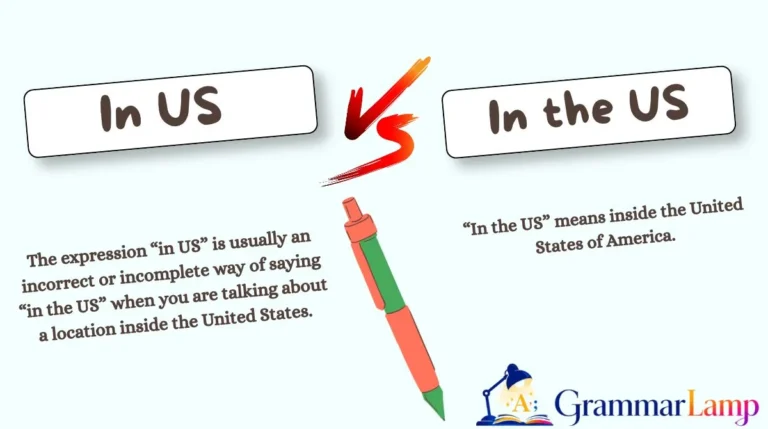
The expression “in US” is usually an incorrect or incomplete way of saying “in the US” when you are talking about a location inside the United States.
The problem is not the preposition “in.” The problem is the missing article “the.”
In standard English, the country name is commonly written as the US, so we normally need the article when using it in a sentence.
For example:
- Incorrect: My brother lives in US.
- Correct: My brother lives in the US.
The United States is a country name that normally takes the definite article “the.” Therefore, when you use the preposition “in” to describe someone’s location there, you should include “the.”
Is “US” a Country Name?
Yes. US is a common abbreviation for the United States of America.
The full name is:
The United States of America
The abbreviation is:
The US
You may also see these forms:
- US
- U.S.
- USA
- U.S.A.
All of them refer to the United States, although their use can depend on the writing style.
In ordinary sentences, the article “the” is generally used before the abbreviation when it functions as the name of the country.
When Should You Avoid Using “In US”?
You should avoid using “in US” when you mean that something happens or exists inside the United States.
For example:
1. Incorrect: My uncle works in US.
Correct: My uncle works in the US.
2. Incorrect: Many people study in US.
Correct: Many people study in the US.
3. Incorrect: She wants to travel in US.
Correct: She wants to travel in the US.
4. Incorrect: My friend has a house in US.
Correct: My friend has a house in the US.
5. Incorrect: Is your family in US?
Correct: Is your family in the US?
6. Incorrect: He was born in US.
Correct: He was born in the US.
7. Incorrect: I want to find a job in US.
Correct: I want to find a job in the US.
Notice that every corrected sentence includes “the” before “US.”
Why Do Learners Make This Mistake?
Many learners think that country names never need articles.
That idea comes from familiar examples such as:
- I live in Pakistan.
- She works in Canada.
- He studies in Australia.
- They travel in Japan.
These sentences are correct without “the.”
However, some country names are exceptions to this general pattern. They normally take the definite article.
For example:
- The United States
- The United Kingdom
- The Netherlands
- The Philippines
Therefore, you should remember that not every country name follows the same article rule.
What Does “In the US” Mean?
“In the US” means inside the United States of America.
It is the standard and natural expression when you want to describe a location within that country.
The word “in” is a preposition. It tells us where someone or something is located.
The word “the” is a definite article. It is part of the usual grammatical form of the country’s name.
For example:
- I live in the US.
- My sister studies in the US.
- They have relatives in the US.
All three sentences are grammatically correct.
When Should You Use “In the US”?
Use “in the US” when talking about:
1. Where someone lives
When you want to explain that someone lives in the United States, use “in the US.”
Example:
My cousin lives in the US with his family.
2. Where someone works
Use it when discussing someone’s workplace or employment location.
Example:
My brother works in the US.
3. Education and studies
Use this expression when talking about schools, colleges, and universities located in the United States.
Example:
Many international students study in the US.
4. Travel and holidays
You can use it when discussing trips, vacations, and places you want to visit.
Example:
I want to visit New York in the US.
5. Business and employment
Use it when talking about companies, jobs, markets, and business activities.
Example:
This company has several offices in the US.
7 Correct Example Sentences With “In the US”
Here are seven easy examples to help you understand the expression.
- My best friend lives in the US.
- She wants to study medicine in the US.
- There are many beautiful cities in the US.
- My uncle has worked in the US for ten years.
- English is widely spoken in the US.
- We are planning to spend our holidays in the US.
- Many international companies operate in the US.
Is “In the US” Formal or Informal?
“In the US” is suitable for both formal and informal English.
You can use it when talking to friends, writing emails, preparing school assignments, or creating professional documents.
For example:
- Informal: My brother is working in the US now.
- Formal: The company operates several offices in the US.
Both sentences are correct.
The expression is not limited to spoken English. It is also common in newspapers, books, reports, and websites.
Difference Between In US and In the US (Detailed Explanation)
The main difference is grammatical correctness.
“In the US” is the standard expression for describing a location inside the United States. “In US” is generally incorrect in ordinary English sentences when referring to the country.
The reason is that the abbreviation “US” normally takes the definite article “the” when used as a country name.
Comparison Table
| Feature | In US | In the US |
|---|---|---|
| Grammar | Usually incorrect | Correct |
| Article | Missing | Includes “the” |
| Natural English | Unnatural | Natural |
| Standard writing | Avoid | Recommended |
| Meaning | Intended to mean inside the US | Inside the United States |
| Everyday use | Not recommended | Very common |
1. Difference in Usage
The biggest difference is how these expressions are used in sentences.
When talking about a location in the United States, use “in the US.”
For example:
Incorrect: My parents live in US.
Correct: My parents live in the US.
The second sentence follows standard English grammar because it includes the article required by the country’s name.
You should apply the same rule when talking about work, education, travel, family, and business.
2. Difference in Grammar
To understand this topic, you need to know what an article is.
English has two main articles:
- Definite article: the
- Indefinite articles: a and an
We use “the” when referring to a particular person, place, or thing.
Country names have their own naming patterns. Many country names do not need an article, but certain names traditionally include one.
For example:
- In Pakistan
- In India
- In France
- In Germany
- In the US
- In the UK
- In the Netherlands
The United States is a country name that uses “the” because its full name describes a union of states.
This is why “in the US” is the natural grammatical form.
3. Difference in Sentence Structure
The sentence structure is simple.
When using “in the US,” follow this basic pattern:
Subject + Verb + in + the US
Examples:
- I live in the US.
- She works in the US.
- They study in the US.
- My parents are in the US.
You can also use the expression at the beginning of a sentence.
In the US + Main clause
Examples:
- In the US, many people celebrate
- In the US, students attend different types of schools.
- In the US, people drive on the right side of the road.
You can use it in questions, too.
Examples:
- Do you live in the US?
- Is your brother working in the US?
- Have you ever studied in the US?
4. Difference in Meaning
There is usually no intended difference in meaning between the two expressions when someone writes “in US” instead of “in the US.”
The writer generally wants to communicate the same idea.
However, one form is grammatically standard, while the other is missing an important word.
Compare:
Incorrect: My sister is studying in US.
Correct: My sister is studying in the US.
Both are intended to say that the sister is studying inside the United States. However, only the second sentence is natural standard English.
5. Why Does the US Need “The”?
This is an interesting question.
The full name of the country is the United States of America.
The word “United” describes states that are joined together. The name refers to a group of states forming one country.
Names of certain countries that describe groups, unions, or plural geographical areas commonly take “the.”
Other examples include:
- The United Kingdom
- The Netherlands
- The Philippines
You do not need to understand every historical reason behind these names to use them correctly. The easiest approach is to learn their standard forms.
Explore More Posts
Ardor vs Ardour: Meaning, Difference, Spelling & Examples (2026)
Fillet vs Filet: What’s the Difference? Meaning, Spelling, and Examples in 2026
Complaint vs Complain: Meaning, Difference, Grammar Rules & Examples (2026)
Differential vs Deferential: Meaning, Difference, Examples, and Grammar Rules (2026)
Grammar Rules You Must Remember
Understanding a few simple grammar rules will help you use country names correctly.
Rule 1: Use “The” Before US When Referring to the Country
When you talk about the United States as a country, normally include “the.”
Examples:
- My brother lives in the US.
- She wants to work in the US.
- They are travelling to the US.
Incorrect: He moved to US last year.
Correct: He moved to the US last year.
Remember that the article is needed even when you use the abbreviation instead of the full country name.
Rule 2: Do Not Use “The” With Most Single Country Names
Most country names do not require “the.”
Examples:
- I live in Pakistan.
- She works in Canada.
- He studies in Japan.
- My friend travels to Australia.
These are all correct.
You should not add “the” simply because you are talking about a country.
Incorrect: I live in the Pakistan.
Correct: I live in Pakistan.
However, some country names have traditionally included “the,” so learn their standard forms.
Rule 3: Use “The US” in Questions and Negative Sentences Too
The article does not disappear when you change a sentence into a question or negative statement.
Examples:
- Do you live in the US?
- Is she working in the US?
- I do not live in the US.
- He has never travelled to the US.
Incorrect: Does your sister study in US?
Correct: Does your sister study in the US?
The same article rule applies in different sentence types.
Rule 4: Use “The US” With Other Prepositions
The article is not only required after “in.”
It is also normally used with other prepositions when referring to the country.
Examples:
- I am travelling to the US.
- She comes from the US.
- My uncle works for a company in the US.
- We are talking about the US.
- He moved from Pakistan to the US.
The important point is that the article belongs to the country’s name, not just to the preposition “in.”
Common Mistakes Students Make
English learners often make small article mistakes when talking about countries.
These mistakes are understandable because English does not use articles in exactly the same way as many other languages.
Let’s look at some common problems and their corrections.
Mistake 1: Leaving Out “The”
Incorrect: My brother lives in US.
Correct: My brother lives in the US.
Why does this happen?
Some learners believe that an abbreviation does not need an article. However, abbreviations usually follow the grammar of the full name when they represent a country.
Correction tip: Remember the complete expression “the United States.” Its common abbreviation is “the US.”
Mistake 2: Adding “The” Before Every Country Name
Incorrect: My friend lives in the Pakistan.
Correct: My friend lives in Pakistan.
Why does this happen?
After learning that “the US” is correct, some learners start adding “the” before every country name.
This creates another grammar mistake.
Correction tip: Learn which country names normally take “the” and which do not.
Mistake 3: Writing “US” Instead of “The US” in Questions
Incorrect: Are you working in US?
Correct: Are you working in the US?
Why does this happen?
Learners sometimes remember the article in ordinary statements but forget it when asking questions.
Correction tip: Changing a statement into a question does not remove the article.
Mistake 4: Confusing “US” and “USA”
Some learners think “US” and “USA” require different article rules.
However, both abbreviations refer to the same country.
Examples:
- I live in the US.
- I live in the USA.
Both are correct.
When using the country’s name in an ordinary sentence, the article is generally retained with either abbreviation.
Mistake 5: Forgetting “The” After Other Prepositions
Incorrect: She is travelling to US.
Correct: She is travelling to the US.
Incorrect: My cousin came from US.
Correct: My cousin came from the US.
Why does this happen?
Some learners think the article is only needed after “in.”
Correction tip: Remember that the article belongs to the country name. It is normally used with different prepositions.
Mistake 6: Confusing “In the US” With “To the US”
These expressions are both correct, but they have different meanings.
- I live in the US.
- I am travelling to the US.
The first sentence describes location. The second describes movement towards a destination.
Correction tip: Use “in” for location and “to” for movement towards a place.
Easy Trick to Remember the Difference
Here is a simple trick that will help you remember the correct expression.
Remember this: US = The US.
Whenever you use the abbreviation to refer to the country in a normal sentence, think about its full name:
The United States of America.
Notice that the full name begins with “the.”
Therefore, the common shortened form also uses “the.”
For example:
- The United States → The US
- I live in the United States → I live in the US.
- She works in the United States → She works in the US.
You can also remember the difference by comparing it with other countries.
| Country | Correct expression |
|---|---|
| Pakistan | In Pakistan |
| India | In India |
| Canada | In Canada |
| Australia | In Australia |
| United States | In the US |
| United Kingdom | In the UK |
| Netherlands | In the Netherlands |
| Philippines | In the Philippines |
A useful way to practise is to say these country names aloud in complete sentences.
For example, say “I live in Pakistan” and then “I want to live in the US.”
After repeating these examples a few times, the correct article will begin to sound natural.
Daily Life Examples of “In the US”
The best way to improve your English is to learn how grammar works in everyday situations.
Here are ten simple examples that show how people naturally use “in the US.”
1. Talking About Family
“My uncle lives in the US with his wife and children.”
This sentence explains where your uncle and his family live.
2. Talking About Education
“I want to study computer science in the US.”
You can use this expression when discussing your education plans or university applications.
3. Talking About Work
“My brother has found a good job in the US.”
This sentence tells someone that your brother has found employment in that country.
4. Talking About Travel
“I hope to visit the US next summer.”
Here, the speaker is discussing a future travel plan.
5. Talking About Friends
“Do you have any friends in the US?”
This is a natural question when asking someone about their friends who live there.
6. Talking About Business
“That company has many customers in the US.”
This example is useful in conversations about business, marketing, and international trade.
7. Talking About Weather
“It gets very cold in some parts of the US during winter.”
This sentence describes weather conditions in different parts of the country.
8. Talking About Technology
“Many famous technology companies are based in the US.”
You might use this sentence when discussing computers, mobile phones, or technology.
9. Talking About Moving
“My cousin moved to the US two years ago.”
The word “to” shows movement towards the country.
10. Talking About Current Location
“My parents are in the US right now.”
This sentence explains where your parents are at the moment.
These examples show that the expression works in many everyday situations. You can use it when talking about family, education, travel, employment, weather, and business.
Practice Section: Test Your Understanding
Now it is time to check what you have learned.
Choose the correct option in each sentence. Remember the rule about the definite article “the.”
Question 1
My sister lives ______.
- A. in US
- B. in the US
Question 2
He wants to study medicine ______.
- A. in the US
- B. in US
Question 3
Are your parents ______ right now?
- A. in US
- B. in the US
Question 4
My uncle moved ______ last year.
- A. to the US
- B. to US
Question 5
Many international students study ______.
- A. in the US
- B. in US
Correct Answers
- B. in the US – The country name normally requires “the.”
- A. in the US – Use the definite article before US.
- B. in the US – Questions follow the same article rule.
- A. to the US – The article is also used after “to.”
- A. in the US – This is the standard expression.
If you answered all five correctly, you have understood the main rule.
If you made a mistake, do not worry. Read the grammar rules again and try the exercise once more.
More Helpful posts
Feel vs Felt: Complete Grammar Guide With Examples (2026)
Role Call or Roll Call? The Correct Spelling and Meaning in 2026
Into or Onto: Complete Difference, Rules, and Examples for 2026
Sole vs Soul: What’s the Difference? Easy Guide With Examples 2026
Frequently Asked Question
1. What Is the Difference Between In US and In the US?
“In the US” is the standard and grammatically correct expression when referring to a location inside the United States.
“In US” is generally incorrect in ordinary English because it is missing the definite article “the.”
For example, write “I live in the US,” not “I live in US.”
2. Is It Correct to Say In US?
In standard English, “in US” is generally not correct when you mean inside the United States.
You should write “in the US” because the country’s name normally takes the definite article.
For example: “My brother works in the US.”
3. Can We Use In the US in Questions?
Yes. You can use “in the US” in questions, statements, and negative sentences.
Examples:
- Do you live in the US?
- Is your sister in the US?
- I do not work in the US.
The article “the” stays in all these sentence types.
4. Is In the US Formal or Informal?
“In the US” is suitable for both formal and informal English.
You can use it in everyday conversations, school assignments, business emails, news articles, and professional reports.
It is the standard expression and does not sound too formal or too casual.
5. Should I Write In US or In USA?
When referring to the country, the standard forms are “in the US” and “in the USA.”
Both are grammatically correct.
For example:
- I live in the US.
- I live in the USA.
Remember that you normally need “the” with both forms.
6. Why Do We Say In the US but In Pakistan?
The difference comes from the traditional names of these countries.
Pakistan is a country name that normally does not take an article.
The United States is a country name that normally takes “the” because of its full name.
Therefore, we say “in Pakistan” but “in the US.”
Conclusion
Understanding the difference between “in US” and “in the US” is a small but important part of learning English grammar.
The main rule is simple: when you are talking about a location inside the United States, use “in the US.”
The word “the” is important because it is normally part of the country’s name. Without it, the expression sounds incomplete in standard English.
Remember that the same rule applies to other expressions, such as “to the US,” “from the US,” and “about the US.” Also, do not add “the” before every country name. We say “in Pakistan,” “in India,” and “in Canada,” but “in the US” and “in the UK.”
Try using these expressions in your daily conversations, messages, and writing. A little practice will help you remember the correct form without thinking too much.
Keep learning, keep practising, and do not be afraid of making small grammar mistakes. Every mistake is an opportunity to improve your English!

Liam Derren is a language writer at GrammarLamp, creating simple, helpful content about grammar, words, and everyday English. He makes language learning clear, practical, and easy to understand.