
English has many word pairs that look almost the same but are not always used in the same way. Lifetime vs life time is one example that can confuse English learners, students, and even people who use English every day.
The confusion is easy to understand. Both forms contain the words life and time. They also seem to express the same general idea: the amount of time someone lives or the period during which something happens.
However, English spelling rules make an important difference between these two forms.
You may have seen expressions such as “a lifetime of memories,” “once in a lifetime,” or “a lifetime guarantee.” In these examples, the word is written as one word.
But what happens when someone writes “life time” as two separate words? Is it always wrong? Can it ever be correct?
These are useful questions because choosing the wrong form can make your writing look less natural. It can also create confusion when you write emails, school assignments, social media posts, or professional documents.
The good news is that the difference is quite simple once you understand how the word works. You will learn what each form means, when to use it, how it fits into a sentence, and which spelling is best in everyday English.
You will also find practical examples, common mistakes, and short exercises to help you remember the correct form.
More Useful posts
Farther vs Further: The Easy Difference Explained for 2026
In Development vs Under Development: Meaning, Differences, and Examples (2026)
Non-Restrictive Clauses: Meaning, Rules, Examples & Differences in 2026
Conform With vs Conform To (2026): What’s the Difference? Easy Grammar Guide for English Learners
What Does “Lifetime” Mean?
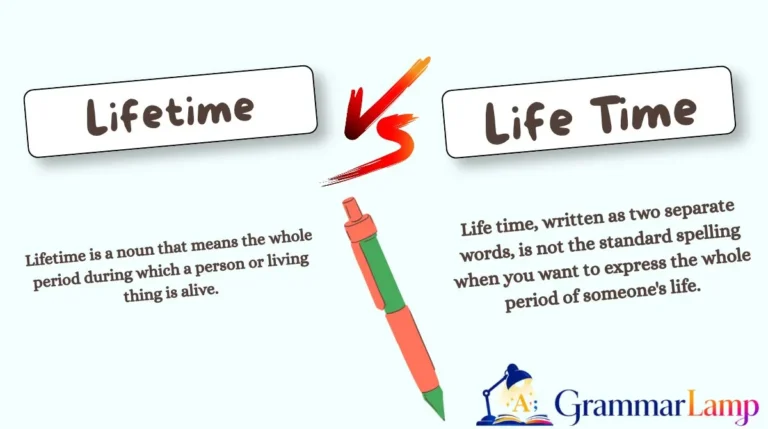
Lifetime is a noun that means the whole period during which a person or living thing is alive. It can also describe a very long period or the full period during which something remains useful, valid, or active.
It is written as one word, without a space between life and time.
For example, if someone says, “I want to travel around the world in my lifetime,” they mean they want to do it before they die.
The word is also used in expressions that describe rare experiences. For example, “This is a once-in-a-lifetime opportunity” means the opportunity is so special that it may happen only once.
When Should You Use “Lifetime”?
Use this word when you are talking about the full length of someone’s life or the entire period of something.
Here are some common situations:
1. Talking about a person’s whole life
When you mean the time from someone’s birth until their death, use this word.
Example: She has collected hundreds of books during her lifetime.
This means she collected the books over the years she was alive.
2. Talking about a long period of experience
It can describe something that takes many years or develops throughout a person’s life.
Example: He has a lifetime of experience in teaching.
This means he has gained a great deal of experience over many years.
3. Talking about a rare opportunity
The expression “once-in-a-lifetime” describes something very special that may not happen again.
Example: Visiting the Great Wall of China was a once-in-a-lifetime experience.
4. Talking about a product’s useful period
A lifetime warranty or lifetime membership refers to an agreement that lasts for a specified lifetime. The exact meaning depends on the company or agreement.
Example: The company offers a lifetime warranty on this product.
Grammar Rule for “Lifetime”
The word lifetime is a compound noun. A compound noun is made by joining two or more words to create one word with its own meaning.
In this case:
- Life = the state of being alive.
- Time = a period or duration.
- Lifetime = the entire period of a life.
It is usually used as a singular countable noun. This means you can use articles such as a or the before it.
Examples:
- A lifetime is a long time to wait.
- She spent her lifetime helping others.
- He has a lifetime of memories.
It can also be used before another noun as an adjective, as in lifetime membership or lifetime achievement.
8 Example Sentences Using “Lifetime”
- I want to make beautiful memories in my lifetime.
- My grandfather has a lifetime of experience in farming.
- Winning this award is a once-in-a-lifetime opportunity.
- She has been interested in music throughout her lifetime.
- The company provides a lifetime guarantee on selected products.
- He spent his lifetime helping poor families.
- A lifetime of hard work made her successful.
- Meeting my favourite singer was a lifetime dream come true.
Notice that the spelling stays the same in all these examples. The two parts are joined because lifetime is the standard compound noun.
Common Learner Confusion
Many learners think that because the word contains two smaller words, they should write it separately.
However, English has many compound words that are written together. Examples include bedroom, sunlight, football, and lifetime.
The meaning of a compound word is not always clear from the spelling of its individual parts. It is important to learn the accepted spelling of the complete word.
For everyday English, remember that lifetime is the normal and correct spelling when you mean the duration of a person’s life or the full duration of something.
What Does “Life Time” Mean?
Life time, written as two separate words, is not the standard spelling when you want to express the whole period of someone’s life. In ordinary modern English, the correct form for that meaning is lifetime.
However, there is an important detail: two separate words can sometimes appear next to each other in a sentence when they have their own separate grammatical roles. This does not mean that life time is a normal alternative spelling of lifetime.
For example, a writer may use the words life and time separately when discussing life as a subject and time as a separate idea. Such wording is unusual and depends on the sentence.
When Can “Life Time” Be Used?
There are a few situations where the two words may appear next to each other, but they should not be confused with the standard compound noun.
1. When discussing life and time as separate ideas
A writer may place these words together in a special sentence where each word has its own meaning.
For example:
– The discussion covered life, time, and human experience.
Here, life and time are two separate nouns in a list. They are not a single expression.
2. When quoting unusual or older wording
You may find life time in older documents, personal writing, or quoted material. It may reflect an author’s personal spelling choice or a nonstandard form.
For example:
– The old document used the expression “life time” in its description.
This tells you how the original document was written. It does not make the two-word form the preferred spelling in modern standard English.
3. When the words belong to different parts of a sentence
Sometimes, two words that normally form a compound expression may appear separately because the sentence gives them different grammatical roles.
However, this is not a reason to replace the standard word lifetime with life time.
Grammar Rule for “Life Time”
There is no general grammar rule that makes life time an accepted alternative spelling of the compound noun lifetime.
The main point is that spelling and grammar are related but different things.
Grammar tells us how words work together in a sentence. Spelling tells us how an individual word should normally be written.
When you mean the full period of someone’s life, write lifetime as one word.
If you genuinely mean life and time as separate ideas, use them separately in a sentence that makes their individual meanings clear.
8 Examples to Understand the Two-Word Form
The following examples show how the words can appear separately. They are not examples of life time being an alternative spelling of the compound noun.
- Life and time are two important subjects in philosophy.
- The writer discussed life, time, and human relationships.
- We spent the evening talking about life and the time we have.
- Life changes with time and experience.
- The book explores life and time from different viewpoints.
- Life is short, so use your time wisely.
- The poem connects life with the passage of time.
- Our ideas about life and time can change as we grow older.
Important: These examples use life and time as separate words. They do not show the standard compound noun written incorrectly.
Common Learner Confusion
The biggest mistake is assuming that lifetime and life time are interchangeable.
For example:
- Incorrect for the intended meaning: I want to achieve this in my life time.
- Correct: I want to achieve this in my lifetime.
The second sentence uses the accepted spelling because it refers to the period of the speaker’s life.
Remember that two words appearing together in a sentence do not automatically form a compound noun. Their meaning and grammatical roles matter.
Difference Between Lifetime and Life Time (Detailed)
The main difference between these forms is their spelling and grammatical function.
Lifetime is a standard English compound noun. It refers to the whole duration of someone’s life or the complete period during which something exists or remains active.
On the other hand, life time is not the standard spelling of that meaning. The two words can appear separately when the sentence treats life and time as different ideas.
This is why choosing the correct form is important.
Comparison Table
| Feature | Lifetime | Life time |
|---|---|---|
| Spelling | One word | Two separate words |
| Standard compound noun | Yes | No |
| Meaning | The whole period of a life | Separate ideas of life and time |
| Grammar | Compound noun | Two separate words |
| Everyday usage | Very common | Unusual in this context |
| Standard writing | Preferred | Avoid as an alternative spelling |
| Example | During my lifetime | Life and time are important |
1. Usage Difference
The word lifetime is used in everyday English. You will find it in books, conversations, advertisements, product descriptions, and professional writing.
For example:
- She achieved many things during her lifetime.
- This is a once-in-a-lifetime chance.
- He has a lifetime membership at the club.
These sentences use the word as a single unit with a clear meaning.
The two-word form is different. When life and time are used separately, they usually express two separate ideas.
For example:
– Life is beautiful, but time passes quickly.
Here, life refers to the experience of being alive, while time refers to the passing of moments.
You should not combine these separate words or split the compound noun without a clear grammatical reason.
2. Grammar Logic
Why is lifetime written as one word?
English often joins two words when they develop a combined meaning. This process is called compounding.
For example:
- Sun + light = sunlight
- Bed + room = bedroom
- Foot + ball = football
- Life + time = lifetime
Once a compound noun becomes established in English, its standard spelling is learned as one complete word.
The meaning of lifetime is more specific than simply putting the words life and time next to each other. It refers to the duration of a life or the full period associated with something.
This is why standard dictionaries list lifetime as one word.
3. Sentence Structure Difference
The two forms also behave differently in sentences.
Lifetime as a noun:
You can use it after articles, possessive words, and prepositions.
Examples:
- A lifetime is not enough to learn everything.
- She spent her lifetime serving others.
- He has many happy memories from his lifetime.
- I hope to achieve this in my lifetime.
Life and time as separate nouns:
Each word has its own meaning and grammatical role.
Examples:
- Life and time are precious.
- We should value life and respect time.
- The book explains how life changes over time.
Notice that the last example uses over time, which is a common expression. It does not require the compound noun lifetime.
4. Meaning Comparison
The word lifetime focuses on a complete duration.
Imagine someone who is 70 years old. When you say, “During his lifetime,” you are talking about the years he has been alive.
When you say, “Life and time are important,” you are talking about two different concepts.
The first expression has one combined meaning. The second has two separate meanings.
This simple difference can help you choose the right spelling whenever you are writing a sentence.
5. Which Form Should You Use?
If you are writing an email, school assignment, article, story, or social media post, use lifetime whenever you mean the whole period of someone’s life.
For example:
- I want to learn many new things in my lifetime.
- She has a lifetime of beautiful memories.
- This is a once-in-a-lifetime opportunity.
Avoid writing life time as a casual alternative.
If you are discussing life and time as separate subjects, use both words separately and make their meanings clear.
Explore More Posts
Orientated vs Oriented: What’s the Difference? [2026 Guide]
Do You vs Are You: What’s the Difference? Complete Guide for 2026
Dateline vs Deadline: Meaning, Difference, Examples & Easy Rules (2026)
Whole vs Hole: Meaning, Difference, Examples, and Easy Rules (2026)
Grammar Rules You Must Remember
Understanding a few simple rules will make this spelling choice much easier. You do not need to memorize complicated grammar terms. Just remember how the word works in everyday sentences.
Rule 1: Use “Lifetime” for the Whole Period of a Life
When you want to talk about the time from someone’s birth until their death, write lifetime as one word.
Examples:
- My grandmother travelled to many countries during her lifetime.
- He learned many useful skills in his lifetime.
- Everyone wants to make good memories in their lifetime.
Remember: If you mean the entire period of being alive, use one word.
Rule 2: Use “Lifetime” in the Expression “Once in a Lifetime”
This is a very common English expression.
It describes an unusual, special, or unforgettable experience that may happen only once.
Examples:
- Winning the competition was a once-in-a-lifetime experience.
- This is a once-in-a-lifetime opportunity.
- Travelling to space would be a once-in-a-lifetime adventure.
When the expression comes before a noun, it is commonly written with hyphens: once-in-a-lifetime opportunity.
Rule 3: Use “Lifetime” for Long-Term Memberships and Guarantees
The word is also used in product descriptions, business agreements, and services.
Examples:
- The shop offers a lifetime warranty.
- He purchased a lifetime membership.
- The company provides lifetime support for selected products.
However, pay attention to the exact terms. A company’s definition of a lifetime warranty may depend on the product, owner, or agreement.
Rule 4: Do Not Use “Life Time” as a Replacement for “Lifetime”
This is the most important rule for English learners.
When you mean the full duration of a person’s life, do not separate the word.
Incorrect: She wants to become a doctor in her life time.
Correct: She wants to become a doctor in her lifetime.
Incorrect: It was a once-in-a-life-time experience.
Correct: It was a once-in-a-lifetime experience.
Remember: The standard compound noun is always written as one word.
Common Mistakes Students Make
English learners often make spelling mistakes because they try to write words according to how they sound or how they look. Since lifetime contains two smaller words, it may seem natural to write them separately.
However, the correct spelling depends on how English recognizes the complete word.
Here are some common mistakes and easy ways to correct them.
Mistake 1: Writing “Life Time” Instead of “Lifetime”
Incorrect: I want to visit many countries in my life time.
Correct: I want to visit many countries in my lifetime.
Why does this mistake happen?
Students recognize life and time as two familiar words. They may think there is no problem with putting a space between them.
How to correct it:
Remember that the compound noun has an established one-word spelling. Whenever you mean the entire period of someone’s life, use lifetime.
Mistake 2: Writing “Once in a Life Time”
Incorrect: This is a once-in-a-life-time chance.
Correct: This is a once-in-a-lifetime chance.
Why does this mistake happen?
Learners may think that every part of an expression should be written separately. However, the word lifetime remains one word even inside this common expression.
How to correct it:
Learn the complete expression as a unit:
“Once in a lifetime.”
When it comes before a noun, use the usual hyphenated form:
“A once-in-a-lifetime opportunity.”
Mistake 3: Using “Lifetime” When You Mean “Over Time”
Incorrect: People change during lifetime.
Better: People change over time.
Also correct: People change throughout their lifetime.
Why does this mistake happen?
Learners sometimes think that lifetime and time have exactly the same meaning.
They are related, but they are not interchangeable.
- Over time means gradually as time passes.
- Lifetime means the complete period of someone’s life.
How to correct it:
Think about the meaning before choosing your expression. If you mean gradual change, over time may be the better choice.
Mistake 4: Forgetting the Article Before a Singular Countable Noun
Incorrect: It was lifetime opportunity.
Correct: It was a once-in-a-lifetime opportunity.
Another correct example: This is a lifetime achievement.
Why does this mistake happen?
Students may focus on the spelling and forget the other grammar rules in the sentence.
Lifetime can be a singular countable noun, so it often needs an article or another suitable determiner when used as a noun.
How to correct it:
Check whether the sentence needs a, an, the, or a possessive word.
Mistake 5: Thinking “Lifetime” Always Means a Person’s Life
Example: The product comes with a lifetime warranty.
Here, the word does not describe a person’s biological life. It describes the period covered by the warranty.
The exact coverage depends on the agreement.
How to correct it:
Remember that lifetime can describe the useful or covered period of something, not just the years a person is alive.
Easy Trick to Remember the Difference
Here is a simple memory trick that can help you remember the correct spelling.
Think of lifetime as one complete journey.
Imagine a person’s life as a long road. The road starts at birth and continues until the end of life. The entire journey is called a lifetime.
Because you are talking about one complete period, remember to write the word together.
You can also use this simple comparison:
- One complete life journey = lifetime.
- Two separate ideas = life and time.
A Simple Memory Sentence
Remember this sentence:
“My lifetime is the time I have during my life.”
The word lifetime is written together because it has one established meaning.
Real-Life Logic
Imagine that your teacher asks you:
“How long do you want to keep learning English?”
You might answer:
“I want to keep learning English throughout my lifetime.”
This means you want to continue learning for as long as you live.
Now imagine your teacher asks:
“Why is time important in life?”
You could answer:
“Life is short, and time is valuable.”
Here, life and time are separate ideas.
That is the main difference. You do not need a difficult grammar rule to remember it. Just look at the meaning of the sentence.
Daily Life Examples (Very Important)
The best way to learn a confusing word is to see how people use it in everyday situations.
Here are 10 simple examples that show how lifetime works in natural English.
1. Talking About Personal Goals
“I want to achieve something special in my lifetime.”
Meaning: The speaker wants to do something important before the end of their life.
2. Talking About Family Memories
“My parents have given me a lifetime of beautiful memories.”
Meaning: The speaker has many wonderful memories connected with their parents.
3. Talking About Travel
“Visiting Paris was a once-in-a-lifetime experience for me.”
Meaning: The trip was very special and may never happen again.
4. Talking About Education
“You can learn many things throughout your lifetime.”
Meaning: Learning does not have to stop when school or university ends.
5. Talking About Business
“This company offers a lifetime warranty on this watch.”
Meaning: The company offers warranty coverage under its stated lifetime terms.
6. Talking About Friendship
“I hope we remain friends for a lifetime.”
Meaning: The speaker hopes the friendship will last throughout their lives.
7. Talking About Success
“Winning this award was the biggest achievement of my lifetime.”
Meaning: The award was one of the most important successes the person has experienced.
8. Talking About Opportunities
“Do not miss this once-in-a-lifetime opportunity.”
Meaning: The opportunity is special and may not come again.
9. Talking About Experience
“My father has a lifetime of experience in this business.”
Meaning: The father has gained many years of knowledge and experience.
10. Talking About Personal Development
“Reading books can help you grow throughout your lifetime.”
Meaning: Reading can support personal growth for as long as you live.
These examples show that the one-word spelling is natural in daily English. You can use it in conversations, messages, schoolwork, and professional writing.
Practice Section: Test Your Understanding
Now it is time to check what you have learned. Read each sentence and choose the correct option.
Do not look at the answers immediately. Try to complete all five questions first.
Question 1
I want to travel around the world in my ______.
- A. life time
- B. lifetime
Question 2
Winning the award was a once-in-a-______ opportunity.
- A. lifetime
- B. life time
Question 3
My grandfather has a ______ of experience in farming.
- A. lifetime
- B. life time
Question 4
Life is short, and ______ passes quickly.
- A. lifetime
- B. time
Question 5
She wants to create beautiful memories during her ______.
- A. life time
- B. lifetime
Answers and Explanations
- B. lifetime – It refers to the complete period of the speaker’s life.
- A. lifetime – The correct expression is “once-in-a-lifetime opportunity.”
- A. lifetime – It describes many years of experience.
- B. time – Here, time is a separate noun describing the passing of moments.
- B. lifetime – It refers to the entire period during which she lives.
Learning tip If you answered all five correctly, you understand the main spelling difference. If you made a mistake, read the comparison table and try the exercise again.
More Helpful posts
John and Me vs Me and John: Which Is Correct? 2026 Grammar Guide
Is It Correct to Say “Repeat Again”? 2026 Grammar Guide
As Soon As vs As Early As: Easy Difference, Rules & Examples in 2026
Imbalanced vs Disbalanced: What Is the Difference? (2026)
FAQs
1. What is the difference between lifetime and life time?
Lifetime is a standard English compound noun meaning the whole period of someone’s life. It can also describe the full duration of something.
Life time is not the standard alternative spelling of this noun. Use lifetime when you mean the duration of a person’s life.
2. Is lifetime one word or two words?
Lifetime is one word. It combines life and time to create a compound noun.
For example: “I want to achieve my goals in my lifetime.”
Writing it as two words is not the standard spelling when you mean the complete period of someone’s life.
3. Is life time ever correct?
The two words can appear separately when life and time have their own meanings in a sentence.
For example: “Life is short, and time is precious.”
However, you should not use life time as a replacement for the standard word lifetime.
4. Is lifetime formal or informal?
Lifetime is suitable for both formal and informal English.
You can use it in everyday conversations, emails, academic writing, business documents, and professional communication.
Examples include “lifetime experience,” “lifetime membership,” and “once-in-a-lifetime opportunity.”
5. Is it correct to say “once in a lifetime”?
Yes. “Once in a lifetime” is a correct and very common English expression.
It describes something special that may happen only once during someone’s life.
Example: “Meeting my favourite author was a once-in-a-lifetime experience.”
When the expression comes before a noun, it is commonly hyphenated: “a once-in-a-lifetime opportunity.”
6. Should I write lifetime warranty or life time warranty?
You should write lifetime warranty.
It is the standard spelling in product descriptions and business writing.
Example: “This laptop comes with a lifetime warranty.”
Always check the warranty terms because the exact meaning of lifetime can depend on the company’s agreement.
Conclusion
Understanding the difference between lifetime vs life time is easier than it first appears.
The most important thing to remember is that lifetime is the standard one-word spelling when you are talking about the complete period of someone’s life or the full duration of something.
The two-word form, life time, is not a standard alternative spelling of this compound noun. You may see life and time used separately when they have different meanings in a sentence, but that is a different grammatical situation.
Remember common expressions such as once in a lifetime, lifetime experience, lifetime membership, and lifetime warranty. Learning these expressions will help you use the word naturally.
Do not worry if you have made this spelling mistake before. It is a common source of confusion for English learners. Read the examples, practise writing your own sentences, and pay attention to the spelling whenever you read English.
With regular practice, choosing the correct form will soon become natural.

Liam Derren is a language writer at GrammarLamp, creating simple, helpful content about grammar, words, and everyday English. He makes language learning clear, practical, and easy to understand.