
Are you confused about whether to write “commensurate with” or “commensurate to”? You are not alone. Both expressions may look correct because they use the same adjective, but they are not equally common or equally accepted in standard English.
The good news is that there is a simple rule you can follow: “Commensurate with” is the standard and widely preferred expression.
Although you may sometimes see “commensurate to” in writing, it is much less common and is generally best avoided in everyday and formal English.
Let’s understand the meaning, grammar, sentence structure, and correct usage through simple explanations and practical examples.
More Useful posts
I’m vs I Am: Complete Difference, Rules, Examples & Usage Guide 2026
Sun vs Son: Meaning, Difference, Rules, and Examples (2026)
A Majority of vs The Majority of: Easy Grammar Guide for 2026
Tomatoes or Tomatos: Which Spelling Is Correct? [2026]
What Does “Commensurate With” Mean?
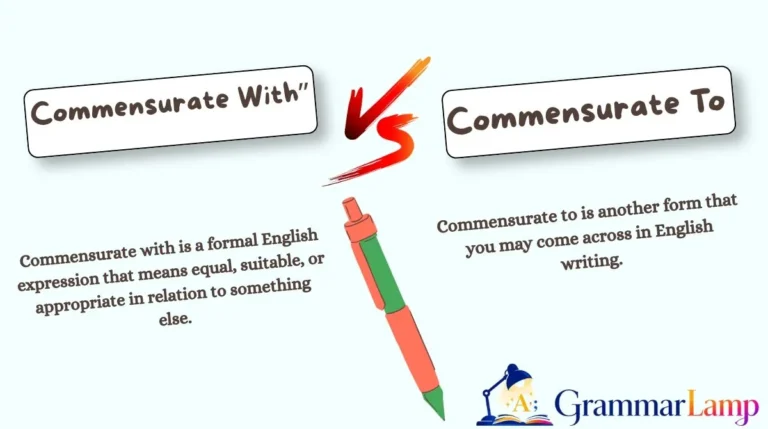
Commensurate with is a formal English expression that means equal, suitable, or appropriate in relation to something else.
We use it when we want to show that two things match in amount, size, level, quality, importance, or value.
In simple words, if one thing is commensurate with another, it is at the right level or in the right proportion.
For example, imagine that a person has ten years of work experience. They apply for a job that requires special skills and offers a good salary. If the salary matches their experience and skills, we can say:
– The salary is commensurate with his experience.
This means that the salary is suitable for the amount of experience he has.
The word commensurate is an adjective. It is usually followed by the preposition with when we compare two things.
When Should You Use “Commensurate With”?
Use this expression when you want to explain that something is suitable or proportional to another thing.
It is especially useful in formal writing, business communication, job advertisements, academic discussions, and professional conversations.
Here are some common situations:
- Salary and experience: When pay matches someone’s skills or experience.
- Work and responsibility: When the amount of work matches a person’s position.
- Effort and reward: When a reward is suitable for the effort someone makes.
- Punishment and crime: When a punishment matches the seriousness of an offence.
- Cost and quality: When a product’s price matches its quality.
- Risk and reward: When a possible reward is suitable for the risk involved.
Grammar Rule for “Commensurate With”
The most common sentence structure is:
Subject + be verb + commensurate with + noun or noun phrase.
Examples:
- Her salary is commensurate with her qualifications.
- The punishment should be commensurate with the crime.
- His responsibilities are commensurate with his position.
You can also use this expression without a linking verb:
Noun + commensurate with + noun.
For example:
- Employees receive benefits commensurate with their experience.
- The company offers salaries commensurate with professional skills.
Notice that the expression does not need the word is or are in every sentence. Its structure depends on how the sentence is written.
8 Examples of “Commensurate With”
1. Her salary is commensurate with her experience.
Her pay matches the experience she has gained.
2. The reward should be commensurate with the effort.
The reward should be suitable for the amount of work done.
3. His responsibilities are commensurate with his position.
His duties match his job level.
4. The punishment must be commensurate with the offence.
The punishment should match the seriousness of the offence.
5. The price of this phone is not commensurate with its quality.
The phone is too expensive for the quality it offers.
6. The company’s investment should be commensurate with its goals.
The amount invested should match what the company wants to achieve.
7. The benefits are commensurate with the employee’s experience.
The benefits are suitable for the employee’s level of experience.
8. The response was not commensurate with the seriousness of the problem.
The response was too small or weak for such a serious problem.
Common Learner Confusion
Some learners think that commensurate with means two things must be exactly equal.
That is not always true.
The expression often means that two things are appropriate or proportional to each other. They do not have to have identical amounts.
For example:
– Her salary is commensurate with her experience.
This does not mean that her salary and experience have the same numerical value. It means that her salary is appropriate for her experience.
Another common confusion is thinking that with always means two things are physically together. In this expression, it shows a relationship or comparison between two things.
This is why learning the complete phrase is more helpful than trying to understand the preposition by itself.
What Does “Commensurate To” Mean?
Commensurate to is another form that you may come across in English writing.
It is used to express the idea that something is suitable, equal, or proportional to another thing.
In other words, it can communicate almost the same meaning as commensurate with.
For example:
– The punishment should be commensurate to the crime.
The sentence means that the punishment should match the seriousness of the crime.
However, there is an important difference in how these expressions are treated in standard English usage.
Major learner dictionaries, including Oxford and Cambridge, present the usual construction as commensurate with. Collins also records the use of to, showing that the alternative exists in English. Oxford Learner’s Dictionaries+2
Therefore, commensurate to is not simply an invented expression, but it is less widely recommended as the default choice.
When Should You Use “Commensurate To”?
You may encounter this construction in formal documents, legal discussions, technical writing, or published material.
Some writers use it to express a direct relationship between two things.
For example:
- The response should be commensurate to the level of risk.
- The payment must be commensurate to the work completed.
Both sentences communicate that one thing should match the level or amount of another.
However, if you are learning English, writing an academic assignment, preparing a professional email, or creating website content, commensurate with is the safer choice.
You do not need to use to to sound more educated or professional.
Clear and natural English is always better than choosing a less familiar construction just to make a sentence look formal.
Grammar Rule for “Commensurate To”
When this construction is used, it generally follows the same basic sentence pattern:
Subject + be verb + commensurate to + noun or noun phrase.
Examples:
- The punishment is commensurate to the crime.
- The payment should be commensurate to the work.
- The response was commensurate to the situation.
You may also find it in sentences without a linking verb:
- Benefits commensurate to experience are available.
- A response commensurate to the challenge is required.
These examples show how some writers use to after the adjective.
However, remember that the more established learner-friendly pattern is commensurate with.
8 Examples of “Commensurate To”
The following examples illustrate how the less common construction may appear:
1. The punishment should be commensurate to the crime.
The punishment should match the seriousness of the crime.
2. The payment was commensurate to the work completed.
The payment was suitable for the work that was done.
3. The company’s response was commensurate to the problem.
The response matched the seriousness of the problem.
4. The benefits should be commensurate to the employee’s position.
The benefits should match the employee’s job level.
5. The investment must be commensurate to the expected return.
The investment should be suitable for the expected reward.
6. The resources allocated were commensurate to the project’s needs.
The resources matched what the project required.
7. The level of support was not commensurate to the students’ needs.
The support was not sufficient for the students.
8. The company’s expenses should be commensurate to its income.
The expenses should be in a suitable proportion to its income.
Common Learner Confusion
The main problem is that learners often see both prepositions used and assume they are equally common in every situation.
English prepositions do not always follow simple rules. Sometimes, two prepositions can express a similar relationship, but one becomes much more common through regular use.
That is what happens here.
If you see commensurate to in a book, article, or formal document, you should understand its intended meaning. You do not need to assume that the writer is using a completely meaningless expression.
However, when you are writing your own sentences, choosing the more established expression will help you avoid unnecessary questions about grammar and style.
Difference Between Commensurate With and Commensurate To (Detailed)
The main difference between these two expressions is their level of acceptance and frequency in standard English.
Both can express the idea of something being suitable or proportional to something else. However, commensurate with is the more common and widely recommended construction.
Oxford and Cambridge give with in their standard definitions and examples. The Canadian government’s Language Portal also specifically recommends the preposition with. Oxford Learner’s Dictionaries+2
Comparison Table
| Point | Commensurate With | Commensurate To |
|---|---|---|
| Meaning | Proportional or suitable | Proportional or suitable |
| Grammar | Adjective + with | Adjective + to |
| Usage | Very common | Less common |
| Standard preference | Preferred | Less preferred |
| Formal writing | Recommended | Use with caution |
| Academic writing | Safer choice | Usually avoid |
| Professional English | Natural choice | Less usual |
| Learner recommendation | Use it | Recognize it |
1. Usage Difference
The biggest difference is how naturally each expression appears in everyday formal English.
For example:
- Preferred: His salary is commensurate with his experience.
- Less common: His salary is commensurate to his experience.
Both sentences express a similar idea. However, the first sounds more natural to most readers and follows the standard dictionary pattern.
This is particularly important when writing job advertisements, business reports, academic papers, or professional documents.
You want your readers to focus on your message, not wonder whether you have selected the correct preposition.
2. Grammar Logic
The word commensurate is an adjective. It describes a relationship between two things.
The adjective is commonly followed by a prepositional phrase beginning with with.
For example:
- The salary is commensurate with the experience.
- The reward is commensurate with the effort.
Here, the preposition introduces the thing against which the first thing is compared.
The same general idea can be expressed with to by some writers, but the traditional learner-friendly construction uses with.
It is important to understand that there is no universal rule saying that every adjective must use only one preposition. Preposition choice depends on established English usage and word combinations.
3. Sentence Structure Difference
The two forms have almost identical sentence structures.
Compare:
| Commensurate With | Commensurate To |
|---|---|
| The salary is commensurate with his skills. | The salary is commensurate to his skills. |
| The reward is commensurate with the effort. | The reward is commensurate to the effort. |
| The punishment is commensurate with the crime. | The punishment is commensurate to the crime. |
The only change is the preposition.
You do not need to change the subject, verb, adjective, or noun to switch between these constructions.
Nevertheless, grammatical similarity does not mean both choices are equally suitable for every writing situation.
4. Meaning Comparison
Do these expressions have different meanings?
In their usual intended use, no major difference in meaning exists.
Both are used to describe a suitable relationship between two things.
Consider this example:
– The reward should be commensurate with the effort.
The reward should be appropriate for the effort someone has made.
Now consider:
– The reward should be commensurate to the effort.
The writer intends to communicate the same message.
The difference is mainly about conventional usage, not a different meaning.
5. Which One Sounds More Natural?
If you want your English to sound natural, use commensurate with.
For example, imagine you are applying for a job and want to discuss your expected salary.
You could write:
“I am looking for a salary commensurate with my qualifications and experience.”
This is a natural and widely recognized professional expression.
Using commensurate to in the same sentence may still communicate your meaning, but it is not the usual choice.
My recommendation: Learn both forms so that you can recognize them, but use commensurate with in your own writing.
Explore More Posts
Honor or Honour: What Is the Difference? A Simple Guide for 2026
Collaborate vs Corroborate: Meaning, Difference, and Examples in 2026
Sleeve vs Sleave: Which Is Correct? Meaning, Difference, and Examples in 2026
Time off vs time-off: The Complete Grammar Guide for 2026
Grammar Rules You Must Remember
Understanding a phrase is useful, but knowing how to use it correctly in a sentence is even more important.
Here are four simple grammar rules that will help you use this adjective naturally.
Rule 1: Prefer “With” After “Commensurate”
The most important rule is to use with as the normal preposition after commensurate.
Examples:
- The salary is commensurate with her experience.
- The reward should be commensurate with the effort.
- His responsibilities are commensurate with his position.
Avoid replacing with with to without a good reason.
If you are unsure, choose with. It is the established standard construction.
Rule 2: Use a Noun or Noun Phrase After the Preposition
The preposition normally introduces a noun, pronoun, or noun phrase.
For example:
- Her salary is commensurate with her experience.
- The punishment should be commensurate with the offence.
- The benefits are commensurate with the job requirements.
You can also use a gerund phrase when it functions as a noun.
For example:
– The reward should be commensurate with working long hours.
The important point is that the phrase after with should complete the comparison.
Rule 3: Match the Verb to the Subject
The word commensurate does not change according to the subject.
However, the verb before it must agree with the subject.
Examples:
- Her salary is commensurate with her experience.
- Their salaries are commensurate with their experience.
- His responsibility was commensurate with his position.
- Their responsibilities were commensurate with their positions.
Do not write commensurates when using this adjective.
Incorrect: Her salary commensurates with her experience.
Correct: Her salary is commensurate with her experience.
Rule 4: You Do Not Always Need a Linking Verb
A sentence can use commensurate with directly after a noun without is, are, was, or were.
For example:
- The company offers benefits commensurate with experience.
- Employees receive salaries commensurate with their qualifications.
- The law requires penalties commensurate with the seriousness of the offence.
These are grammatically correct structures.
They are especially common in formal writing because they make sentences shorter and more direct.
Common Mistakes Students Make
Even advanced English learners sometimes struggle with prepositions.
The problem is not always a lack of vocabulary. Sometimes, learners know the meaning of an adjective but have not learned which preposition normally follows it.
Here are some mistakes to avoid.
Mistake 1: Treating Both Forms as Equally Preferred
Some students believe that because both forms can be understood, they should be used equally.
However, natural English depends on common usage as well as meaning.
Less preferred: The salary is commensurate to his experience.
Preferred: The salary is commensurate with his experience.
Correction tip: Memorize the complete expression instead of learning the adjective alone.
Mistake 2: Using “Commensurate” Without a Comparison
The word usually describes a relationship between two things.
Unclear: Her salary is commensurate.
Clear: Her salary is commensurate with her experience.
The first sentence does not explain what the salary is being compared with.
Correction tip: Ask yourself, “Commensurate with what?” This question will help you complete your sentence.
Mistake 3: Adding an Unnecessary Preposition
Some learners accidentally use two prepositions together.
Incorrect: His salary is commensurate with to his experience.
Correct: His salary is commensurate with his experience.
You only need one preposition.
Correction tip: Choose with and remove the extra to.
Mistake 4: Using the Adjective as a Verb
Commensurate is an adjective, not a normal action verb.
Incorrect: His salary commensurates with his skills.
Correct: His salary is commensurate with his skills.
Correction tip: Use a suitable linking verb such as is, are, was, or were when your sentence needs one.
Mistake 5: Thinking It Always Means Exactly Equal
This word does not always describe two identical amounts.
Incorrect understanding: If two things are commensurate, they must have exactly the same numerical value.
Correct understanding: They are suitable or proportional to each other.
For example, a salary can be commensurate with experience without the salary amount being numerically equal to the number of years worked.
Correction tip: Think of appropriate proportion, not necessarily exact equality.
Mistake 6: Using It in Very Casual Conversations
Although the expression is correct, it is quite formal.
For example, saying “Your payment should be commensurate with your effort” to a friend may sound unnecessarily formal.
A simpler alternative would be:
“Your pay should match the work you do.”
Correction tip: Use commensurate with in formal situations and simpler expressions such as match, be suitable for, or be proportional to in everyday conversations.
Easy Trick to Remember the Difference
If you often forget whether to use commensurate with or commensurate to, try this simple memory trick.
Remember: Commensurate WITH = Matching WITH something.
Think about two things that need to match.
For example:
- Salary matches experience.
- Reward matches effort.
- Punishment matches the crime.
- Responsibility matches position.
Whenever you want to describe this relationship, remember the expression commensurate with.
A Simple Real-Life Example
Imagine that two people work for the same company.
One person has two years of experience, while the other has fifteen years of experience.
The second person has more experience and may reasonably expect a higher salary.
You can describe this situation by saying:
“The salary should be commensurate with the employee’s experience.”
This means that the salary should be suitable for the employee’s level of experience.
Another Easy Way to Remember
Think of the word with as connecting two related things.
For example:
- Effort with reward.
- Experience with salary.
- Responsibility with position.
- Quality with price.
You are comparing one thing with another to see whether they are suitable or proportional.
Do not spend too much time trying to memorize complicated grammar explanations. Remember the complete phrase and practise using it in simple sentences.
Daily Life Examples (Very Important)
Learning grammar rules is helpful, but using them in real situations makes them easier to remember.
The following examples show how commensurate with can be used in conversations, workplaces, schools, and everyday situations.
1. Talking About Salary
Ali: What salary are you expecting from this company?
Ahmed: I am looking for a salary commensurate with my experience.
Meaning: Ahmed wants a salary that matches his work experience.
2. Talking About Hard Work
Friend 1: You worked really hard on that project.
Friend 2: Yes, I hope the reward is commensurate with my effort.
Meaning: The person hopes to receive a reward that is suitable for the work done.
3. Talking About Job Responsibilities
Manager: Are you comfortable with your new position?
Employee: Yes, but I think my responsibilities should be commensurate with my job title.
Meaning: The employee believes that the duties should match the position.
4. Talking About Product Prices
Customer 1: This laptop is very expensive.
Customer 2: I agree. Its price should be commensurate with its quality.
Meaning: The customer believes the price should match the product’s quality.
5. Talking About Education
Student 1: Do you think experienced teachers should receive higher salaries?
Student 2: Yes. Their salaries should be commensurate with their qualifications and experience.
Meaning: Teachers’ pay should reflect their skills and experience.
6. Talking About Punishment
Person 1: Do you think the punishment was fair?
Person 2: It should be commensurate with the seriousness of the offence.
Meaning: The punishment should match how serious the offence was.
7. Talking About Business
Business Owner: We are planning to invest more money in advertising.
Business Partner: The investment should be commensurate with our business goals.
Meaning: The amount of money spent should be suitable for the company’s goals.
8. Talking About Risk
Friend 1: This investment seems very risky.
Friend 2: Yes, the possible reward should be commensurate with the risk.
Meaning: The possible benefit should be suitable for the level of risk.
9. Talking About Employee Benefits
Employee: I have worked here for ten years, but my benefits have not improved.
Manager: Your benefits should be commensurate with your experience.
Meaning: The employee’s benefits should reflect their years of work.
10. Talking About a Serious Problem
Person 1: Do you think the company’s response was enough?
Person 2: No, it was not commensurate with the seriousness of the problem.
Meaning: The company’s response was too weak for such a serious issue.
These examples show that the expression is especially useful when discussing fairness, suitable rewards, professional duties, money, and responsibility.
You may not hear it in every casual conversation, but it is useful to understand when reading formal documents or communicating in a professional setting.
Practice Section: Test Your Knowledge
Now it is time to check what you have learned.
Choose the better option in each sentence. Remember that commensurate with is the standard preferred construction.
Question 1
Her salary should be ______ her qualifications.
- A. commensurate with
- B. commensurate to
Question 2
The punishment must be ______ the seriousness of the crime.
- A. commensurate to
- B. commensurate with
Question 3
The company offers benefits ______ employees’ experience.
- A. commensurate with
- B. commensurate to
Question 4
The reward should be ______ the amount of effort.
- A. commensurate with
- B. commensurate to
Question 5
The price of the product is not ______ its quality.
- A. commensurate with
- B. commensurate to
Answers and Explanations
1. A. Commensurate with – This is the standard expression for describing a salary that matches someone’s qualifications.
2. B. Commensurate with – The punishment should match the seriousness of the crime.
3. A. Commensurate with – The benefits should be suitable for the employees’ experience.
4. A. Commensurate with – The reward should be appropriate for the effort made.
5. A. Commensurate with – The sentence compares the product’s price with its quality.
5 out of 5 Excellent! You understand the main usage rule.
If you made a mistake, do not worry. Read the examples again and try writing five original sentences of your own.
More Helpful posts
Afterward or Afterwards? Meaning, Difference, and Correct Usage in 2026
A MA or an MA Degree? The Correct Grammar Rule in 2026
A or an: Easy Rules, Examples, and Common Mistakes in 2026
From My End or From My Side? Which Is Correct in English? (2026 Guide)
FAQs
1. What is the difference between commensurate with and commensurate to?
Both expressions can communicate that two things are suitable or proportional to each other.
However, commensurate with is the standard and more widely preferred construction in modern English. Commensurate to is less common, although it is recorded as an alternative by some dictionaries.
2. Is commensurate with grammatically correct?
Yes. It is the standard construction and is accepted in both British and American English.
For example: “Her salary is commensurate with her experience.”
It is suitable for professional emails, academic writing, business documents, and formal conversations.
3. Is commensurate to grammatically correct?
The construction is found in published English and is recognized by some dictionaries, including Collins.
However, it is less common than commensurate with. If you want to follow the usual standard, choose commensurate with.
4. Is commensurate with formal or informal?
Commensurate with is a formal expression.
It is commonly used in business, education, legal discussions, professional communication, and academic writing.
In casual conversations, simpler alternatives such as matches, is suitable for, and is proportional to may sound more natural.
5. Can I use commensurate with in a question?
Yes. You can use this expression in both questions and statements.
For example:
- Is your salary commensurate with your experience?
- Are the benefits commensurate with the responsibilities?
- Should the punishment be commensurate with the offence?
The sentence structure changes according to the type of question, but the expression remains the same.
6. What are some alternatives to commensurate with?
Several expressions can communicate a similar idea, depending on the sentence.
Common alternatives include:
- Proportional to
- Appropriate for
- In line with
- Corresponding to
- Matching
- In proportion to
For example, “The salary should be commensurate with experience” can also be written as “The salary should be appropriate for the employee’s experience.”
Conclusion
Understanding the difference between commensurate with and commensurate to is easier when you remember their meaning and common usage.
Both expressions can describe a suitable or proportional relationship between two things. However, commensurate with is the more common, natural, and widely recommended choice in standard English.
You can use it when talking about salaries, qualifications, rewards, responsibilities, prices, risks, and punishments. It is particularly useful in professional and academic writing.
Although you may come across commensurate to in published material, there is usually no reason to prefer it over the more familiar construction.
Remember the simple rule: use commensurate with when you want to describe something that matches another thing in amount, value, quality, or importance.
Keep practising with everyday examples, and this expression will soon become easier to use. Good grammar is not about using difficult words. It is about choosing the right words and using them naturally.

Liam Derren is a language writer at GrammarLamp, creating simple, helpful content about grammar, words, and everyday English. He makes language learning clear, practical, and easy to understand.