English learners often get confused by the words happen and happened, especially when asking questions. You may hear someone say, “What happened?” or “What will happen?” But what about “What happen?” Is it correct English?
The answer depends on the sentence and the time you are talking about.
Both happen and happened are forms of the same verb. However, they are not used in exactly the same way. One is the base form of the verb, while the other is the past form. Choosing the wrong one can make your question sound unnatural or grammatically incorrect.
This confusion is common among beginners, students, and people who speak English as a second language. It can happen during everyday conversations, text messages, phone calls, and even at work.
For example, imagine that your friend suddenly looks upset. You want to ask why. Should you say, “What happen?” or “What happened?” The correct question is “What happened?”
Understanding this small grammar difference can make your English clearer and more natural.
You will learn when to use each form, how to make correct questions, which common mistakes to avoid, and how to use these expressions in real-life conversations.
More Useful posts
Whether It Be vs Whether It Is: Meaning, Difference, and Correct Use in 2026
EG vs IE: Easy Difference, Meaning, Rules, and Examples in 2026
Dragged vs Drug: What Is the Difference? Easy Guide for 2026
Consult With, To, On or About: Which Is Correct? 2026
What Does “Happen” Mean?
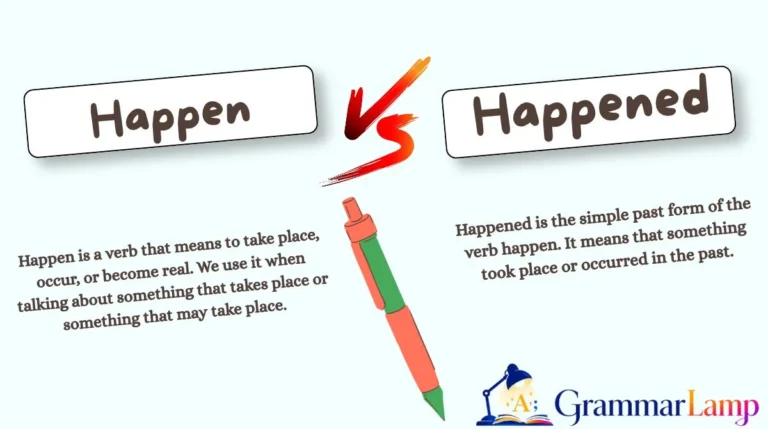
Happen is a verb that means to take place, occur, or become real. We use it when talking about something that takes place or something that may take place.
It is the base form of the verb. This means it is the basic form before adding endings such as -s, -ed, or -ing.
For example:
- Something can happen today.
- An accident may happen on the road.
- Good things happen when you work hard.
Notice that the word does not describe only one particular time. Its tense depends on the other words in the sentence.
When Should You Use Happen?
There are several situations where the base form is necessary.
1. When talking about the future
Use happen after future words such as will.
Examples:
- What will happen tomorrow?
- I don’t know what will happen next.
- Everything will happen at the right time.
Here, the sentences talk about events that have not taken place yet.
2. After modal verbs
Modal verbs include can, could, may, might, must, and should. Use the base form of the verb after these words.
Examples:
- What can happen if we wait?
- Something bad might happen.
- This should never happen again.
Do not add -ed after a modal verb.
3. After do, does, and did in questions and negatives
The base form is used after do and does in the present simple.
Examples:
- What do you think will happen?
- Why does this happen every day?
- I don’t know what may happen.
After did, use the base form when making a past-tense question.
Example:
– What did happen after the meeting?
This is grammatically possible, but it usually adds emphasis. The more common question is “What happened after the meeting?”
4. When talking about things in general
Use happen to describe regular events, habits, or general truths.
Examples:
- Accidents happen sometimes.
- Strange things happen in this world.
- Mistakes happen when people are tired.
8 Example Sentences With Happen
Here are some simple examples that show how to use the word naturally.
- What will happen if we miss the bus?
- I don’t know what might happen tomorrow.
- These problems happen in many schools.
- Can this happen again?
- Why do bad things happen to good people?
- Nothing can happen without a reason.
- This doesn’t happen very often.
- I hope something good will happen soon.
Common Learner Confusion About Happen
Many learners think that happen is only used for the present. That is not true.
It can appear in sentences about the present, future, and even the past when a helping verb requires the base form.
For example:
- Present: What does happen here every morning?
- Future: What will happen tomorrow?
- Past: What did happen yesterday?
The important point is that the helping verb controls the form of the main verb.
Remember this simple rule: after will, can, should, and did, use the base form of the verb.
What Does “Happened” Mean?
Happened is the simple past form of the verb happen. It means that something took place or occurred in the past.
We use it when talking about an event that has already happened.
For example:
- What happened yesterday?
- Something strange happened at school.
- The accident happened last night.
In these sentences, the events took place before the present moment.
When Should You Use Happened?
There are several common situations where happened is the correct choice.
1. When asking about something in the past
Use happened when you want to know about an event that has already taken place.
Examples:
- What happened at the party?
- What happened to your phone?
- What happened yesterday morning?
These questions ask about completed events.
2. When describing past events
Use happened to explain something that took place earlier.
Examples:
- I don’t know what happened.
- The accident happened near my house.
- Something unexpected happened during the class.
3. When using past-time expressions
Words such as yesterday, last night, last week, and two days ago often appear with the simple past tense.
Examples:
- What happened last night?
- The problem happened two days ago.
- A funny thing happened yesterday.
4. When talking about something that affected someone
We often use happened with the preposition to when asking about an experience or event involving a person or thing.
Examples:
- What happened to your brother?
- What happened to my bag?
- What happened to the old building?
This structure is very common in everyday English.
8 Example Sentences With Happened
- What happened to your bicycle?
- Something unusual happened yesterday.
- I don’t know what happened at school.
- The accident happened in the morning.
- What happened after you left?
- A small mistake happened during the test.
- Nothing serious happened last night.
- She told me what happened at work.
Common Learner Confusion About Happened
A common mistake is using happened after the helping verb did.
For example:
Incorrect: What did happened yesterday?
Correct: What did happen yesterday?
However, in normal conversation, people usually say:
What happened yesterday?
Why?
Because happened already shows the past tense. When we use did, the helping verb carries the past tense, so the main verb returns to its base form.
This is one of the most important grammar rules to remember.
Difference Between Happen and Happened (Detailed)
The main difference between these two words is their grammatical form and how they express time.
Happen is the base form of the verb, while happened is its simple past form.
The choice depends on the sentence structure and whether you are talking about something that generally happens, something that may happen, or something that already took place.
Comparison Table
| Point | Happen | Happened |
|---|---|---|
| Verb form | Base form | Simple past |
| Main use | Present, future, and after certain helping verbs | Past events |
| Time | Depends on sentence | Past |
| Example | What will happen? | What happened? |
| With will | Correct | Incorrect |
| With did | Correct | Incorrect as the main verb |
| With yesterday | Needs suitable structure | Usually correct |
| Meaning | Take place | Took place |
1. Usage Difference
Use happen when the sentence needs the base form of the verb.
Examples:
- What will happen next?
- What can happen here?
- What does happen when you press this button?
Use happened when you are talking about an event in the past without a past-tense helping verb.
Examples:
- What happened next?
- What happened at the office?
- What happened to your computer?
The difference becomes easier when you look at the helping verbs.
For example:
- What did happen?
- What happened?
Both can be correct, but they have slightly different uses. The first places extra emphasis on the event, while the second is the normal everyday question.
2. Grammar Logic
English verbs change form depending on tense and sentence structure.
The verb happen follows a regular pattern:
| Verb form | Word |
|---|---|
| Base form | Happen |
| Third-person singular | Happens |
| Simple past | Happened |
| Past participle | Happened |
| -ing form | Happening |
This pattern helps you understand why the two words are not interchangeable.
Consider these sentences:
- Something happens every day.
- Something happened yesterday.
- Something will happen tomorrow.
- Something is happening right now.
Each sentence uses a different verb form because the meaning and grammar are different.
3. Sentence Structure Difference
The sentence structure is another important difference.
Using happen:
Subject + helping verb + happen
Examples:
- What will happen?
- What can happen?
- What should happen next?
Using happened:
Subject + happened
Examples:
- Something happened.
- An accident happened.
- A problem happened yesterday.
Using did in a question:
Question word + did + subject + happen?
Examples:
- What did happen?
- Why did it happen?
- When did this happen?
Remember that did is followed by the base form, not the past form.
4. Meaning Comparison
Although both words refer to events, they communicate different time meanings in ordinary sentences.
Look at these examples:
- What will happen to us? (Asking about the future.)
- What happened to us? (Asking about the past.)
The first question asks about something that may take place later. The second asks about something that has already taken place.
Here is another example:
- What can happen if you drive too fast?
- What happened when you drove too fast?
The first asks about possible results. The second asks about a real past event.
Is “What Happen” Correct English?
This is an important question because many learners use this expression in everyday conversation.
On its own, “What happen?” is not standard grammatical English when you want to ask what took place.
The correct expression is:
- What happened? (Past)
- What will happen? (Future)
- What can happen? (Possibility)
- What happens? (Present or general situation)
However, the base verb can appear in questions with other helping verbs.
For example:
- What did happen?
- What might happen?
- What should happen?
In informal speech, you may sometimes hear people say “What happen?” This does not make it standard English. It is better to use the correct grammatical form, especially in writing, schoolwork, and professional communication.
Explore More Posts
Run vs Ran: What Is the Difference? Easy Grammar Guide 2026
It Worth It or Is It Worth It? Which One Is Correct in 2026?
Symbol vs Cymbal 2026: Meaning, Difference, Examples, and Easy Grammar Rules
In My Spare Time or On My Spare Time in 2026? The Correct Expression Explained
Grammar Rules You Must Remember
Learning a few simple rules can help you avoid most mistakes with these two verb forms.
Rule 1: Use Happened for a Normal Past-Tense Question
When asking about something that already took place, use happened without adding did.
Correct examples:
- What happened yesterday?
- What happened to your friend?
- What happened after the game?
Incorrect examples:
- What happen yesterday?
- What happened did yesterday?
The simple past form already shows that the event took place in the past.
Rule 2: Use the Base Form After Did
When you use did in a past-tense question, the main verb must be in its base form.
Correct examples:
- What did happen?
- Why did this happen?
- When did the accident happen?
Incorrect examples:
- What did happened?
- Why did this happened?
- When did the accident happened?
The reason is simple: did already carries the past tense. You do not need to make the main verb past again.
Rule 3: Use Happen After Will and Modal Verbs
After modal verbs, use the base form of the main verb.
Correct examples:
- What will happen tomorrow?
- What can happen next?
- What might happen if it rains?
- What should happen now?
Incorrect examples:
- What will happened tomorrow?
- What can happened next?
- What might happened?
This rule applies to many other English verbs, too.
For example, say “will go,” not “will went.”
Rule 4: Use Happens for General Present Statements
When the subject is he, she, it, or a singular noun, use happens in the simple present tense.
Examples:
- What happens when you mix these colors?
- This happens every morning.
- It happens to everyone.
- A similar problem happens at work.
With plural subjects, use happen.
Examples:
- Accidents happen.
- These things happen sometimes.
- Problems happen in every family.
This rule is useful because learners sometimes confuse happen with happens as well.
Common Mistakes Students Make
Many English learners make mistakes because they try to translate questions directly from their first language.
In some languages, the verb does not change in the same way as it does in English. As a result, learners may use the base form and past form together or forget to change the verb.
Here are some common mistakes and their corrections.
Mistake 1: Saying “What Happen?”
Incorrect: What happen to you?
Correct: What happened to you?
Why?
You are asking about something that has already taken place. Therefore, the simple past form is needed.
Mistake 2: Using Happened After Did
Incorrect: What did happened at school?
Correct: What did happen at school?
More natural in ordinary conversation: What happened at school?
Why?
The word did already shows the past tense. The main verb must stay in its base form.
Mistake 3: Using Happened After Will
Incorrect: What will happened tomorrow?
Correct: What will happen tomorrow?
Why?
The word will is followed by the base form of the verb.
Mistake 4: Forgetting the -s in Present Simple
Incorrect: What happen when you click this button?
Correct: What happens when you click this button?
Why?
The subject is an understood singular situation, so the simple present form is happens.
Mistake 5: Mixing Past and Present Time
Incorrect: What happen yesterday?
Correct: What happened yesterday?
Why?
The word yesterday refers to the past. Use the past form when there is no helping verb such as did.
Easy Correction Tips
Try these simple tips whenever you are unsure:
- If you see yesterday, last night, or last week, consider using happened.
- If you see will, use happen.
- If you see did, use happen after it.
- If you are talking about a general situation with a singular subject, use happens.
- If you are asking a normal question about a past event, use What happened?
Practising these patterns will make your English questions more natural.
Easy Trick to Remember the Difference
Here is a simple memory trick that can help you remember the correct form.
HAPPEN = Base Form
HAPPENED = Past Form
Think about three different situations in your daily life.
Situation 1: Something may happen tomorrow.
You are talking about the future.
Say:
“What will happen tomorrow?”
Situation 2: Something happened yesterday.
You are talking about the past.
Say:
“What happened yesterday?”
Situation 3: Something happens every day.
You are talking about a regular event.
Say:
“What happens every morning?”
You can also remember this small formula:
- Will + happen
- Did + happen
- Happened (without did)
- Happens (general present with a singular subject)
Imagine that you are watching a cricket match. Your team loses a wicket, and you want to ask your friend about it.
If the wicket has already fallen, ask:
“What happened?”
If you are asking about the next few overs, say:
“What will happen next?”
This simple real-life example makes the difference easier to understand.
The best trick is to check the helping verb before choosing the main verb. If you see will or did, the base form is usually the correct choice.
Daily Life Examples (Very Important)
The best way to learn grammar is to see how people use it in normal conversations.
Here are ten everyday examples that show the difference between the two forms.
1. Talking to a Friend
Ali: You look worried. What happened?
Ahmed: I lost my wallet on the way home.
Here, happened is correct because Ali is asking about a past event.
2. Talking About Tomorrow
Sara: What will happen if we don’t finish our homework?
Ayesha: The teacher may give us extra work.
The question uses happen because it refers to a possible future situation.
3. Asking About a Phone
Brother: What happened to your phone?
Sister: It fell on the floor.
The event already took place, so happened is correct.
4. Talking About a Regular Problem
Teacher: Why does this happen every week?
Student: Some students forget their books.
The question uses happen after does because the helping verb carries the tense.
5. Talking About an Accident
Friend: What happened last night?
You: There was a small accident near my house.
The word last night tells us that the event took place in the past.
6. Talking About a Possible Problem
Mother: What can happen if you don’t sleep properly?
Son: I may feel tired the next morning.
The modal verb can is followed by the base form.
7. Talking About a School Event
Student: What happened during the exam?
Friend: The electricity went out.
This is a question about a completed event.
8. Talking About the Future
Friend: What will happen after the match?
You: We will go home and have dinner.
The question is about a future event, so happen is correct.
9. Talking About a Mistake
Manager: What happened to the report?
Employee: I accidentally deleted the wrong file.
The manager is asking about something that already happened.
10. Talking About Life
Friend: Why do strange things happen in life?
You: Sometimes we cannot explain everything.
The sentence talks about general situations, so the base form is used after do.
These examples show that the correct choice depends on the time and sentence structure, not simply on the word what.
Practice Section: Choose the Correct Option
Now it is your turn to practise.
Choose the correct word in each sentence. Think about the helping verb and the time being discussed.
1. What ______ to your brother yesterday?
- A. happen
- B. happened
2. What will ______ if we are late?
- A. happen
- B. happened
3. Why did this ______?
- A. happen
- B. happened
4. What ______ when you press this button?
- A. happen
- B. happens
5. What ______ last night?
- A. happen
- B. happened
Answers and Explanations
- B. happened – Yesterday refers to the past.
- A. happen – Use the base form after will.
- A. happen – Use the base form after did.
- B. happens – The subject is singular, and the sentence describes a general situation.
- B. happened – Last night refers to a completed past event.
If you answered all five correctly, you have understood the main grammar rules.
If you made a mistake, read the explanations again and try writing your own sentences.
More Helpful posts
May or May Not: Meaning, Grammar Rules, Examples, and Common Mistakes in 2026
Peaked vs Peeked vs Piqued: Meaning, Differences, Examples, and Grammar Rules (2026)
If There Is Any vs If There Are Any: Meaning, Difference, and Examples (2026)
Also Have or Have Also: Which Is Correct? Complete Grammar Guide 2026
FAQs
1. What is the difference between “happen” and “happened”?
Happen is the base form of the verb, while happened is its simple past form. Use happen after helping verbs such as will, can, and did. Use happened when asking about or describing a completed past event.
2. Is “What happen?” grammatically correct?
No, “What happen?” is not standard English when asking what took place. The correct expression is “What happened?” for a past event. For the future, say “What will happen?” and for a general situation, say “What happens?”
3. Should I say “What happen” or “What happened”?
In normal conversation, use “What happened?” when asking someone about an event that has already taken place. For example, if your friend looks upset, you can ask, “What happened?” It is the natural and grammatically correct choice.
4. Can we use “happen” in past-tense questions?
Yes. You can use happen in past-tense questions when the helping verb did is present. For example, “What did happen?” is grammatically correct, although it usually adds emphasis. The more common question is “What happened?”
5. Is “What will happened?” correct English?
No, this sentence is grammatically incorrect. After will, always use the base form of the verb. Therefore, the correct sentence is “What will happen?” This rule also applies to other verbs, such as go, eat, and play.
6. What is the difference between “What happened?” and “What happens?”
“What happened?” asks about an event in the past. “What happens?” usually asks about a regular event, a general fact, or something that occurs under certain conditions. For example, “What happens when you press this button?” asks about a general result.
Conclusion
Understanding the difference between happen and happened is a small but important part of learning English grammar. Both words come from the same verb, but they have different uses.
Use happen when you need the base form, especially after helping verbs such as will, can, should, and did. Use happened when talking about something that already took place in the past. Also, remember to use happens for general present-tense statements with singular subjects.
The most important question to remember is “What happened?” It is the natural way to ask someone about a past event.
Do not worry if you sometimes make mistakes. Learning a language takes time, and even small grammar lessons can improve your speaking and writing.
Try using these expressions in your daily conversations, messages, and English practice. The more you use them, the easier the difference will become.
Keep practising, and your English will become clearer and more confident!

Liam Derren is a language writer at GrammarLamp, creating simple, helpful content about grammar, words, and everyday English. He makes language learning clear, practical, and easy to understand.