
English has many words and phrases that look similar but are used in different situations. Ask a question and pose a question are two expressions that often confuse English learners. Both are connected to questions, so it is easy to think they mean exactly the same thing.
However, there is a small but important difference.
We usually use ask a question in everyday conversations. It is a common expression that means saying or putting a question to someone because you want information, an answer, or help.
For example, a student may ask a teacher a question about homework, or a customer may ask a shopkeeper about a product.
On the other hand, pose a question is more formal. It means presenting or raising a question for people to think about, discuss, or answer. You may see this expression in classrooms, meetings, books, news reports, and academic writing.
The good news is that both expressions are grammatically correct. The main difference is their tone and the situation in which they are used.
Understanding this difference will help you speak more naturally, write better sentences, and choose the right expression in different situations.
You will also learn their grammar rules, common mistakes, and practical examples that you can use in daily English.
More Useful posts
In the Morning vs On the Morning: Complete Grammar Guide for 2026
Inside of vs Inside: The Easy Difference Explained in 2026
Attend vs Tend: Meaning, Differences, Grammar Rules & Examples (2026)
Better Understand vs Understand Better: Meaning, Grammar, and Correct Usage (2026)
What Does “Ask” Mean?
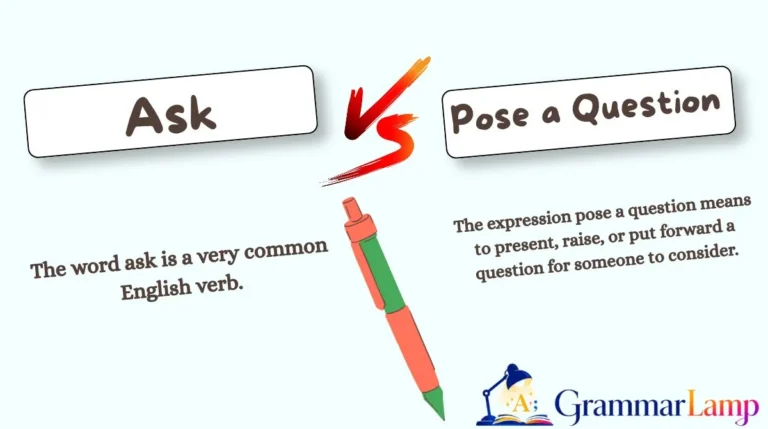
The word ask is a very common English verb. It means to say something because you want information, an answer, permission, or help from another person.
When you ask a question, you want someone to respond. You may ask a friend about their plans, a teacher about a lesson, or a stranger about directions.
It is one of the most useful verbs in everyday English because people ask questions all the time.
When Should You Use “Ask”?
Use ask when you want information from someone or want them to answer something.
For example, imagine that you are in a classroom and do not understand a lesson. You can raise your hand and say:
“I want to ask a question.”
This is natural, simple, and correct English.
You can also use this verb in many other situations, such as:
- Asking someone for help.
- Asking a teacher about homework.
- Asking a friend about their day.
- Asking for permission.
- Asking someone for directions.
- Asking about the price of something.
The verb is not limited to formal or informal conversations. You can use it in almost any situation.
Grammar Rules for “Ask”
The verb ask can be used in several sentence patterns.
1. Ask + a question
Use this structure when you want to say that someone is asking something.
Examples:
- I want to ask a question.
- She asked an interesting question.
- The student asked a difficult question.
- Can I ask you something?
- He asked a question during the meeting.
2. Ask + someone + a question
Use this structure when you mention the person who receives the question.
Examples:
- I asked my teacher a question.
- She asked her father a question.
- The manager asked the employee a question.
3. Ask + someone + about + something
Use this structure when you want information about a particular subject.
Examples:
- I asked him about his job.
- She asked me about my family.
- They asked the teacher about the exam.
4. Ask + someone + to + verb
This structure is used when you request someone to do something.
Examples:
- I asked him to help me.
- She asked her brother to wait.
- The teacher asked us to sit down.
Notice that ask is a flexible verb. It can be used for questions, requests, and permission.
8 Example Sentences Using “Ask”
Here are some simple examples that show how the word works in everyday English.
- Can I ask you a question?
- The little boy asked his mother about the moon.
- I asked my teacher to explain the lesson again.
- She wants to ask something about the homework.
- He asked me where I lived.
- The customer asked the shopkeeper about the price.
- Please ask your brother to call me.
- We asked several questions during the meeting.
All these sentences are natural and grammatically correct.
Common Learner Confusion About “Ask”
Some learners believe that ask can only be used when speaking to another person face-to-face. This is not true.
You can ask questions in emails, text messages, online meetings, interviews, and written discussions.
For example:
- I asked him a question by email.
- She asked me something on WhatsApp.
- The journalist asked the minister a question during the interview.
Another common confusion is the difference between ask a question and ask a person.
Both are correct, but they have different sentence structures.
- I asked a question. (The focus is on the question.)
- I asked my friend. (The person is mentioned, but the question itself is not specified.)
Remember that ask is the normal choice when talking about questions in everyday English.
What Does “Pose a Question” Mean?
The expression pose a question means to present, raise, or put forward a question for someone to consider.
It is often used when a person wants others to think about an idea, discuss an issue, or find an answer to a problem.
For example:
“The teacher posed an interesting question to the class.”
This means the teacher presented a question for the students to think about and answer.
The expression is similar to ask a question, but it often sounds more formal, thoughtful, or academic.
When Should You Use “Pose a Question”?
Use pose a question when you want to introduce a question for discussion, thought, or examination.
It is especially common in:
- Academic writing.
- Classroom discussions.
- Business meetings.
- Research papers.
- Public speeches.
- News articles.
- Formal presentations.
Imagine that a teacher is discussing climate change with students. Instead of simply asking what causes climate change, the teacher may pose a question that encourages the whole class to think deeply.
For example:
“The teacher posed an important question about the future of our planet.”
Here, the focus is not only on getting a quick answer. The question introduces a subject for thought and discussion.
However, remember that pose does not always mean a difficult or complicated question. It can be used for a simple question too, especially in formal writing.
Grammar Rules for “Pose a Question”
The verb pose is used in a few common sentence patterns.
1. Pose + a question
This is the basic structure.
Examples:
- The teacher posed a question.
- The speaker posed an interesting question.
- The researcher posed a difficult question.
2. Pose + a question + to + someone
Use this structure when you mention the person or group receiving the question.
Examples:
- The teacher posed a question to the students.
- The journalist posed a question to the president.
- She posed an important question to the audience.
3. Pose + a question + about + something
Use this structure when you want to identify the subject of the question.
Examples:
- He posed a question about education.
- The article poses a question about modern technology.
- The researcher posed a question about human behavior.
4. Pose + an important or interesting question
The verb often appears with adjectives that describe the value or nature of a question.
Examples:
- This discovery poses an interesting question.
- The discussion poses an important question.
- The problem poses a difficult question for scientists.
8 Example Sentences Using “Pose a Question”
Here are eight examples to help you understand how this expression works.
- The teacher posed an interesting question to the students.
- The speaker posed a question about the future of education.
- The researcher posed an important question in her study.
- The article poses a question about modern technology.
- During the meeting, the manager posed a difficult question.
- The professor posed several questions for discussion.
- His speech posed a challenge to the audience’s beliefs.
- The writer posed a question that made everyone think.
Notice that most of these examples describe situations where a question is introduced for thought or discussion.
Common Learner Confusion About “Pose”
Some English learners think that pose means only to stand in a particular position for a photograph.
For example:
“She posed for a picture.”
That is one meaning of the word, but it is not the only one.
The verb pose also means to present something, such as a question, problem, challenge, or threat.
Consider these examples:
- The model posed for a photograph.
- The teacher posed a question.
- The new law poses a challenge for businesses.
- Pollution poses a serious threat to the environment.
The meaning depends on the words around it.
Another common confusion is thinking that pose a question is incorrect because people usually say ask a question.
That is not true. Both expressions are correct. They simply have different uses and levels of formality.
Difference Between Ask and Pose a Question (Detailed)
The main difference between ask a question and pose a question is the way a question is presented.
Ask a question is the normal and widely used expression in everyday English. It focuses on asking someone for information or an answer.
Pose a question is more formal and often focuses on presenting a question for people to consider, discuss, or examine.
Both expressions can refer to the same action, but they do not always create the same feeling.
Comparison Table: Ask vs Pose a Question
| Point | Ask a question | Pose a question |
|---|---|---|
| Meaning | Request an answer or information | Present a question for consideration |
| Tone | Neutral and everyday | More formal |
| Common use | Daily conversations | Academic and formal discussions |
| Main focus | Getting an answer | Introducing a question |
| Grammar | Ask + a question | Pose + a question |
| Formal writing | Suitable | Very suitable |
| Spoken English | Very common | Less common |
| Classroom use | Common | Common in formal teaching |
1. Difference in Meaning
The first difference is meaning.
When you ask a question, you usually want someone to give you an answer.
For example:
“I asked my friend about his new job.”
You wanted information, so you asked him a question.
When you pose a question, you present a question that may require thought or discussion.
For example:
“The professor posed a question about the future of science.”
The professor introduced an idea for the students to consider.
The difference is not absolute, though. Someone who poses a question may also expect an answer.
2. Difference in Usage
The two expressions are used in different situations.
Ask a question is suitable for almost every everyday situation.
For example:
- Can I ask you something?
- I need to ask my teacher a question.
- She asked me about my plans.
These sentences sound natural in ordinary conversations.
Pose a question is more common in formal or thoughtful situations.
For example:
- The researcher posed a question about climate change.
- The speaker posed an important question to the audience.
- The article poses a question about social responsibility.
These examples sound suitable for academic writing, formal discussions, and presentations.
3. Difference in Grammar Logic
Both verbs are transitive in these expressions. This means they take an object.
With ask, the object is often the question or the person being asked.
Examples:
- She asked a question.
- She asked me a question.
With pose, the object is generally the question or problem being presented.
Examples:
- She posed a question.
- She posed a question to me.
One useful difference is that we commonly use ask someone a question, while the matching structure with pose is usually pose a question to someone.
Compare:
- I asked my teacher a question.
- I posed a question to my teacher.
Both are grammatically correct, although the second sounds more formal.
4. Difference in Sentence Structure
The basic structures are easy to remember.
| Expression | Sentence structure |
|---|---|
| Ask | Subject + ask + question |
| Ask someone | Subject + ask + person + question |
| Pose | Subject + pose + question |
| Pose to someone | Subject + pose + question + to + person |
Examples:
Using ask:
- The student asked a question.
- The student asked the teacher a question.
Using pose:
- The student posed a question.
- The student posed a question to the teacher.
Both verbs can also be used in different tenses.
- She asks many questions.
- She asked an interesting question.
- She will ask another question.
- She poses difficult questions.
- She posed an important question.
- She will pose a question during the meeting.
5. Can You Replace “Ask” With “Pose”?
Sometimes, yes.
For example:
- The teacher asked a question about history.
- The teacher posed a question about history.
Both sentences are correct. The second sounds more formal and may suggest that the question is intended to encourage thought.
However, replacing one verb with the other is not always natural.
Consider:
“Can I ask you for some help?”
This is a normal request.
“Can I pose you for some help?”
This is incorrect because pose does not work with that meaning or structure.
Similarly:
“I asked him to open the door.”
This is correct.
“I posed him to open the door.”
This is not a correct replacement.
Therefore, remember that the two verbs are related, but they are not interchangeable in every sentence.
Explore More Posts
Hear vs Here: Meaning, Difference, Grammar Rules & Examples in 2026
Hasn’t vs Haven’t: Easy Grammar Rules, Examples & Differences in 2026
Smooth vs Smoothe: Which Spelling Is Correct? Complete Guide for 2026
Mine as Well or Might as Well? The Correct Phrase Explained in Simple English (2026)
Grammar Rules You Must Remember
Learning a few simple rules will help you use both expressions correctly. You do not need to memorize complicated grammar terms. Just understand how each verb works in a sentence.
Rule 1: Use “Ask” for Normal Everyday Questions
When you want information from another person, ask is usually the best choice.
It sounds natural in conversations with friends, family members, teachers, and colleagues.
Examples:
- I want to ask you a question.
- Can I ask something about the lesson?
- She asked her mother about dinner.
Remember: If you are speaking naturally in everyday English, ask a question is usually your safest choice.
Rule 2: Use “Pose” to Present a Question for Thought
When you introduce a question for discussion, examination, or careful thought, you can use pose.
It is particularly useful in formal writing and presentations.
Examples:
- The professor posed an interesting question.
- The report poses an important question about public safety.
- The speaker posed a challenge to the audience.
Remember: Pose often makes a question sound more formal or thoughtful.
Rule 3: Learn the Correct Preposition and Word Order
The verb ask commonly follows this structure:
Ask + someone + a question.
Example:
“She asked the teacher a question.”
The verb pose commonly follows this structure:
Pose + a question + to + someone.
Example:
“She posed a question to the teacher.”
Do not confuse these two patterns.
Also remember that we say ask someone a question, not normally ask a question to someone in everyday English, although the latter can occur in some contexts.
Rule 4: Both Verbs Can Be Used in Different Tenses
You can use both verbs in the present, past, and future.
Examples with ask:
- I ask questions in class.
- I asked a question yesterday.
- I will ask another question tomorrow.
Examples with pose:
- The teacher poses questions regularly.
- The teacher posed a question yesterday.
- The teacher will pose another question tomorrow.
The verb forms are:
| Tense | Ask | Pose |
|---|---|---|
| Present | Ask | Pose |
| Past | Asked | Posed |
| Past participle | Asked | Posed |
| -ing form | Asking | Posing |
These forms are useful when you want to build longer sentences.
Common Mistakes Students Make
Many learners understand the meanings of both expressions but still make mistakes when using them in sentences.
This usually happens because they translate directly from their first language or assume that similar meanings always require the same grammar.
Let’s look at some common errors.
Mistake 1: Thinking “Pose a Question” Is Incorrect
Incorrect idea
“Pose a question is wrong English.”
Correct understanding
“Pose a question” is a correct English expression.
For example:
“The teacher posed a question about science.”
This sentence is perfectly correct. The expression is simply more formal than ask a question in many situations.
Correction tip: Remember that pose can mean present or put forward a question.
Mistake 2: Using “Pose” Instead of “Ask” in Every Situation
Incorrect:
“Can I pose you for some help?”
Correct:
“Can I ask you for some help?”
The problem is that the learner knows pose can be used with questions and tries to use it with every meaning of ask.
But ask for help and pose a question have different sentence patterns.
Correction tip: Use ask when requesting help, permission, or information. Use pose when presenting a question.
Mistake 3: Forgetting “To” After “Pose a Question”
Incorrect:
“The teacher posed a question the students.”
Correct:
“The teacher posed a question to the students.”
When you mention the person or group receiving a posed question, the preposition to is normally needed in this structure.
Correction tip: Remember the pattern: pose a question to someone.
Mistake 4: Using the Wrong Word Order
Incorrect:
“I asked a question my teacher.”
Correct:
“I asked my teacher a question.”
The normal pattern is ask + person + question.
You can also say:
“I asked a question to my teacher.”
However, I asked my teacher a question is generally more natural.
Correction tip: Learn the full sentence pattern instead of memorizing only the verb.
Mistake 5: Thinking Both Expressions Have Exactly the Same Tone
Incorrect idea:
“Ask a question and pose a question always sound exactly the same.”
Correct understanding:
They can describe similar actions, but pose often sounds more formal.
For example:
“I asked my friend a question.”
This sounds natural in daily conversation.
“The researcher posed a question about the results.”
This sounds more suitable for an academic discussion.
Correction tip: Think about the situation before choosing your verb.
Mistake 6: Confusing “Pose a Question” With “Pose for a Picture”
Incorrect understanding:
“Pose only means standing for a photograph.”
Correct understanding:
The word has several meanings.
Examples:
- She posed for a photograph.
- He posed a question during the meeting.
- The problem poses a serious risk.
Correction tip: Look at the object and the context to understand which meaning is being used.
Easy Trick to Remember the Difference
Here is a simple trick that can help you remember the difference without studying complicated grammar rules.
Think of ask as getting information and pose as presenting an idea.
ASK = Get an answer
When you want information from someone, ask a question.
Example: I want to ask my teacher about the homework.
POSE = Present a question
When you introduce a question for people to think about, pose a question.
Example: The teacher posed an important question for discussion.
Imagine two different situations.
First, you are talking to your friend. You do not know what time the bus leaves, so you say:
“Can I ask you a question?”
You want your friend to give you some information.
Now imagine that you are in a classroom. Your teacher wants everyone to think about a difficult problem. The teacher says:
“Let me pose a question for the class.”
The teacher is presenting something for the students to consider.
That is the basic difference.
One easy memory sentence:
Ask when you want to know something. Pose when you want to present something for thought.
This small trick will help you choose the correct expression in most situations.
Daily Life Examples (Ask vs Pose a Question)
The best way to learn English is to see how words are used in real situations. The following examples show how both expressions work in conversations and everyday writing.
Examples Using “Ask a Question”
1. Talking to a teacher
Student: Excuse me, can I ask a question?
Teacher: Of course. What do you want to know?
Here, the student wants an explanation about something.
2. Talking to a friend
Ali: Can I ask you something?
Hamza: Sure. Go ahead.
Ali: Are you coming to the match tonight?
This is a normal, friendly conversation.
3. At a shop
Customer: Can I ask you a question about this phone?
Shopkeeper: Yes, of course.
Customer: How long does the battery last?
The customer wants information about a product.
4. At home
Daughter: Mom, can I ask you a question?
Mother: Yes, dear. What is it?
Daughter: When will Dad come home?
This is a simple example of everyday spoken English.
5. During a job interview
Interviewer: Do you have any questions?
Applicant: Yes, I would like to ask a question about the working hours.
The verb ask is also suitable in professional situations.
Examples Using “Pose a Question”
6. In a classroom
Teacher: I want to pose an important question to the class.
Student: What is the question, sir?
Teacher: Why is education important for society?
The teacher introduces a topic for discussion.
7. During a business meeting
Manager: I would like to pose a question about our new plan.
Employee: Sure. Please go ahead.
The manager uses a more formal expression.
8. In a research discussion
Researcher: Our study poses an important question about online learning.
Colleague: That is an interesting point. We should examine it further.
Here, the question is part of a wider academic discussion.
9. During a public speech
Speaker: Let me pose a question to everyone in this room.
Audience: We are listening.
Speaker: What kind of future do we want for our children?
The speaker wants the audience to think.
10. In an article
Writer: This situation poses an important question about the role of technology in our lives.
The writer introduces an issue that readers should consider.
These examples show that both expressions are useful. The important thing is choosing the one that matches your meaning and situation.
Practice Section: Test Your Understanding
Now it is time to check what you have learned. Read each sentence and choose the correct word: ask or pose.
Try to answer all five questions before checking the answers.
Question 1: Can I _____ you a question about the homework?
a) ask
b) pose
Question 2: The professor decided to _____ an important question during the lecture.
a) ask
b) pose
Question 3: I need to _____ my father for some money.
a) ask
b) pose
Question 4: The article _____ an interesting question about modern society.
a) asks
b) poses
Question 5: She _____ the teacher a question about the exam yesterday.
a) asked
b) posed
Answers and Explanations
- a) ask – This is an everyday question directed to another person.
- b) pose – The professor is introducing a question for consideration.
- a) ask – We use ask for when requesting something.
- b) poses – The article presents an issue for readers to consider.
- a) asked – This is a natural sentence about asking a teacher for information.
Well done!
If you answered all five correctly, you have understood the basic difference. If you made a mistake, read the grammar rules and try the exercise again.
More Helpful posts
Alternative of vs Alternative for vs Alternative to: Which Is Correct? 2026 Guide
Realise or Realize: Which Spelling Is Correct in 2026?
Berth vs Birth: Meaning, Difference, Examples & Easy Rules for 2026
Insight vs Incite: What’s the Difference? Easy Guide for 2026
FAQs
1. What is the difference between ask and pose a question?
Ask a question means requesting information or an answer from someone. It is common in everyday conversations.
Pose a question means presenting a question for thought, discussion, or consideration. It is more common in formal and academic situations.
Both expressions are grammatically correct.
2. Can we use “pose” instead of “ask” in English?
Sometimes, yes. You can say both “The teacher asked a question” and “The teacher posed a question.”
However, the second sentence sounds more formal.
You cannot replace ask with pose in every expression. For example, we say “ask for help,” not “pose for help.”
3. Is “pose a question” formal or informal?
“Pose a question” is generally considered more formal than “ask a question.”
It is common in academic writing, research, business meetings, speeches, and formal discussions.
However, you can also hear it in spoken English, especially when someone wants to introduce an interesting topic.
4. Is “ask a question” always correct?
“Ask a question” is a correct and natural expression in everyday English.
You can use it when talking to friends, teachers, family members, or colleagues.
For example: “May I ask you a question?” is a perfectly correct sentence.
5. Is it correct to say “pose a question to someone”?
Yes, it is completely correct.
For example:
“The teacher posed a question to the students.”
The structure is:
Pose + a question + to + someone.
It is a useful pattern in formal writing and discussions.
6. Which expression is better for everyday English: ask a question or pose a question?
Ask a question is usually better for everyday English because it sounds natural, simple, and friendly.
For example, say “Can I ask you something?” when speaking to a friend.
Use “pose a question” when introducing a question in a formal meeting, academic discussion, or presentation.
Conclusion
Understanding the difference between ask a question and pose a question is simple once you know how each expression works.
Both are correct English expressions, but they are not always used in the same way.
Use ask a question when you want information, an answer, permission, or help. It is the more common choice in everyday conversations and is suitable for both casual and professional situations.
Use pose a question when you want to present a question for people to think about, discuss, or examine. It is especially useful in academic writing, formal meetings, speeches, and research discussions.
Remember this easy rule: Ask means you want to know something, while pose means you are presenting something for consideration.
Do not worry if you sometimes confuse these expressions. Learning a language takes time, and regular practice makes a big difference. Read the examples, create your own sentences, and try using both expressions in the right situations.
With practice, choosing the correct word will become much easier.

Liam Derren is a language writer at GrammarLamp, creating simple, helpful content about grammar, words, and everyday English. He makes language learning clear, practical, and easy to understand.