
Are “crier” and “cryer” the same word, or is one spelling incorrect? This is a common spelling question for English learners.
Both words look almost identical, and they sound exactly the same in ordinary English pronunciation. However, their spelling and usage are not equally common.
The correct spelling in standard modern English is usually crier. It refers to a person who cries or someone who makes public announcements, especially a town crier.
The spelling cryer is much less common. It may appear as a surname or as a rare spelling variation, but it is not the normal choice in everyday writing.
This small difference matters when writing school assignments, emails, stories, articles, or other English texts. Choosing the standard spelling helps your writing look clear and professional.
There is also an interesting reason behind the confusion. English has many words that change their spelling when we add endings such as -er. Sometimes the spelling follows a familiar pattern, while sometimes it does not.
By understanding the meaning, spelling rules, and real-life examples, you can easily remember which form to use and avoid common mistakes.
More Useful posts
Formal vs Informal Usage: Complete Guide to English in 2026
Please Advise or Please Advice? The Correct Usage Explained (2026)
See vs Look vs Watch: Easy English Grammar Guide for 2026
Recommend to vs recommend for 2026: Clear Grammar Rules, Examples, and Common Mistakes
What Does “Crier” Mean?
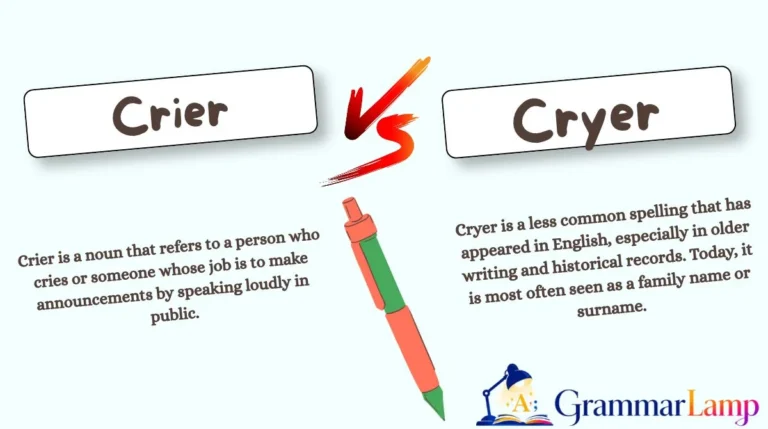
Crier is a noun that refers to a person who cries or someone whose job is to make announcements by speaking loudly in public.
It is the standard spelling in modern English. You can use it when talking about someone who cries easily because of strong feelings, sadness, happiness, or other emotions.
The word also has a historical meaning. In the past, a town crier was a person who walked through streets and announced important news, rules, or public messages. People did not have televisions, websites, or mobile phones, so public announcements were an important way to share information.
According to the Oxford Advanced Learner’s Dictionary, a crier was traditionally someone who walked through a town shouting news and official announcements. Oxford Learner’s Dictionaries+1
Simple Definition
A crier is:
- A person who cries or becomes emotional easily.
- A person who makes loud public announcements.
- A person who announces news, information, or messages to a group.
When Should You Use Crier?
Use this spelling when you are describing someone who cries.
For example, if your friend starts crying whenever they watch a sad movie, you can say:
“She is a real crier.”
You can also use it when discussing history, public announcements, or traditional jobs.
For example:
“The town crier announced the arrival of the king.”
Grammar Rule
The word crier is a singular countable noun.
It comes from the verb cry with the noun-forming ending -er. The spelling changes from the final y to i before adding the ending.
- Cry + er = Crier
- Try + er = Trier
- Dry + er = Drier
Remember that the spelling of a word can change when we add an ending. This is why the standard noun is written as crier, not cryer.
You can use it with articles such as a and the:
- A crier
- The crier
- Two criers
- Several criers
8 Example Sentences Using Crier
1. My little sister is a crier. She becomes emotional over small things.
2. I am not a crier. I usually stay calm when something makes me sad.
3. The town crier announced the new rules. He shared important information with everyone.
4. She became a crier after watching the sad movie. The story made her emotional.
5. The crier walked through the village. He shouted the latest news in the streets.
6. My brother is a happy crier. He sometimes cries when he receives good news.
7. The court crier asked everyone to remain silent. He made an official announcement in the courtroom.
8. You do not have to be a crier to show your feelings. People express emotions in different ways.
Common Learner Confusion About Crier
Many English learners wonder why the word is written with ie instead of ye.
The confusion comes from the verb cry. When learners see this verb, they naturally think that adding -er should produce cryer.
However, English spelling has rules for adding endings. When a word ends in a consonant followed by y, the y often changes to i before an ending such as -er.
That is why crier is the accepted spelling for this noun.
What Does “Cryer” Mean?
Cryer is a less common spelling that has appeared in English, especially in older writing and historical records. Today, it is most often seen as a family name or surname.
This is where things become interesting. Although cryer looks like a natural spelling because it comes from the verb cry, it is not the preferred spelling for the ordinary English noun.
In modern writing, if you want to describe someone who cries or a person who makes public announcements, choose crier.
However, it would be inaccurate to say that cryer has never existed. Historical dictionaries have recorded it as a variant of crier. Noah Webster’s 1828 dictionary, for example, included both spellings. originalsources.com+2
Simple Definition
Cryer can refer to:
- A family name or surname.
- A historical spelling variation of crier.
- A spelling found in some older English records and texts.
It is important to understand that these uses are not equal. A surname is a person’s name, while a common noun is an ordinary word used to describe someone or something.
When Should You Use Cryer?
There are two main situations in which you may see this spelling.
1. When writing someone’s surname
If a person’s actual family name is Cryer, you must keep that spelling.
For example:
“Jon Cryer is an actor.”
Here, Cryer is a proper noun. It is the person’s family name, so changing it to Crier would be incorrect.
2. When reading historical material
You may find cryer in an old book, document, dictionary, or family record.
In such cases, it may represent an older spelling of the word crier. You should understand it in the context of the sentence rather than assuming that every historical spelling follows today’s rules.
Grammar Rule
When Cryer is used as a surname, it is a proper noun.
Proper nouns name particular people, places, organizations, or things. They usually begin with a capital letter.
Examples:
- Jon Cryer
- Mr. Cryer
- The Cryer family
- A book written by someone named Cryer
When it appears as a historical spelling of the common noun, it may be written with a lowercase letter.
However, for ordinary modern English writing, use crier.
8 Example Sentences Using Cryer
1. Jon Cryer is a well-known actor. Here, Cryer is his family name.
2. Mr. Cryer teaches English at our school. The spelling identifies a particular person.
3. The Cryer family lives near our village. Here, Cryer is a surname.
4. I found the name Cryer in an old family record. The word is part of a historical family name.
5. Mrs. Cryer invited us to her birthday party. Cryer is the guest’s surname.
6. The historical document used the spelling cryer. This example refers to an older spelling variation.
7. My friend said that Cryer was his family name. The word identifies his surname.
8. We found several people named Cryer in the family history book. It is being used as a proper family name.
Common Learner Confusion About Cryer
The biggest problem is that the spelling seems to follow a simple pattern.
Students often think:
- Cry + er = Cryer.
- Therefore, Cryer must be correct.
The problem is that not every English word can be spelled by simply joining two parts. Established spelling conventions sometimes differ from what seems logical.
Another reason for confusion is that Cryer is a real surname. People see it in names, newspapers, books, and online articles and assume it is equally acceptable as a common noun.
Remember that a spelling can be correct as a person’s name without being the preferred spelling of an ordinary English word.
Difference Between Crier and Cryer (Detailed)
The main difference is their standard usage.
Crier is the normal spelling of the English noun. Cryer is mainly a surname and a rare historical spelling variation.
Both forms are pronounced alike in ordinary English, which makes them easy to confuse when speaking and writing.
Crier vs Cryer: Comparison Table
| Feature | Crier | Cryer |
|---|---|---|
| Standard modern spelling | Yes | No |
| Part of speech | Noun | Usually a proper noun |
| Main meaning | A person who cries or announces news | A family name |
| Historical use | Yes | Yes, as a variant |
| Common in modern writing | Yes | Mainly in names |
| Pronunciation | /ˈkraɪər/ | Usually /ˈkraɪər/ |
| Capital letter | Usually lowercase | Capitalized as a surname |
| Example | She is a crier. | Jon Cryer is an actor. |
1. Usage Difference
The most important difference is how you use each spelling.
Use crier when describing someone who cries easily or someone who makes public announcements.
For example:
- My mother is a crier.
- The town crier shared the news.
- He became a crier after watching the film.
Use Cryer when writing someone’s actual surname.
For example:
- Mr. Cryer is our new teacher.
- I watched a television show featuring Jon Cryer.
If you are writing an ordinary sentence about crying, crier is the right choice.
2. Grammar Logic
Both spellings are connected historically to the verb cry, but their modern grammatical roles are different.
The noun crier uses the ending -er, which often describes a person who performs an action.
Consider these examples:
| Verb | Noun |
|---|---|
| Teach | Teacher |
| Sing | Singer |
| Write | Writer |
| Drive | Driver |
| Cry | Crier |
The ending -er is useful because it turns many action words into nouns referring to people.
Cryer, on the other hand, is commonly used as a surname. Surnames do not have to follow the same spelling patterns as ordinary words.
3. Sentence Structure Difference
Both forms can appear in sentences, but their roles are not always the same.
Crier as a common noun:
- She is a crier.
- He became a town crier.
- The crier announced the news.
Cryer as a proper noun:
- Mr. Cryer is waiting outside.
- Jon Cryer appeared in the programme.
- The Cryer family moved to another city.
Notice that the first group describes a person by their actions or role. The second group identifies particular people.
4. Meaning Comparison
The word crier has two familiar meanings:
- Someone who cries.
- Someone who makes public announcements.
The spelling Cryer generally identifies a person or family by name.
For example, compare these sentences:
- “He is a crier.” This means he cries.
- “He is Mr. Cryer.” This identifies his surname.
The meaning changes because the words have different functions in the sentences.
5. Pronunciation Difference
There is generally no pronunciation difference between the two spellings when Cryer is used as the surname with the usual English reading.
Both are commonly pronounced with the same sounds.
This means you cannot always identify the correct spelling by listening. You need to understand the meaning and context.
For more information about the standard noun and its pronunciation, see the
Explore More Posts
Instructions on vs Instructions for: Meaning, Difference, and Correct Usage in 2026
Wether vs Weather vs Whether: What’s the Difference? 2026 Guide
Role vs Roll: Meaning, Difference, Rules & Examples (2026)
John and I or John and Me? The Easy Grammar Guide for 2026
Grammar Rules You Must Remember
Understanding a few simple grammar rules will help you choose the correct spelling whenever you write about someone who cries or makes public announcements.
Here are four useful rules to remember.
Rule 1: Use Crier for Someone Who Cries
When you want to describe a person who cries, use crier.
It does not matter whether the person cries because of sadness, happiness, fear, or another strong feeling.
Examples:
- My baby is a little crier.
- She is an emotional crier.
- He became a crier after watching the film.
Remember: The standard noun is always spelled crier in modern everyday English.
Rule 2: Use Crier in the Expression Town Crier
A town crier was a person who announced important news in public places.
This job was especially important before modern communication methods became available.
Examples:
- The town crier announced the king’s arrival.
- The crier shared the latest village news.
- Everyone listened to the town crier.
The expression town crier is the traditional and accepted spelling.
Rule 3: Use Cryer When It Is Someone’s Actual Surname
Family names are different from ordinary English words.
If someone’s surname is Cryer, you must preserve that spelling.
Examples:
- Mr. Cryer is my neighbour.
- Jon Cryer is an actor.
- The Cryer family lives in London.
Do not change someone’s name just because another spelling looks more suitable.
Rule 4: Remember the Y-to-I Spelling Rule
Many English words ending in a consonant followed by y change the y to i when certain endings are added.
For example:
- Cry + er = Crier
- Try + er = Trier
- Carry + ed = Carried
- Happy + ness = Happiness
This is a helpful spelling pattern, although English has exceptions.
When you need the ordinary noun referring to someone who cries, remember the established spelling crier.
Common Mistakes Students Make
Even students with good English skills sometimes confuse these spellings.
The main reason is that both words sound alike. When people hear a word, they may spell it according to what seems logical instead of following its accepted written form.
Let’s look at some common mistakes.
Mistake 1: Writing Cryer Instead of Crier
Incorrect: She is a very emotional cryer.
Correct: She is a very emotional crier.
Why?
Crier is the standard noun for someone who cries. The spelling cryer is not the normal choice for this meaning.
Mistake 2: Writing Town Cryer
Incorrect: The town cryer announced the news.
Correct: The town crier announced the news.
Why?
The traditional expression is town crier. It refers to someone who makes public announcements.
Mistake 3: Changing Someone’s Family Name
Incorrect: Jon Crier is a famous actor.
Correct: Jon Cryer is a famous actor.
Why?
Names must be written according to their owner’s actual spelling. A family name should not be changed to match the spelling of an ordinary noun.
Mistake 4: Thinking Both Spellings Are Equally Common
Incorrect: Both spellings are always interchangeable.
Correct: Crier is the preferred modern noun, while Cryer is mainly a surname or historical variant.
Why?
Although both spellings have appeared in English, they do not have equal status in modern writing.
Mistake 5: Ignoring the Meaning of the Sentence
Incorrect: My brother is a Cryer because he cries during movies.
Correct: My brother is a crier because he cries during movies.
Why?
The sentence describes a person’s behaviour, not their family name. Therefore, the ordinary noun is needed.
Easy Tips to Correct These Mistakes
Follow these simple suggestions:
- Think about the meaning before choosing a spelling.
- Use crier for someone who cries.
- Remember the expression town crier.
- Keep Cryer when it is someone’s actual surname.
- Check a trusted dictionary when you are unsure.
A small spelling difference can change the way a reader understands your sentence.
Easy Trick to Remember the Difference
Remembering the correct spelling does not need to be difficult. You only need one simple trick.
Think of the letter I in crier as the standard spelling for an individual who cries.
Whenever you want to describe someone who cries, choose crier.
Here is another easy way to remember:
CRIER
Ordinary English noun
A person who cries or makes public announcements.
Example: My sister is a crier.
CRYER
Usually a family name
Used when someone’s actual surname is Cryer.
Example: Mr. Cryer is our teacher.
Use Real-Life Logic
Imagine that your friend starts crying while watching a sad movie.
You want to tell another friend about it.
You would say:
“My friend is a crier.”
You would not normally write:
“My friend is a cryer.”
Now imagine that your friend’s family name is Cryer.
You would write:
“My friend’s surname is Cryer.”
The difference becomes easy when you think about what you are describing.
One important reminder: Do not assume that every unusual spelling is wrong. English has historical variations, and family names often keep older forms.
Daily Life Examples of Crier and Cryer
Real-life sentences make spelling rules easier to understand. The following examples show how these words appear in everyday conversations, family situations, school, and general writing.
10 Examples Using Crier
1. Talking About a Friend
A: Why does Sarah cry during every sad movie?
B: Because she is a natural crier.
2. Talking About a Baby
A: Is your baby sleeping well?
B: Not really. He is a little crier at night.
3. Talking About Emotions
A: Do you cry when you feel happy?
B: Sometimes. I am a happy crier.
4. Talking About a Film
A: Did you enjoy that movie?
B: Yes, but it made me a crier!
5. Talking About Childhood
A: Were you emotional as a child?
B: Yes, I was always a crier.
6. Talking About History
A: How did people hear important news in the past?
B: A town crier announced it in public.
7. Talking About a Village
A: Who announced the new village rules?
B: The town crier did.
8. Talking About a Family Member
A: Does your brother cry easily?
B: Yes, he is more of a crier than I am.
9. Talking About a Wedding
A: Why was your father crying at the wedding?
B: He is a happy crier. He was very emotional.
10. Talking About Personal Feelings
A: Do you think crying is a weakness?
B: No. Being a crier does not mean someone is weak.
5 Examples Using Cryer
These examples show how the spelling appears in names and historical contexts.
1. Jon Cryer is an actor. Here, Cryer is his surname.
2. Mr. Cryer is waiting for his appointment. The word identifies a particular person.
3. The Cryer family moved to another town. It is a family name.
4. I found the surname Cryer in an old record. It appears in a historical document.
5. The old dictionary included cryer as a variant of crier. Here, it refers to a historical spelling.
Practice Section: Test Your Understanding
Now it is time to check what you have learned.
Choose the correct spelling for each sentence. Think about the meaning before selecting your answer.
Choose the Correct Option
Spelling practice
0/5 answered
1. My little brother is a very emotional ____.criercryer
2. Jon ____ is a famous actor.CrierCryer
3. The town ____ announced the latest news.criercryer
4. Mr. ____ is our new English teacher.CrierCryer
5. She is a happy ____ who cries when she receives good news.criercryer
Check my answers
More Helpful posts
Peaked vs Peeked vs Piqued: Meaning, Differences, Examples, and Grammar Rules (2026)
If There Is Any vs If There Are Any: Meaning, Difference, and Examples (2026)
Also Have or Have Also: Which Is Correct? Complete Grammar Guide 2026
Sneaked vs Snuck: What Is the Difference? 2026 Guide
FAQs
Here are answers to six common questions that English learners ask about these spellings.
1. What Is the Difference Between Crier and Cryer?
Crier is the standard modern English noun for someone who cries or makes public announcements.
Cryer is mainly used as a family name and can also appear as an older spelling variation. Although they look similar and usually sound the same, their modern usage is different.
2. Is Crier the Correct Spelling?
Yes. Crier is the preferred spelling in standard modern English.
Use it when describing someone who cries easily or someone who makes public announcements. For example, “My sister is a crier” is correct.
3. Is Cryer a Real English Word?
Yes, the spelling has appeared in historical English dictionaries and texts.
It is also a genuine surname. However, it is not the usual spelling of the ordinary noun in modern English. Use crier in normal writing.
4. Can I Use Crier in a Question?
Yes. You can use crier in questions because it is a normal countable noun.
For example:
- Is your brother a crier?
- Are you a crier when watching sad movies?
- Was the town crier at the market?
The spelling stays the same in questions.
5. Is Crier Formal or Informal?
Crier can be used in both formal and informal English.
You can use it in everyday conversations, stories, articles, and school assignments. The expression town crier is also suitable for historical and educational writing.
6. Why Do Crier and Cryer Sound the Same?
Both spellings usually have the same pronunciation because they represent the same basic sequence of sounds.
The difference is in their written form and usage, not normally in how people say them. This is why it is important to understand the context when choosing between them.
Conclusion
Understanding the difference between crier and cryer is easier when you remember how each spelling is used.
Crier is the standard modern English spelling. It describes someone who cries or a person who makes public announcements, such as a traditional town crier.
Cryer is mainly used as a family name. It has also appeared as a historical spelling variation, but it is not the preferred spelling for the ordinary noun.
The easiest way to remember the difference is to connect crier with crying and public announcements, while remembering that Cryer can be someone’s actual surname.
Good spelling is not only about remembering letters. It is also about understanding the meaning of words and using them in the right situation.
Keep practising with simple sentences, read English regularly, and check unfamiliar words when necessary. With a little practice, you will feel much more confident choosing the correct spelling.
Remember: When talking about someone who cries, write crier!

Liam Derren is a language writer at GrammarLamp, creating simple, helpful content about grammar, words, and everyday English. He makes language learning clear, practical, and easy to understand.